



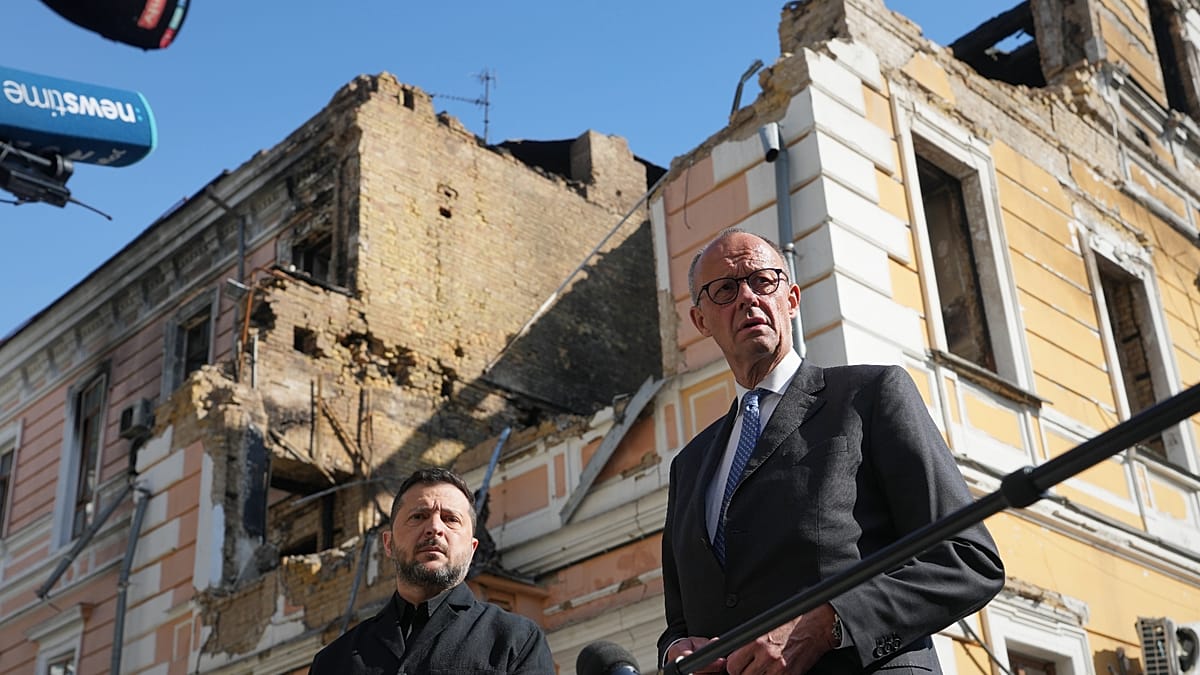
Friedrich Merz arrived in the Ukrainian capital, Kyiv, by special train on Sunday morning. The visit had not been publicly announced beforehand. Alongside Merz was Economy Minister Katherina Reiche, as well as around ten representatives of German companies from the defence and energy sectors.
The focus of the trip is further support for Ukraine in its war against Russia. According to German government sources, thousands of interceptor drones are to be delivered to the Ukrainian armed forces in the coming months. The systems are designed to counter Russian jet-powered drones, which are difficult to intercept due to their high speeds.
In addition, joint production of long-range weapons between Germany and Ukraine is to be expanded. Around one billion euros from already approved budget funds is to be made available for this purpose. A further €350 million from Germany is earmarked for the repair and reconstruction of damaged Ukrainian power plants.
Merz: Ukraine needs support now
Upon his arrival, Merz justified his trip by pointing to the current situation in the country. Ukraine needs “all our support for the coming weeks,” the German chancellor said. Referring to the upcoming fifth winter of the war, he pointed to Russian attacks on cities, homes and energy infrastructure.
In Kyiv, Merz was welcomed by Ukrainian President Volodymyr Zelenskyy. Their talks are expected to focus not only on military support, but also on energy supplies and further cooperation between the two countries.
The trip is taking place under particularly tense security conditions. On Saturday, Russia warned foreign nationals and diplomats against travelling to Kyiv, advising them to leave the city due to the risk of Russian airstrikes.
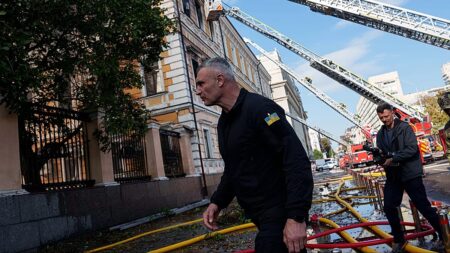
In the morning, according to Kyiv Mayor Vitali Klitschko, a road on the northern bridge over the Dnipro River was hit by at least one Russian drone.
Speaking to reporters, Merz addressed a message to Russian President Vladimir Putin: “Mr Putin, stop this senseless war! We are ready for talks, we are ready to discuss how to end this war. But these barbaric attacks on Ukraine’s civilian population must stop.”
Merz is increasingly relying on military pressure. Russia only understands the “language of strength”, the chancellor said.
Merz: Expand defence cooperation
In addition to immediate military aid, Merz’s visit also focuses on closer cooperation between the German and Ukrainian defence industries. According to Reuters, the two sides are seeking to advance an agreement on the joint development and production of drones. The focus is on systems designed to counter particularly fast Russian drones.
The German government is increasingly linking military support to closer industrial cooperation between the two countries. The German delegation, which includes representatives from the defence and energy sectors, is therefore also preparing economic agreements and declarations of intent.
For Merz, this is his second visit to Ukraine since taking office as chancellor. Just days after being sworn in, he travelled to Kyiv in May 2025 alongside then-British Prime Minister Keir Starmer, French President Emmanuel Macron and Polish Prime Minister Donald Tusk.
With the announced billions in aid and deeper defence cooperation, the German government is signalling its continued support for Ukraine.
Union under pressure: AfD extends lead
For Merz’s CDU/CSU alliance, the latest INSA Sunday poll is a worrying signal: the CDU and CSU fall by another percentage point to 18%, the lowest figure INSA has recorded for the alliance so far.
At the same time, the AfD rises to 30%, reaching a new high. The gap between the two parties has widened to 12 percentage points.
AfD co-leader Alice Weidel commented on the chancellor’s visit to Ukraine on the social media platform X on Sunday.
The SPD and Greens follow at 14% each, while the Left Party stands at 10%. The FDP and BSW are both at 4%, below the 5% threshold.
The poll also paints a poor picture of the federal government overall: the CDU/CSU and SPD together receive just 32%.
At the same time, approval of Chancellor Friedrich Merz has fallen to a new low. Only 15% are satisfied with his performance, while 79% are dissatisfied. Approval of the federal government is even lower, at 14%, with 79% rating its performance negatively.
For the Sunday trend, INSA surveyed 1,202 people between September 28 and October 2. The figures on satisfaction with the chancellor and federal government are based on a separate survey of 1,001 people conducted on October 1 and 2.
Support for Ukraine is eroding
The ARD-Deutschlandtrend poll at the beginning of September already showed a clear east-west divide: in eastern Germany, more than half of respondents believed that German support for Ukraine had gone too far. Against this backdrop, the latest state elections can also be interpreted as reflecting growing scepticism towards Germany’s policy on Russia and Ukraine.
Support for Ukraine remains higher in western Germany and Berlin. But scepticism is also growing nationwide: more than four in ten respondents now say that German support for Ukraine has gone too far. This is the highest level recorded since Russia’s full-scale invasion of Ukraine began in February 2022.
The trend is clear: support for Ukraine remains, but approval of Germany’s current aid policy is coming under increasing pressure.
Read the full article here