





GOP House Speaker Mike Johnson and Republican Senator Ted Cruz pushed back on a social media post from the account of a fellow Republican, U.S. Representative Andy Ogles, after the Tennessee congressman’s X profile said that “homosexuality has no place in America.”
Cruz, of Texas, told TMZ on Tuesday, “I think for all of recorded history, homosexuals have been part of humanity,” adding, “I think the behavior of consenting adults is their business.”
On Wednesday, Johnson said he has not yet spoken with Ogles but emphasized the biblical virtue that “we are supposed to love our neighbors” and “treat everybody with dignity and respect.”
Both Cruz and Johnson, however, have a long history of opposing some LGBTQ+ protections.
Newsweek has reached out to Cruz and Johnson’s press teams for comment via email on Wednesday.
What To Know
Cruz’s comments came shortly after the Tuesday post on Ogles’ X account, reading: “Homosexuality has no place in America. Happy Nuclear Family Month.” The comment has since been deleted.
Ogles’ post immediately sparked pushback. Cruz also told TMZ, “You know, I gotta say, I’m quite libertarian by nature. I think the behavior of consenting adults is their business.”
Johnson said in a news conference on Wednesday: “I haven’t had a chance to talk to Representative Ogles yet, and he’s a good guy, and his tweet explained that he pulled it down. He explained that some errant staffer did that.”
“Andy took it down and did it publicly. He should have done that, that was the right response,” Johnson added.
In an email to Newsweek, Johnson’s team also sent the House speaker’s statement: “I’ll tell you what my worldview is. I mean I’m pretty clear on this and y’all understand. I believe the Bible is unequivocal – we’re supposed to love our neighbors as ourselves. Everybody. We’re supposed to treat every single person with dignity and respect, whether we agree with them or not. It’s a Christian virtue. It’s a biblical virtue. It’s also an American virtue. It’s part of who we are, you know, ‘out of many, one’, we’re a melting pot, okay? So, we can advocate for policies and disagree with our colleagues or anyone else but still treat them with dignity and respect. That’s an obvious thing. We want every member here to walk in the dignity of their office, Republican, Democrat, independent or otherwise. And we’re always consistent about that.”
Others in the party also responded to Ogles’ post, with the Log Cabin Republicans, the nation’s largest Republican organization dedicated to representing LGBT conservatives and allies, writing, “What has no place in America is Andy Ogles’ bigoted views.”
The post continued, “It’s worth noting that a majority of Americans and indeed most Republicans sharply disagree. Andy Ogles is such an astonishingly unaccomplished member of Congress it’s easy to forget he even exists.”
Representative Mike Lawler, a New York Republican, posted on X shortly after, writing, “Homosexuality exists. In America. In fact Andy, you have family, friends, neighbors, colleagues and constituents who are gay and lesbian.” He continued, “It doesn’t make them less than or somehow unworthy of being an American. What an absolutely idiotic statement to make.”
After deleting the post, Ogles responded to the backlash he faced, writing on X: “Earlier today while working on the farm, my phone began going crazy because of a post made by a member of my comms team.”
He added: “The post was stupid, hurtful and a complete distraction from my America First focus. The employee has been reprimanded.”
Mike Johnson’s Record on LGBTQ+ Issues
Before his political career, Johnson served as senior legal counsel for the Alliance Defending Freedom (ADF), formerly Alliance Defense Fund, from 2002 to 2010. The ADF has been labeled a hate group by the Southern Poverty Law Center, which says that ADF called for the recriminalization of sexual acts between consenting LGBTQ+ adults in the U.S.
Johnson reportedly gave legal advice to Exodus International, a group that promoted conversion therapy, according to CNN. The group, which was founded in 1976, aimed to use conversion therapy programs to make gay people heterosexual. It was shuttered in 2013.
In 2003, Johnson wrote a column in The Times of Shreveport, Louisiana, in response to the Supreme Court’s decision in Lawrence v. Texas, which struck down Texas’ sodomy law, writing that the ruling “has a devastating blow to fundamental American values and millennia of moral teaching.” He had filed an amicus brief in the case.
“Most of the briefs shared two common essential themes: States have many legitimate grounds to proscribe same-sex deviate sexual intercourse, including concerns for public health (the exponential spread of STDs and HIV), safety, morals and the promotion of healthy marriages: and the unelected Supreme Court should not override the judgement of elected state officials, who have proscribed conduct that has been outlawed for hundreds of years,” he wrote.

He added “There is clearly no ‘right to sodomy’ in the Constitution, and the right of ‘privacy of the home’ has never placed all activity within the home outside the bounds of the criminal law.”
The following year, in 2004, he wrote another column in support of an amendment to ensure that marriage is between a man and woman. “The state and its citizens have a compelling interest in preserving the integrity of the marital union by making opposite-sex marriage the exclusive form of family relationship endorsed by the government…simply put, sex of any kind outside of the marriage of one man and one woman is ultimately destructive,” he wrote.
He continued, “Homosexual relationships are inherently unnatural and, the studies clearly show, are ultimately harmful and costly for everyone. Society cannot give its stamp of approval to such a dangerous lifestyle.”
Years later, in the Louisiana State House, Johnson sponsored the Marriage and Conscience Act, which critics and advocates like the American Civil Liberties Union said would discriminate against same-sex couples.
In 2022, Johnson introduced Stop the Sexualization of Children Act of 2022, aiming to prohibit federal funding for any “sexually-oriented” event or material for children under the age of 10. It also sought to bar state agencies like the Department of Health from discussing sexual orientation and gender with children. Critics called the legislation the “Don’t Say Gay” bill.
Johnson also voted against the Respect for Marriage Act in 2022. The measure, which was later signed into law by then-President Joe Biden, codified federal protections for same-sex and interracial marriages.
At the time of Johnson’s rise to House speaker in 2023, Kelley Robinson, president of the Human Rights Campaign, said the Louisiana congressman would be “the most anti-equality” speaker in U.S. history.
“This is a choice that will be a stain on the record of everyone who voted for him,” Robinson said in a statement Wednesday. “Johnson is someone who doesn’t hesitate to express his disdain for the LGBTQ+ community from the rooftops and then introduces legislation that seeks to erase us from society.”
Meghan McCain, political commentator and daughter of late-Republican U.S. Senator John McCain, called Johnson a “raging homophobe” at the time.
That same year, Johnson sent a fundraising email speaking out against growing numbers of young people who are identifying as LGBTQ+.
“Our culture has fallen so far since the founding of our country, and it’s just getting worse. I fear America may be beyond redemption…1 in 4 high school students identifies as something other than straight,” Johnson said in the email, a copy of which was first obtained by Punchbowl News. “What are they being taught in school?” Johnson added.
Ted Cruz’s Record on LGBTQ+ Issues
Cruz, who has represented Texas in the Senate since 2013, has spoken out on LGBTQ+ issues, opposing same-sex marriage and has supported legislation that would limit protections.
Early in his tenure, Cruz called for amending the U.S. Constitution to prevent the government or Supreme Court from overturning an individual state’s ban on same-sex marriage. In 2015, he introduced the Restoration of Marriage Amendment and the Protect Marriage from the Courts Act of 2015.
In a statement after the Supreme Court heard oral arguments in the 2015 case Obergefell v. Hodges, Cruz said, according to University of California Santa Barbara’s The American Presidency Project’s archives, “For millennia, the union of a man and a woman has been the fundamental building block of society, and the Judeo-Christian value of traditional marriage is a cornerstone upon which the strength of our Nation rests.”
He went on, “This effort to redefine marriage by judicial fiat poses a serious threat to the religious liberty for those who embrace traditional marriage. We are seeing businesses shut down and individuals threatened with costly lawsuits simply because they do not agree with same-sex marriage.”
Cruz added, “This is why I am proud to have filed an amicus brief in support of the right of states to define marriage as the union of one man and one woman.” In a 5-4 decision, the Supreme Court ruled that same-sex couples have a constitutional right to marry.
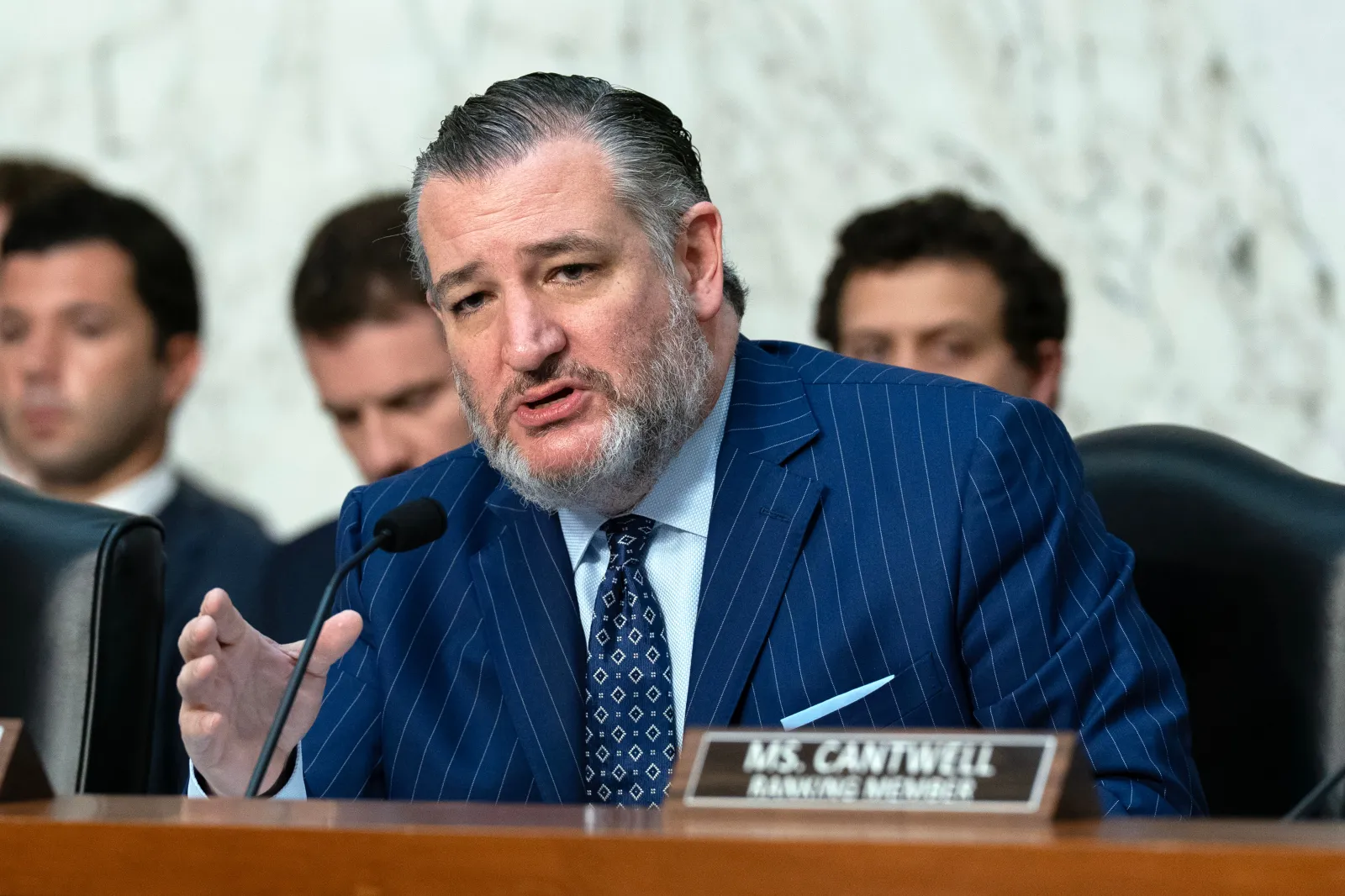
In 2022, Cruz said that the Supreme Court’s decision in Obergefell v. Hodges was “clearly wrong” and argued that the court had overstepped its authority. The senator also said that marriage policy should be determined by individual states rather than the federal courts.
Cruz, along with Texas counterpart Senator John Cornyn, voted against the Respect for Marriage Act. Twelve Republican senators joined Democrats is passing it. Cruz had filed an amendment to the bill, seeking to ensure states would not be forced to accept polygamous, incestuous or child marriages from other states.
He said in a statement shortly after its passage, “The so-called Respect for Marriage Act is going to set the stage for the Biden IRS to target people of faith, and in particular, to deny tax exempt status to churches, charities, universities, and K-12 schools. This bill creates a federal cause of action to sue institutions that believe marriage is the union of one man and one woman.”
More recently, in 2023, he introduced a bill that would prohibit federal agencies from requiring workers to address other employees using their preferred pronouns.
Read the full article here