



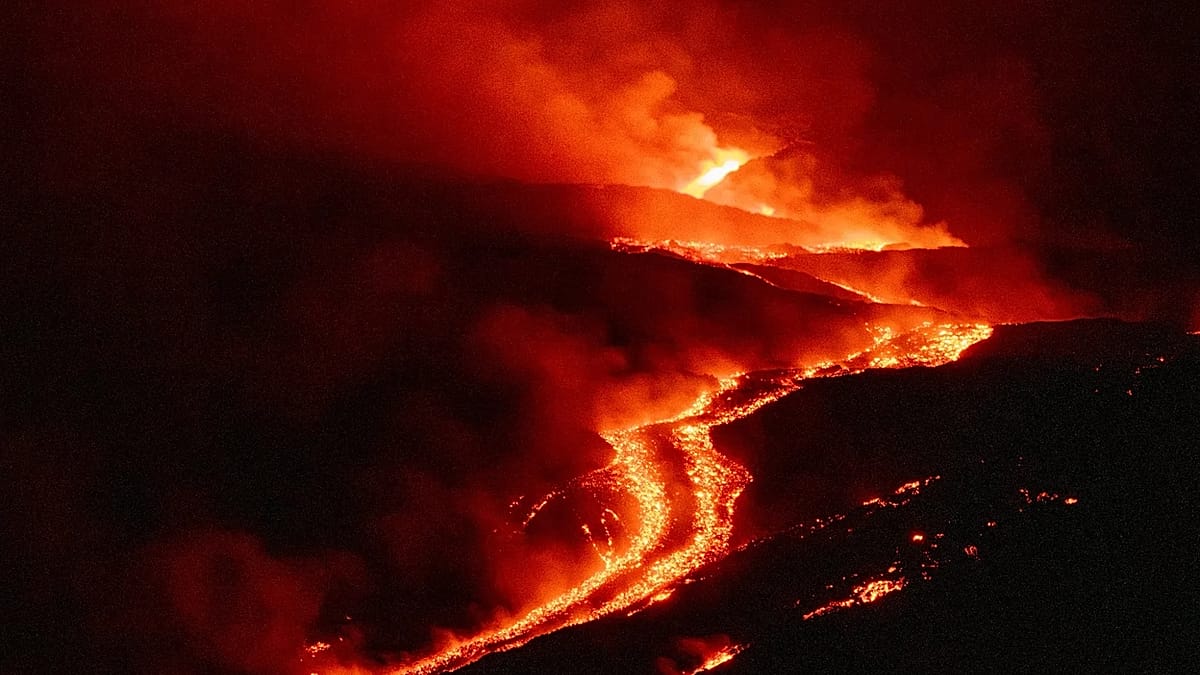
The eruption of Sicil’s Mount Etna volcano, now in its sixth consecutive day, continues to disrupt air traffic in the island at the height of the summer season.
On Wednesday, Catania–Fontanarossa Airport was forced to suspend all arrivals and departures until 6 pm.
According to data from the airport’s tracking system, around 55 outbound flights have been cancelled, on top of roughly 388 departures scrapped between the start of the eruption and the previous day.
Dozens of other flights have been rescheduled or diverted to other airports in the region, notably Palermo, Trapani and Comiso.
At the latter airport, operations were halted for several hours on Wednesday morning, until 10 am, because of volcanic ash.
The airport later resumed operations, with both departures and arrivals restored.
Etna causes disruption beyond Italy’s borders
Etna is Europe’s most active volcano, located around 220 kilometres north of Malta. The impact of its activity has spread beyond Italy’s borders.
Ash clouds have forced some aircraft arriving in and departing from Malta to alter their routes.
The disruption has also affected some local celebrations on the island. The Socjeta Muzikali La Stella Levantina of Attard postponed the fireworks display scheduled for Tuesday, the Feast of Santa Marija.
The organiser explained that the fireworks launch site is close to the runway approach path and that, after consulting with authorities, it decided to postpone the display for as long as operational restrictions remain in force at the airport.
The Volcanic Ash Advisory Centre in Toulouse (VAAC) has noted that the volcanic ash cloud continues to drift south and southwest.
According to a VAAC bulletin issued on Tuesday evening, the highest concentration of ash remains over Sicily, while lower levels have been reported between eastern Malta and as far as northern Libya.
A political issue
Catania airport, just a few kilometres from the volcano, has been forced to close several times in recent weeks, with numerous flights cancelled or diverted to Palermo at the height of the summer season. The repeated shutdowns have reignited a political and infrastructure debate.
The Minister for Civil Protection and Maritime Policies, Nello Musumeci, has weighed in on the issue.
“What has been happening in recent days at the airports of Catania and Comiso, with cancellations, delays and serious disruption for thousands of citizens and tourists at the height of the summer season, brings back to the fore a problem that Sicily has known about for a long time,” the minister said.
The minister said this is an issue he had already highlighted during his time as president of the Province of Catania, when he put forward a plan for the Sicilian airport that failed to win support.
“As far back as 1999, as president of the Province of Catania, I had pointed out the limitations of the Fontanarossa airport and its particular vulnerability linked to its proximity to Etna,” he said.
“We did not stop at raising the issue: we included in the provincial spatial plan a proposal to relocate the airport. We also commissioned a preliminary study for a new airport on the plain between Catania and Enna, designed to serve seven of the island’s nine provinces.”
“That idea of mine did not receive any backing,” Musumeci added, explaining that he returned to the issue when he was president of the region, only to encounter opposition from the airport operator and indifference from local authorities.
“The events of recent days show just one thing: it is not the volcano that is in the wrong place, but the airport.”
Read the full article here