



Opinion
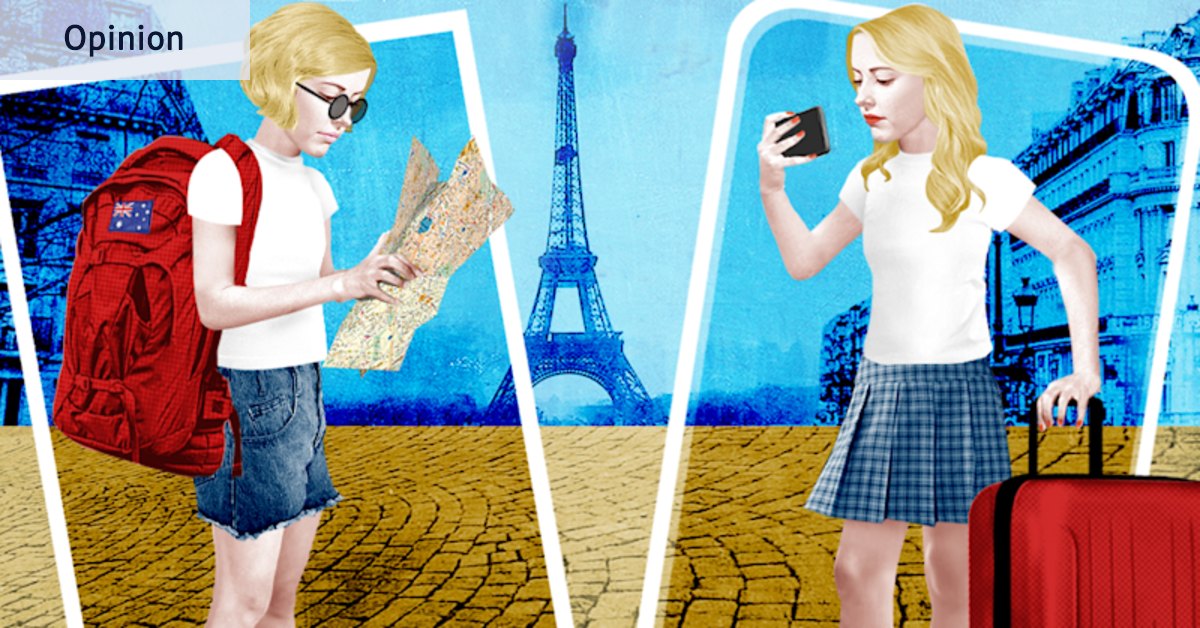
“I can’t believe,” says my daughter as I navigate our rented manual car around the narrow, cobbled streets of Nazaré, Portugal, “that you used to have to read maps to travel.” As the gears grind yet again under my rusty touch, I glance at her and laugh: “But we were using a whole part of our brain that you guys don’t touch now.” She shrugs, tapping on her phone.
Remember maps? Calling from a phone box? Aerogram letters? Post-school travel for those born in the ’70s meant disappearing into Europe like a gumboot into quicksand, swallowed whole by different cultures. We were not being monitored, surveilled, tracked: we were finding our own paths, new ones. We didn’t have mobile phones with location data, downloadable maps, apps to make bookings. This, too, confounds my daughter: “But your parents wouldn’t know if you were dead.” I guess they just waved us off and hoped for the best.
There was something delightful about the invisibility, being out of range and absolved of all responsibility. We were just gone, and we’d be back in a few months. Sure, I’d call home every week or two – collect, to the eye-rolls of my parents – and send the odd postcard, but that was it. We took photos on little cameras and mailed the film back home to be developed: they were unfailingly blurry, unflattering, often tilted or poorly framed.
But it wasn’t about how we looked, it was about what we were looking at. There are few things as genuinely thrilling about entering and inhaling a new country for the first time. We took terrible risks, sleeping on beaches, train stations, boat shacks, all to save money, and relied on overnight train trips to get some rest, zigzagging around the continent with a heavily stamped Eurail Pass.
My daughter and her friends are too smart to do stupid things like sleep in public places. But I watch the reels and feeds of this Euro-generation, who save up and go year after year to the prettiest places in Europe, navigating swelling crowds, and I am gobsmacked.
First, they look so good. Polished and picture-perfect. I think I packed a hairbrush, but I can’t be sure. Maybe an eyeliner? Nothing more. I was gripped by an Oscar Wilde biography (the superb work by Richard Ellmann) and was somehow inspired by that to invest in several vintage Spanish brocade jackets which were hopeless in the cold and probably looked half mad, paired with scuffed Doc Martens and cut-off jeans. Today I scroll through Instagram and see a string of girls in bikinis and impeccable, tasteful clothes. Carousels of cute poses.
Second, there is an ease to travel we did not know, facilitated by the phone and by the now-widespread fluency in English across Europe. If we didn’t make an effort to learn the local language, we were cooked: Google Translate didn’t exist.
According to travel research group MMGY’s 2025 Portrait of European Travellers (surveying France, Germany, Italy, Spain and the UK), Gen Z (aged 14-29) is responsible for the travel boom in Europe, and is planning to spend more on global travel and take more vacations than any other age bracket. Unsurprisingly, Italy, Spain and Greece are considered the most desirable, while the US flags in popularity. They are using planning tools and AI to map out itineraries.
But tech isn’t just aiding travel, it’s shaping and changing it. The most picturesque, Insta-worthy places are swamped by young people looking for the perfect shot to post, much to the annoyance of locals. Sweating crowds in sweltering Europe jostle around landmarks and crowd the most photogenic vistas. Today in the centre of Lisbon, where I have come to research a book, on the way to the train station I wove past dozens of people in Instagram poses, hands on hips, laughing, tilting heads, pouting, flexing.
What they are missing is the joy of not being seen.
Of waking up on beaches with panda eyes, not worrying someone will take a shot and post it.
I remember speaking a year ago to one teen who was preparing for a Mediterranean trip by having her eyelashes, nails and brows done: “No way am I going to be chopped [look unattractive] in Greece,” she said.
The prevalence of social media has also led to milder behaviour, according to a 2024 survey by youth travel agency StudentUniverse. It found only one in five young Australians planned to party when travelling overseas: 84 per cent of Gen Z full-time students scheduled trips where there would be no drinking. Many parents would cheer, given the genuine concerns about drink-spiking and safety, but 27 per cent of Gen Z also said they just didn’t want to be snapped doing something embarrassing.
StudentUniverse’s Will Jones told Student Traveller this trend – of “dry-trippers” – had been rapid and widespread: “This is the first generation to be setting this trend. I’m a Millennial and I remember when I was their age having holidays focused on drinking and partying. So it is amazing how much, and how quickly, this has changed.
“Australians used to be seen as big party people, but this Gen Z is the first global generation. Because of social media, they all seem to be following the same trends and doing the same things.”
This is a generation that is having less sex, drinking less and reading fewer books (although they are reading in digital formats). But they are travelling more often. War or global instability haven’t deterred them, with only 1.5 per cent of Australians under 30 cancelling trips to Europe in 2026.
Home ownership is hard, almost impossible; holidays are within reach.
In 2023, The Guardian declared “gritty gap years” were out and “grand tours of Europe’s charisma” were in. Is it weird to be nostalgic about the grit? A time when we could run wild, unobserved, learning how to fend for ourselves? When we could just have fun – or not – instead of feeling like we also had to look like we were having fun?
I realise this makes me seem ancient. I also feel like I’m describing the daily life of ancient explorers. But in trading concealment for convenience, evaporation for ease, surely we are in danger of losing the pleasure of forgetting ourselves and truly paying attention, marvelling.
Julia Baird is a journalist, author and regular columnist. Her latest book is Bright Shining: How grace changes everything.
Get a weekly wrap of views that will challenge, champion and inform your own. Sign up for our Opinion newsletter.
 Julia Baird is a journalist, author and regular columnist. Her latest book is Bright Shining: how grace changes everything.Connect via X, Facebook or email.
From our partners
Read the full article here