



By Laura Fleischmann
Published on
Authorities in Nepal suspect that the recent devastating flash flood was triggered by a glacial lake outburst or a glacier collapse in the Himalayas – something experts say could also threaten the Alps.
A torrent of water, mud and debris surged almost 170 kilometres through southwest Tibet and into central Nepal earlier this week, killing hundreds of people.
Such disasters are also possible in Europe, particularly in the Alps, explains glaciologist Olaf Eisen, a professor at the Alfred Wegener Institute for Polar and Marine Research and at the University of Bremen.
As an example, Eisen cites an incident in the Swiss village of Blatten in May 2025, where a rock and glacier collapse occurred. The village had been evacuated beforehand, but a 64-year-old man was killed.
However, Eisen considers it unlikely that such an event in the Alps could reach the same scale as in Nepal.
“The disaster in Nepal was, in terms of the volume of the avalanche, around 10 to 20 times larger than Blatten, according to current estimates,” Eisen said.
“Europe is among the continents warming the fastest, driven by human-made climate change. Rapidly retreating glaciers and thawing permafrost are destabilising high mountain regions,” he added.
The areas most at risk are those at about 2,500 to 3,000 metres, including parts of France, Italy, Austria and Switzerland.
“In combination with extreme weather events such as heatwaves or heavy rainfall, similar natural disasters are becoming more likely there too,” Eisen continued.
Risk of glacier collapse in Switzerland
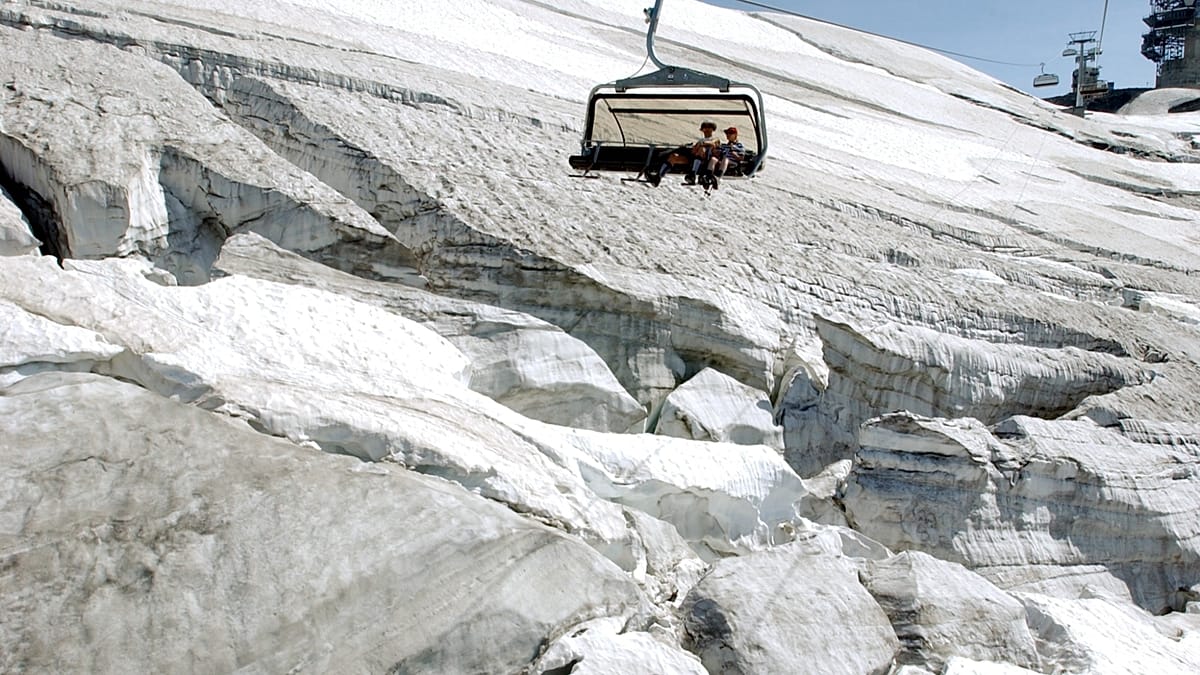
Around 1,000 glaciers have disappeared in Switzerland since 1850. In total, an area of about 1,000 square kilometres has lost its ice cover, according to SRF.
One glacier that has been monitored for years is Weisshorn East, which saw three small glacier collapses earlier this week.
“This glacier has been monitored for years and there are repeated movements – sometimes more, sometimes less,” Frederic Imboden, the mayor of Randa, the municipality bordering the glacier, told SRF.
Several hundred thousand cubic metres could potentially break away from the glacier. While there is no danger for local residents at present, according to Imboden, hiking trails and cycling routes have nevertheless been closed.
Causes of glacier collapses
There are several causes of glacier collapses: on the one hand they can be normal, cyclical processes, Eisen told Euronews.
Increasingly, though, they are being driven by human-induced climate change.
The situation is particularly critical in regions that have historically remained permanently below freezing.
These contain so-called permafrost, ice that has stayed frozen continuously for at least two years.
“As temperatures rise, permafrost begins to thaw and a glacier starts to melt at its base. As a result, it no longer ‘sticks’ as firmly to the ground,” Eisen says.
“In some cases, the formation of a pocket of water has been observed beneath a glacier that was still frozen at its snout,” he continued.
During heatwaves or rainfall, this pocket can exert such intense pressure that the still-frozen front of the glacier gives way.
That would then cause the entire ice mass to be released in one go, Eisen explains.
Such an incident occurred in 2022 on Italy’s Marmolada glacier in the Dolomites, when a huge block of ice broke away from the glacier, killing 11 mountaineers.
“Climate protection is glacier protection. Every tenth of a degree less counts. If average temperatures were to fall again, glaciers could adapt and grow,” Eisen says.
Mechanical protection would only have a short-lived effect and is used solely in certain ski areas, requiring a great deal of energy and labour.
Read the full article here