



During the opening of the inquest on Monday, Gallagher heard an autopsy revealed Thea had a previously undiagnosed condition of transposition of the great arteries.
Along with transposition, which affects blood through the heart, Thea had other conditions that could have contributed to her death.
Diehm asked Tshamala if it occurred to him while treating Thea that she might have had a transposition heart defect.
Tshamala said transposition was on a large list of conditions that could have matched Thea’s symptoms and he considered it “in a general way”.
In response to the Flaskett family’s barrister, Sarah Lane, Tshamala said he had not considered Thea’s case to be high-risk despite her birth being induced because of concerns over a low heart rate.
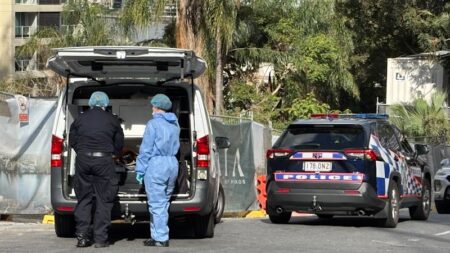
Gallagher heard the neonatal retrieval service arrived at Redcliffe Hospital at 2.05am with specialist equipment including an automatic ventilator.
Tshamala said Thea was unable to be moved by ambulance to a larger hospital in Brisbane because she suffered cardiac arrest.
Loading
Royal Brisbane and Women’s Hospital senior staff neonatologist Pieter Koorts testified about how he arranged for the service to attend Redcliffe Hospital.
“It was a quick turnaround given the time of night,” he said.
Koorts said transposition would be high on his list of possible diagnoses if at the time he had access to all the information available about Thea’s birth.
Gallagher previously heard testimony Thea’s transposition was not detected in pre-birth ultrasounds but if it had been, she would have been sent to a major Brisbane hospital for her birth.
Barrister for Redcliffe Hospital, April Freeman, asked Koorts if Thea’s survival would have been guaranteed if she were born at a hospital that could immediately insert a catheter into her heart as a precursor to surgery.
“Even at a tertiary centre with a cardiologist on standby, the outcome is not assured,” Koorts said.
The inquest is due to run in Brisbane for another four days.
Read the full article here