



Kim Jong Un said on Wednesday that North Korea had “more than doubled” its weapons-grade nuclear material in five years and vowed to build up his nuclear forces “at an exponential rate,” state media reported.
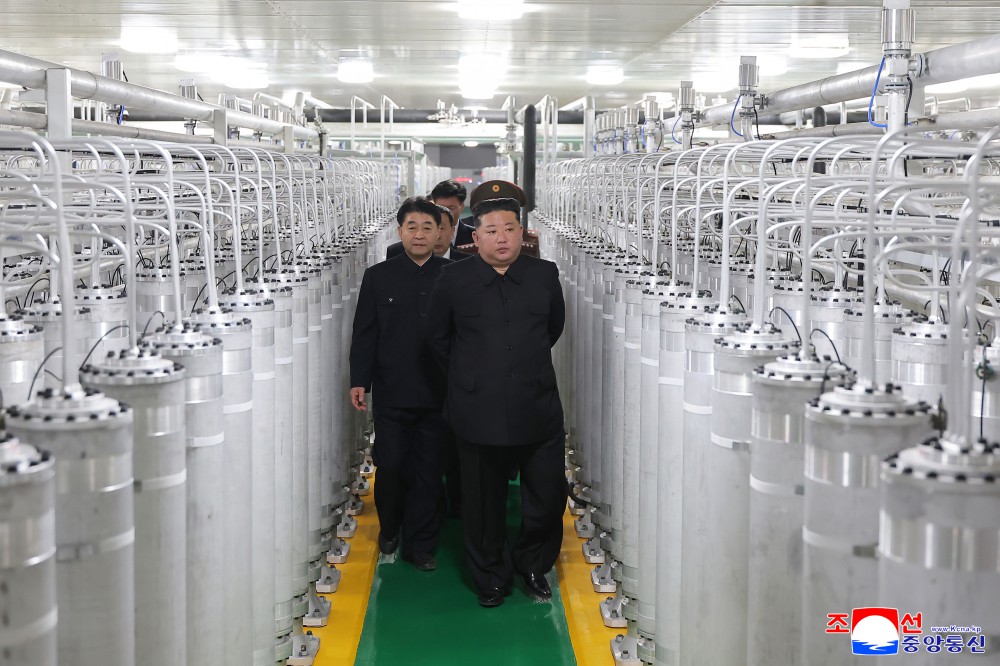
Images released by the state-run Korean Central News Agency showed the North Korean leader and senior officials visiting a new nuclear enrichment site at an undisclosed location.
Pyongyang’s desire to grow its stockpile of weapons and the platforms that launch them come amid a severe downturn in relations with the U.S.-allied government in Seoul, which it no longer recognizes as a partner for the eventual reunification of the Korean Peninsula.
One partially pixelated photograph appeared to show Kim reviewing the design of a nuclear warhead, at a meeting where he doubled down on the need for a stronger nuclear deterrent.
What North Korea Learned From Iran War
North Korea has at least 60 nuclear warheads, according to publicly available estimates, a fraction of the Russian and U.S. inventories, which both exceed 5,000.
The regime appears to be taking lessons from the fate of nonnuclear allies—including Venezuela and Iran, both of which have failed to deter military coercion and attack by the United States.
For Kim, the U.S. bombing of Iranian nuclear sites last June and this year’s ongoing war between Washington and Tehran have likely further demonstrated the value of a nuclear deterrent.
“Potential threats and unpredictable long-term crises further highlight the urgency and responsibility of the historic mission to bolster up both in quality and quantity and in a sustained and accelerated way the nuclear war deterrent,” KCNA quoted Kim as saying.
“Very clear is the stand taken by our Party and government … in implementing the strategy to deter a war and fight a war, and thoroughly exercise the position of a nuclear weapons state,” he said.
Military Power Beyond Nuclear Weapons
North Korea has the world’s second-largest standing army at 1.1 million soldiers, smaller than India’s 1.24 million but bigger than China 950,000, according to an annual assessment released last week by the International Institute for Strategic Studies.
North Korea’s buildup of conventional and nuclear arms is driving U.S. and regional responses in the Pacific, including in the acquisition of long-range strike capabilities and advancements in hypersonic weaponry and missile defense systems.
Hypersonics were on Kim’s wish list of sophisticated weaponry announced in 2021, along with nuclear submarines. He likely wants hypersonic missiles for “strategic and prestige reasons,” Daniel Salisbury, an arms control expert, wrote in the IISS report.
Salisbury said, “North Korea, the region’s youngest nuclear state, which public estimates from outside the U.S. intelligence community suggest has produced material for up to 90 warheads and likely assembled 50, also continues to grow its arsenal, with much ambiguity remaining over the scale of its ambitions.”
North Korea’s New Nuclear Enrichment Site
The existence of a new North Korean plant to produce highly enriched uranium was first disclosed by the U.N.’s nuclear watchdog one year ago.
On June 9, Rafael Grossi, the director general of the International Atomic Energy Agency, described the construction of a new facility in Yongbyon, the center of North Korea’s nuclear weapons research and one of three cities with known enrichment sites, along with Kangson and Kusong.
The IAEA did not provide imagery of the new plant, but researchers at the Middlebury Institute of International Studies in California said the following day that it matched one they had been monitoring in Yongbyon.
“As North Korea has expanded its production of enriched uranium by building new facilities, North Korea has packed more centrifuges into a much smaller floorspace,” Jeffrey Lewis and Sam Lair of the Center for Nonproliferation Studies at MIIS wrote at the time.
Lewis said on X on Wednesday that the KCNA pictures appeared to show a plant with two levels.
“We think its 28 cascades or about 4,600 machines which, with the new annexes constructed at Kangson and the older Yongbyon location, would double HEU production,” he wrote.
What Happens Next
On the same day as the facility tour, Kim also chaired “an important consultative meeting for bolstering up the nuclear forces,” according to KCNA.
“We have confirmed the order of priority for implementing the ambitious future plan designed to beef up our state’s nuclear forces at an exponential rate, as well as a requisite guarantee for the purpose,” Kim said.
He called it “a historic event that has set up an epochal milestone in rapidly upgrading our nuclear capabilities.”
The White House said President Donald Trump and Chinese counterpart Xi Jinping “confirmed their shared goal to denuclearize North Korea” in their Beijing summit last month. However, China’s readout of the talks did not go that far.
Trump may be seeking a new round of talks with Kim, but North Korea’s supreme leader appears less interested in arms control talks than in growing strategic ties to Xi and Russian President Vladimir Putin.
Pyongyang said last week that the denuclearization of North Korea “will never happen forever.”
Read the full article here