



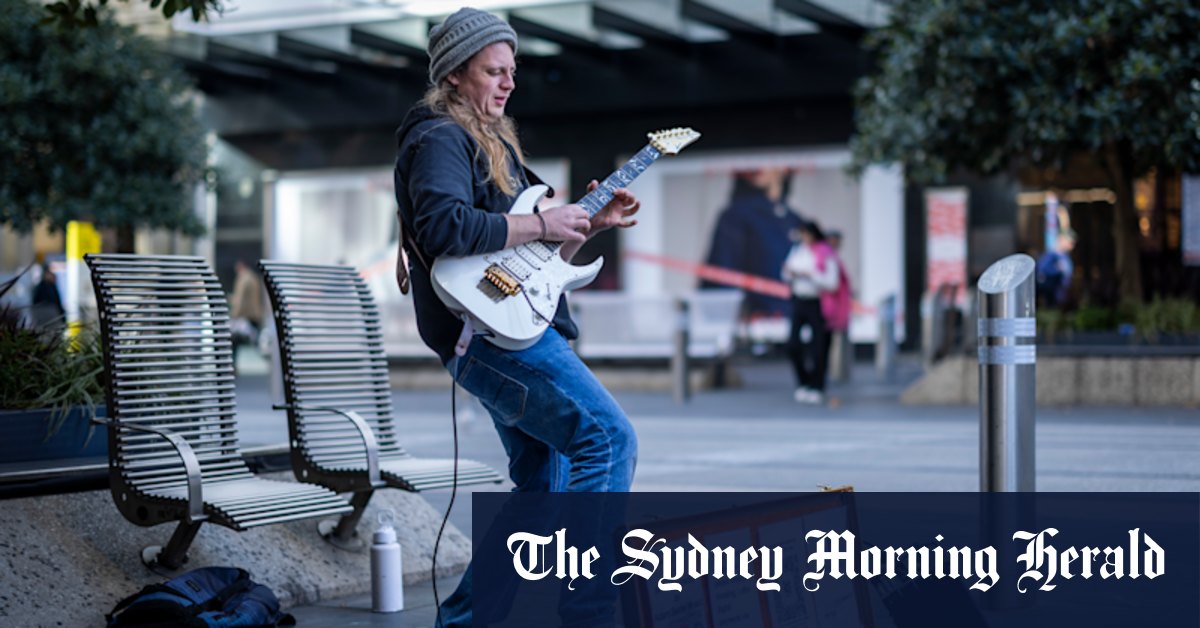
Seidel also said performing on the street was starting to feel increasingly dangerous. The musician recently decided to stop posting his performance schedule on social media.
Loading
“[Busking] definitely paints a kind of target on you. Because you’re trying to grab attention. You don’t know anyone who’s walking past … it is no exaggeration to say I get verbal abuse daily.”
Composer and producer Gareth Wiecko, who has been busking in the CBD intermittently for 12 years, has also noticed his income dwindling. Things were different eight years ago, when he was able to fund his $64,000 degree by busking full-time.
“There’s maybe two buskers who do really well. They play the popular stuff, which goes down really well with the vast majority of people. But if you’re a solo guitar [or] solo piano, people don’t really stop as much,” Wiecko said.
“The city’s changed a lot … being on the streets most days, stuff’s changed. People aren’t as open or as considerate of one another any longer, and that definitely feeds into the busking.”
A spokeswoman for the City of Melbourne acknowledged there has been a decline in the number of busking permits issued over the past two years and said that similar trends could be seen in other cities.
Tones and I performing in the Bourke Street Mall in 2020. The Victorian singer started her career as a busker.
She cited a range of factors (including cost of living pressures, the increasing popularity of social media and fewer people carrying cash) as potential reasons behind the drop.
However, Lord Mayor Nick Reece said busking remained an important part of the city’s arts scene.
“Melbourne has a proud reputation as the busking capital of Australia. Our busking auditions give local talent a shot at performing at the most prominent sites in Melbourne – if not the world,” Reece said.
Loading
“Whether it’s through one-on-one support or curating vibrant pop-up busking sessions, we’ll always provide buskers with the support they need to continue showcasing their craft on our streets.”
Both Wiecko and Seidel praised the City of Melbourne for certain aspects of the busking program. But the musicians said better financial frameworks could help the CBD maintain its thriving arts scene.
Seidel suggested retainer payments as a way to provide more certainty of what buskers would earn in a shift, while Wiecko said reducing the price of permits could be beneficial.
“The council do a great job. But I feel like permits could potentially be a little bit cheaper, or they could support the artists a little bit more. It feels like there’s a bit of a divide between the two establishments,” Wiecko said.
While some aspects of the program might be in need of a refresh, Wiecko still sees the value in encouraging talented musicians to perform on Melbourne’s streets.
“Free art is amazing. The fact that you don’t have to pay for art to come and look at it, and people can engage with it. It brings people together and creates a sense of community,” he said.
Start the day with a summary of the day’s most important and interesting stories, analysis and insights. Sign up for our Morning Edition newsletter.
Read the full article here