




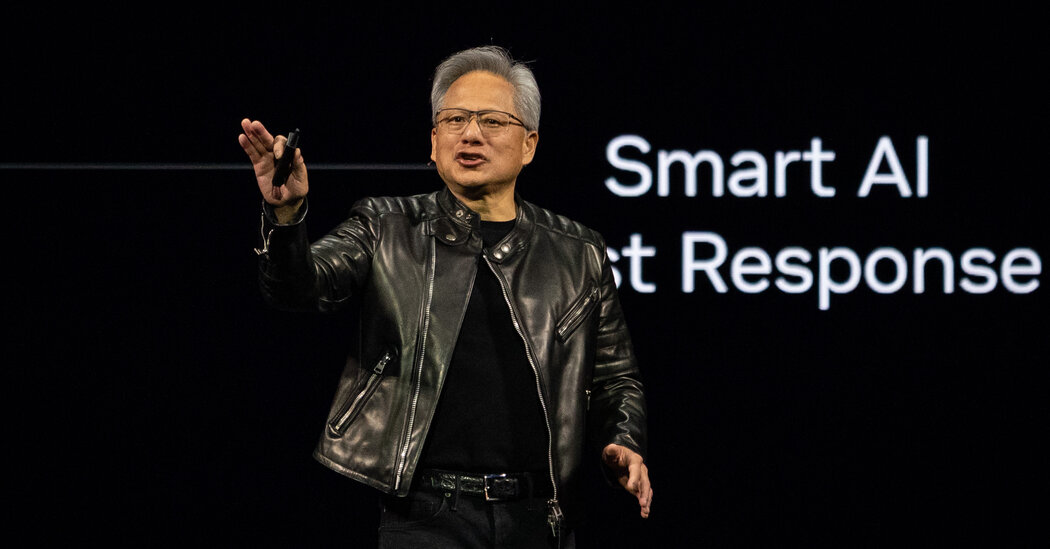
Nvidia, the artificial intelligence chipmaker, was crowned the world’s first $4 trillion public company last month and has become perhaps the most important factor determining the direction of the stock market.
On Wednesday, the Silicon Valley company reported results that showed that spending on A.I. infrastructure remains robust, easing the anxieties of Wall Street and investors around the world.
Concerns over whether tech companies would continue shelling out billions to build A.I. data centers — spending that has helped prop up the economy — had mounted in recent months. But Nvidia’s sales rose 56 percent to $46.74 billion in the three months that ended in July, just topping Wall Street’s expectations. Profit increased more than 59 percent to $26.42 billion.
Revenue in the current quarter is projected to rise 54 percent from a year ago to $54 billion, as tech companies pour money into data centers. The forecast was in line with Wall Street’s prediction for $53.9 billion, but the company said that its estimates didn’t include any sales for China, which would lift its revenue higher.
“The A.I. race is on,” said Jensen Huang, Nvidia’s chief executive, in a statement. He said the company’s chips were “at its center.”
Shares of Nvidia fell more than 3 percent in after-hours trading.
Nvidia’s results have been closely watched since OpenAI released its ChatGPT chatbot in late 2022, igniting an A.I. boom. The company’s fortunes have soared as tech companies have flocked to buy its chips, which are ideal for powering the development of A.I. Nvidia has grown into the market’s most significant stock, accounting for 7.5 percent of every dollar in the S&P 500, up from 3 percent in December. Its results also influence the values of tech and energy companies with A.I. businesses.
“The question has been: Will the A.I. wave continue or could it meaningfully slow down?” said Melissa Otto, the head of research at S&P Global Visible Alpha. Failing to meet expectations would be “like a grenade on the market,” she said. “It could blow up a lot of things.”
In recent months, demand for Nvidia’s newest chip, the Blackwell, has been especially scrutinized. Sales of the product, released late last year, have accelerated, with the company distributing about 72,000 Blackwell chips a week for an estimated price of $30,000 each.
The chip has contributed to increased spending on data centers by Meta, Google and other cloud computing companies. In July, Meta said it would spend $7 billion more on data centers than planned this year, and Google said it would spend an additional $10 billion.
Yet Nvidia has faced challenges, namely getting caught in the broader U.S.-Chinese power struggle. China is the world’s largest chip market, and Mr. Huang has said Nvidia needs to be there because half of the world’s A.I. developers are Chinese. But it has needed permission from Washington and Beijing to operate there.
In April, the Trump administration blocked Nvidia from selling its H20 chip, which was made specifically for Chinese companies, over concerns the chips could be used to help China’s A.I. industry and military. After Mr. Huang lobbied to reverse that decision, President Trump agreed in August to allow the sales.
China later summoned Mr. Huang to Beijing to discuss its concerns about the security of Nvidia’s chips. It later discouraged Chinese companies from buying the H20.
Analysts estimated that Nvidia would reap $16 billion in revenue from China this year and have projected that sales there could eclipse $56 billion next year, which would be a major boost to the company’s total revenue. But Nvidia said in a news release that it has not assumed it will have any sales in China in the current quarter.
Mr. Huang has spoken with the Trump administration about selling a modified version of the company’s Blackwell chip, which would be 30 percent to 50 percent less powerful than the chips sold in the United States.
Lennart Heim, a tech analyst at RAND Corporation, a think tank, said Chinese companies would most likely buy two of those chips at a premium price and piece them together to get more performance.
“If this chip gets approved, there would be massive demand,” Mr. Heim said. “It’s significantly better than any chip China can produce, and they would love it.”
Read the full article here