




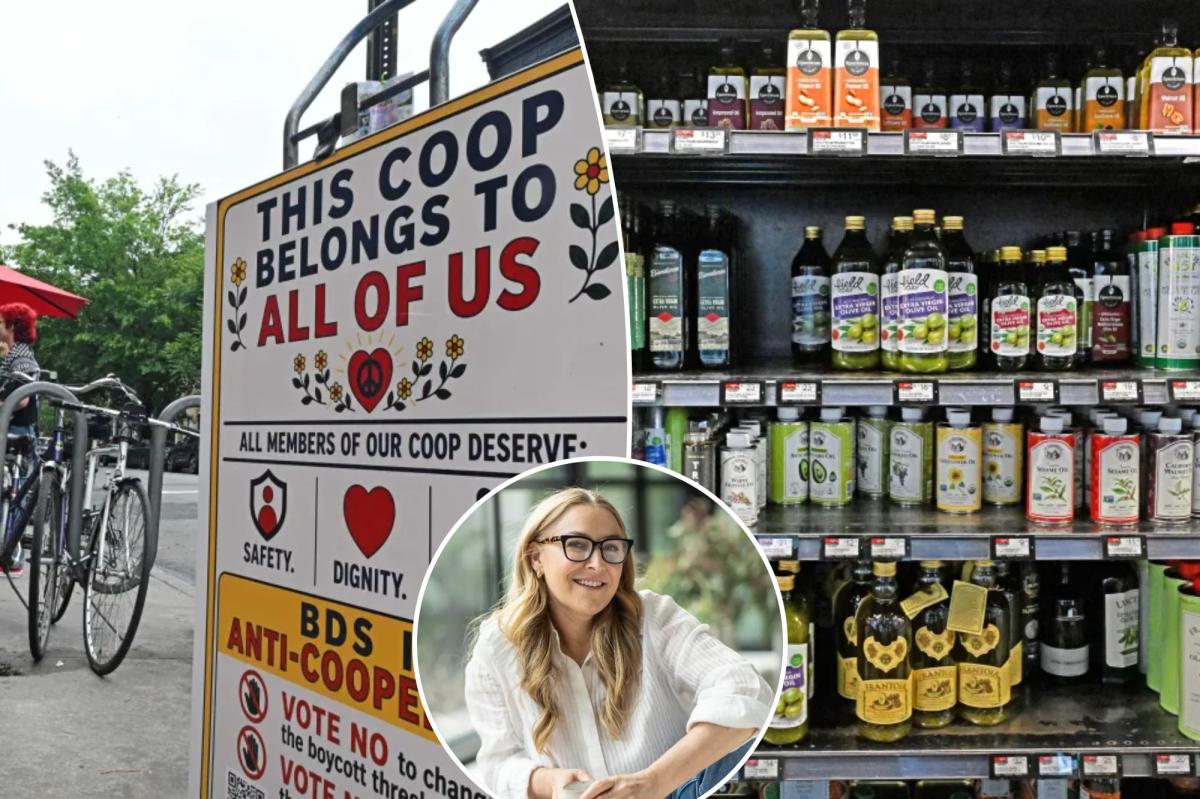
Park Slope Food Coop’s contested vote to boycott Israeli products earlier this week has actually removed Arab-founded products from the shelves, according to one of the business owners impacted.
Rachel Simons, the founder and CEO of tahini brand Seed + Mill — one of the products impacted by the boycott — told The Post that the ban also included fellow tahini rival Al Arz, formerly owned by Julia Zaher, an Israeli-Arab.
“This is an Arab-Israeli woman who’s just grown and built a successful business and sold it for $50 million,” Simons said.
“And now you’re going to punish her brand, her legacy, that business, because of your desire to dismantle something that, in my opinion, doesn’t exist.”
Another product, Equal Exchange Olive Oil — also ripped from the shelves — is actually made by a non-profit organization led by a team of Arab and Jewish women.
The boycott vote on May 26 — which drew over 7,000 members and passed with an overwhelming 67% in favor — went into effect immediately, with the Israeli products vanishing from the shelves by Wednesday morning.
The controversy has been brewing at the Union Street coop for years, with BDS supporters claiming Israel was committing genocide in Gaza and demanding that all products from the country be barred.
But the fallout, Simons told The Post, won’t impact the Israeli government — it will hurt the finances of Arab, Jewish, Christian, and Druze workers.
Seed + Mill works with a co-packing facility in Northern Israel that is owned by Arab Muslim Israelis, says Simons.
The family-owned factory employs a mix of Arab, Jewish, Christian, and Druze workers, who will also be economically impacted.
“It’s a multicultural, multi-ethnic factory that’s producing tahini for both the domestic market and export market, and they’ve worked harmoniously,” Simons said.
“There’s zero evidence of an apartheid system in that factory.”
The New York-based sesame and halva company, which began as a stall in Chelsea Market in 2016, has sold products through the Park Slope Food Coop since roughly 2019, according to the founder and CEO.
“We’re a teeny tiny tahini brand,” Simons said, who adds that the boycott has a larger impact than just financial.
“This decision to boycott our brand and others has had a pretty devastating personal impact on our morale as a team and the values that we’ve always stood for.”
Simons, along with her co-founders, has received regular monthly orders from the coop over the last six years and described the opportunity to retail with them as something she felt excited by and aligned with a shared ethos.
“Yes, I’m Jewish, but I didn’t start Seed + Mill as a Jewish brand,” said Simons. I didn’t start it to represent any one individual culture.”
What frustrates her the most about the boycott is the “reductive” assumption that the products sourced from Israel represent a simple political viewpoint.
Simons argues that boycott campaigns often fail to account for the entire ecosystem associated with a product.
While she acknowledges that supporters of the boycott view this as a nonviolent means of protest against Israel, the boycott is affecting workers and business owners who have built careers around cooperation.
For Simons, whose company was built around celebrating sesame’s ancient history rather than a single identity, it raises a broader question about consumer boycotts and their ripple effects on workers far removed.
“What I find just so personally disappointing is the way everything has just been reduced into a slogan, or we’ve stopped talking to each other,” the Australian-born founder said.
“I feel that this boycott is so reductive and it’s like a blunt instrument that genuinely doesn’t achieve any of its stated outcomes.”
Read the full article here