



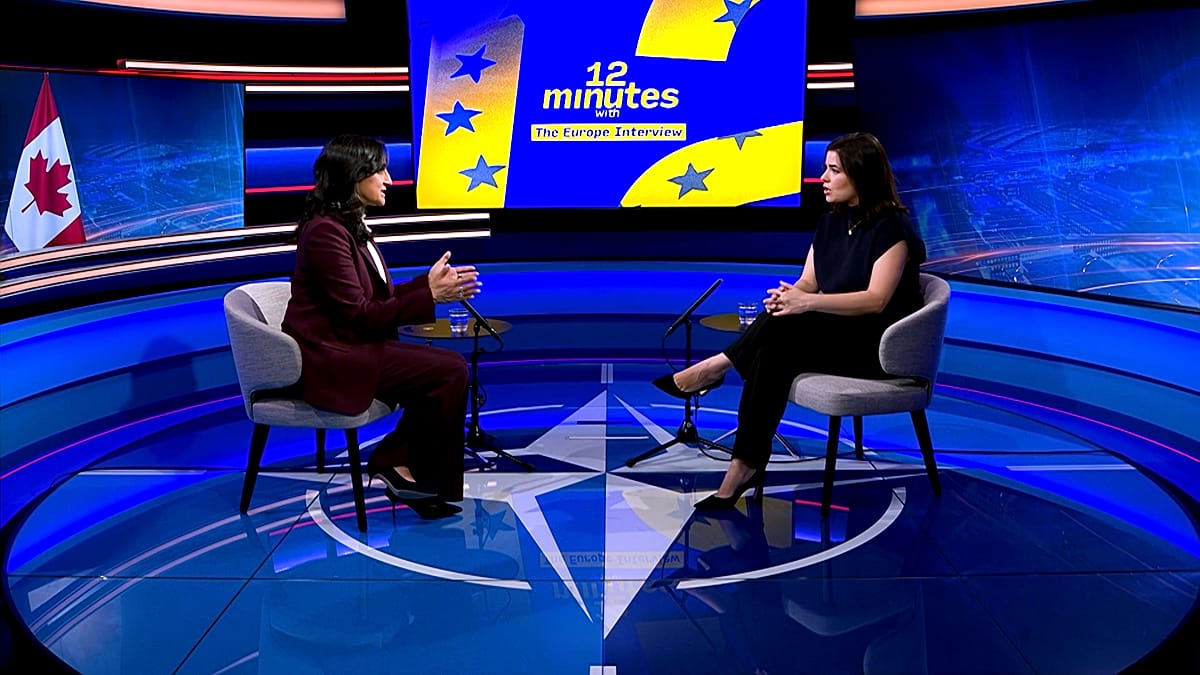
Canada is deepening alliances globally, including with the European Union, Anita Anand told Euronews, as part of a foreign policy focused on middle-power cooperation and reducing the country’s economic and security reliance on the US.
“Over the last year, we’ve signed over 20 security, defence and economic agreements around the world, and we’re just getting started,” Anand said on Euronews’ interview programme 12 Minutes With during a visit to Brussels.
She said these relationships are being built for the long term and are not simply a response to US President Donald Trump.
“They [Canada’s relations with the EU] will stand the test of time,” Anand said.
“The reason is that it’s not just a policy response. The policy response is based on like-mindedness, on shared values, and on the belief that territorial integrity, state sovereignty, and multilateral trade are important values that we will continue to collectively work for in the short and long term.”
Her comments come days after Canada made history as the first non-European country to participate in a European Political Community (EPC) summit in Yerevan, Armenia.
“We are very enthusiastic about continuing to work with Europe, with like-minded countries,” Anand said of the gathering.
“You see that already in the SAFE agreement, in the Security and Defence Partnership, in CETA [the free trade agreement between Canada and the European Union and its member states].”
In a speech to the EPC summit, Canadian Prime Minister Mark Carney said Europe would not submit to an “insular and brutal world”, and could instead serve as a base from which a new international order could be rebuilt.
Earlier this year, speaking at Davos, he drew attention for referring to a “rupture” in the US-led system of global governance, arguing that middle powers needed to chart a new path.
“What I believe we should be looking at is how we can work together pragmatically for our respective countries to deliver economic benefits and defence and security benefits,” Anand said. “Over the last year, we’ve signed over 20 security, defence and economic agreements around the world, and we’re just getting started.”
Questions have been raised over whether Canada’s closer ties with the EU could eventually go as far as EU membership, amid deteriorating relations with the US.
Asked whether this is something Ottawa is actively considering, Anand was non-committal, saying: “What we’re doing is diversifying our trade relationships and really doubling down on this middle-power approach across a series of areas, whether it is security and defence, economic interests, agriculture and agri-food, artificial intelligence…”
‘Decisions on mediation rest with Kyiv’
Canada is also closely aligned with the EU on its response to Russia’s ongoing war in Ukraine.
Anand was in Brussels on Monday 11 May to co-chair a high-level meeting of the International Coalition for the Return of Ukrainian Children.
She announced that Canada is sanctioning an additional 23 individuals and five entities involved in violations against Ukrainian children, adding to existing measures.
Asked about the possibility of Canada joining future talks between Brussels and Moscow, Anand said firmly that decisions on Ukraine’s future rest with President Volodymyr Zelenskyy.
“We believe that any mediator that is chosen must be one that Ukraine agrees with. In particular, we want to see a ceasefire, which Zelenskyy agreed to, respected. What we’ve seen is Russia violating ceasefires, violating commitments, violating international law, unjustifiably and illegally killing Ukrainian individuals… That’s unacceptable.”
Read the full article here