




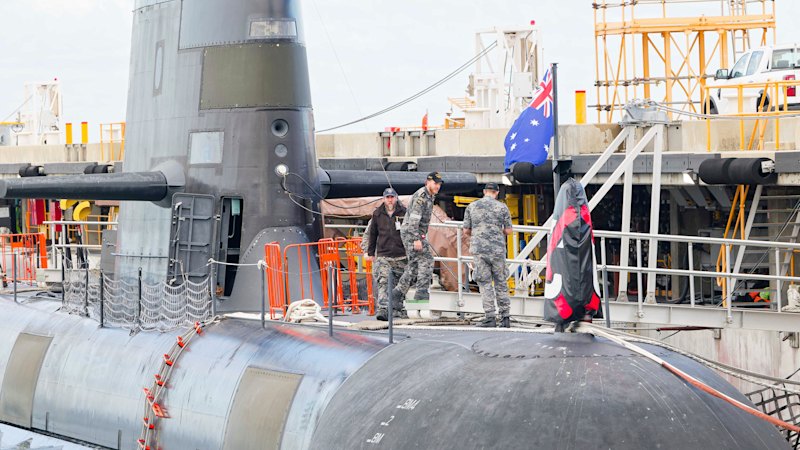
Hospitals in Perth’s southern suburbs could distribute iodine tablets to the community in the “extremely low” chance of a radiation spill, as WA prepares for the arrival of nuclear-powered submarines under the AUKUS partnership.
It comes as the first US and UK submarine rotations are due to begin next year through Garden Island’s naval base, HMAS Stirling, under Submarine Rotational Force-West (SRF-West).
The plans emerged earlier this year after Legalise Cannabis WA MP Dr Brian Walker questioned the health minister in parliament about the government’s emergency preparedness ahead of the incoming visits.
During question time, Walker asked whether the state government would supply the anti-nuclear pills to locals, “as a treatment against radiation poisoning in the event of a nuclear leak or spill”.
An emergency guide released by the Australian Radiation Protection and Nuclear Safety Agency, which leads the national response to a nuclear emergency, describes taking potassium iodide – or KI pills – as a “short-term” measure that blocks radioactive iodine from being absorbed by the thyroid.
The health minister wrote a response to parliament stating the WA Department of Health “has established plans and exercised processes to pre-position and distribute supplies of stable iodine to local hospitals, as required, based on needs and relevant circumstances”, but did not reveal which hospitals would hold the tablets or how many would be available.
Walker said the state government lacked “a clear emergency plan” for communities like Rockingham, Cockburn and Kwinana.
He pointed to France, where iodine tablets have been distributed to communities near nuclear facilities, but warned the pills were only one part of preparing for a potential emergency,
Visiting nuclear-powered ships are monitored by authorities including ARPANSA and the Department of Defence, who conduct continuous air monitoring and seawater tests to ensure no radioactive gas or material was released.
An ARPANSA spokesperson said the likelihood of a nuclear spill was “extremely low”.
“These measurements are extremely sensitive and no radioactive material from a visiting submarine has ever been detected,” the spokesperson said.
“Detailed emergency response plans are developed and exercised prior to a visit, and strict controls are in place when the vessels are in port to ensure there is no harmful discharge of radioactive materials into the environment.”
Nuclear engineer and Australian National University honorary associate professor Toni Irwin said he did not believe there was a credible scenario that would expose locals to radiation at a level that would require tablets.
“There aren’t any credible scenarios that would cause the kind of problem where you would need iodine tablets.”
Nuclear engineer and Australian National University honorary associate professor Toni Irwin
Irwin said the submarine’s nuclear fuel was encased in metal and protected by multiple physical barriers designed to prevent hazardous material escaping.
The WA Department of Health has been contacted for comment, but did not respond before publication.
 Carla Hildebrandt is a journalist with WAtoday. She previously worked on ABC’s Four Corners and as a court reporter at The Daily Telegraph in Sydney. For secure contact: carlahildebrandt@proton.me.Connect via email.
From our partners
Read the full article here