



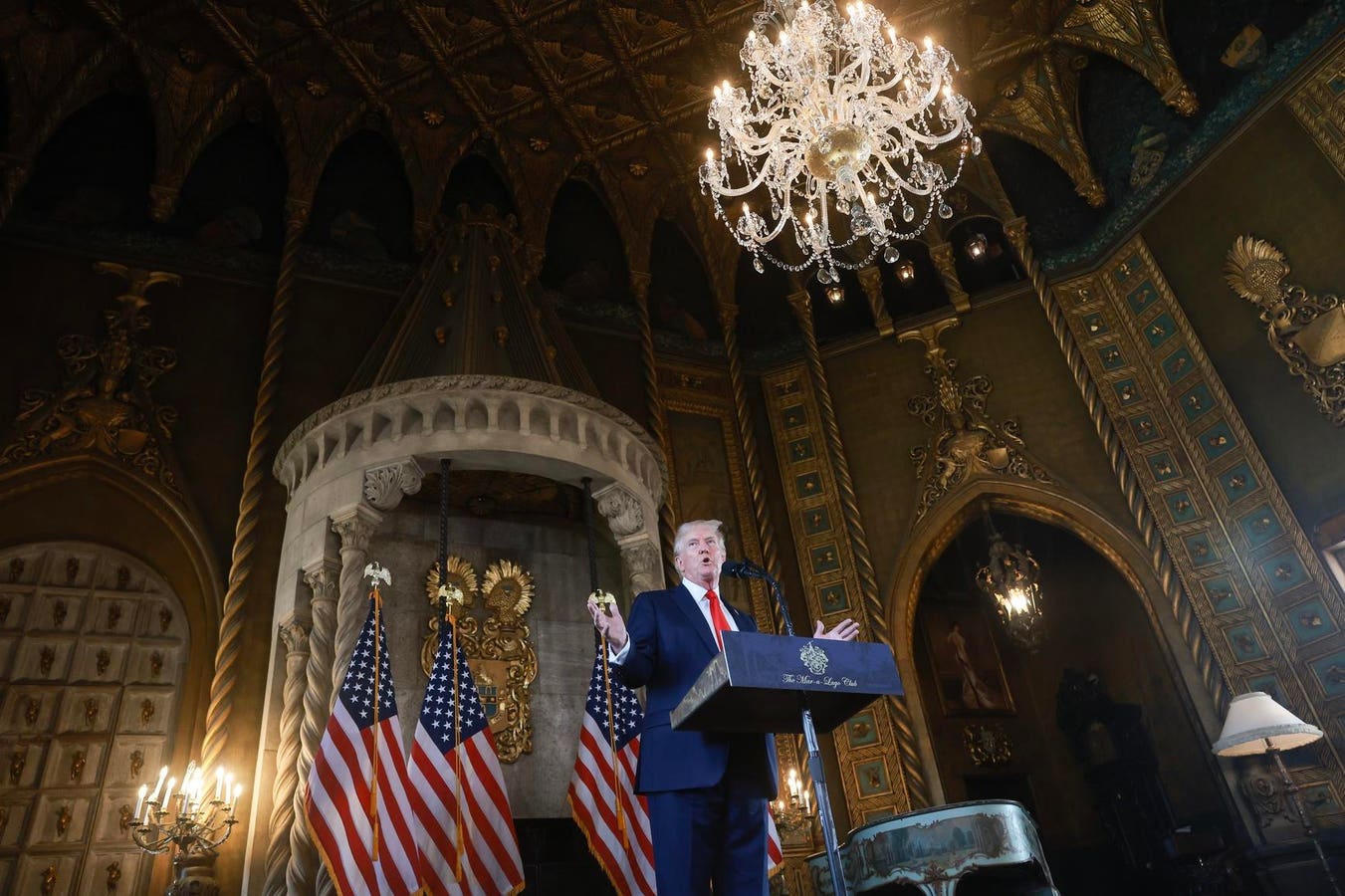
IN LATE APRIL, Donald Trump boarded Air Force One for his 26th trip to Palm Beach of his second term. War was stirring in the Middle East. Gas prices and grocery costs were rising across America. But the president had more important business to attend to. He was headed to Mar-a-Lago, where nearly 300 holders of his memecoin were gathering for a private event.
Launched three days before Trump’s inauguration, the coin had provided him with about $635 million during his first year in office. The event added appeal to an asset devoid of intrinsic value, treating top buyers to a lineup of prominent guests, including billionaire Tim Draper, investor Cathie Wood and boxer Mike Tyson. The main attraction, however, was the president himself.
Guests filed into a ballroom bedizened with the trappings of the Trump brand: crystal chandeliers, walls spattered with gold ornaments, merchandise bearing the president’s name. On seats throughout the room sat goodie bags featuring trading cards with Trump’s picture, gold statuettes in his image and MAGA-red watches imprinted with his signature.
Bill Zanker, the guy behind this bazaar, took to the stage to warm up the crowd with some personal stories. “At around midnight two months ago, I get a call from the president,” he said. “I’m in bed. Kind of drowsy, sleepy a little bit. He calls up. He says, ‘What are you doing?’ I go, ‘I’m in bed, sleeping.’ He goes, ‘Hey, listen, I’ve looked at our Trump watch logo. I don’t think it’s great.’ Now, this is the president of the United States. Busy. He says, ‘I think we’ve got to change the logo to make it more modern.’
“I say, ‘Okay, sure.’ I wake up in the morning. There’s the new logo. I can’t believe it. I went to sleep around 12:30. I got up at 7. New logo. And what’s crazy is, with the new logo, our Trump watches sold even faster.”
While fairly quotidian, the story was notable for what it exposed about a fundamental assumption underlying Donald Trump’s career in politics. For years, Trump and his family have maintained that, even though he continues to own his assets, the president is walled off from decision making inside the Trump Organization.
He is not.
Sure, first sons Eric and Don Jr. handle the day-to-day responsibilities, but the president still weighs in when he wants, according to those who have interacted with him directly. Sometimes, he gets involved in big-picture decisions, such as whether to sell a property. Other times, he digs into operational details, like golf-course landscaping, Mar-a-Lago maintenance and that watch logo. He talks business with his sons, his employees, his partners, even world leaders.
The official position still remains the same. “There are no conflicts of interest,” the White House repeatedly says when asked about Trump’s business. Recently, deputy press secretary Anna Kelly tried out a new line. “All of President Trump’s assets are held in fully discretionary accounts managed by independent third-party financial institutions,” she said, before accusing “the fake news media” of “years of lies and false accusations.”
But, with the exception of his stock-and-bond portfolio, Trump’s assets are not managed by third-party institutions. When informed of that, Kelly responded, “You can use the rest of the statement if you don’t want to use the first sentence.”
ON JANUARY 11, 2017, nine days before his first inauguration, Donald Trump convened a press conference inside Trump Tower to explain how he planned to separate himself from his business.
He wouldn’t sell his assets or put them in a blind trust. Instead, he would set them in a trust overseen by his family and a longtime executive (who later ended up serving two stints in jail for a slate of crimes including tax fraud, falsification of business records and perjury). Voluntary restrictions would limit potential conflicts of interest, including a pledge that Trump would no longer participate in the business.
“I’m not going to have anything to do with the management of the company,” said the president-elect. He noted that the law did not restrict him from getting involved but said he thought it would be a bad look. A month into his first term, Eric Trump told Forbes the president was staying true to his promise. “There is kind of a clear separation of church and state that we maintain, and I am deadly serious about that exercise,” Eric said. “I do not talk about the government with him, and he does not talk about the business with us.”
But Trump kept visiting his businesses. A lot.
During his first term, the president reportedly spent time at Mar-a-Lago on 133 days and his Palm Beach golf club on 83 days. He spent 99 days at a New Jersey property and 85 days at one in Virginia. He visited his Washington, D.C. hotel 28 days.
Those stop-ins did not prove Trump was managing his businesses. But when the president inevitably requested things, it was impossible to distinguish whether he was acting as customer or boss. Former Mar-a-Lago employee Bobby Langlois was tending to his food-and-beverage responsibilities one day when he saw the president wave down Bernd Lembcke, Trump’s trusted hand running the club.
“I just saw him pointing to the floor to Mr. Lembcke. And the next thing I know, Mr. Lembcke starts, you know, like waving his hand at me. You know, like clean this whatever it was. It looked like some soda on the carpet.” It was a little thing, but also just the sort of detail that a sharp-eyed mogul couldn’t let go. “He would point things out to Mr. Lembcke, and then Mr. Lembcke would come and either tell one of the restaurant managers or tell one of the staff,” Langlois says. “He was constantly, like, pointing things out. Things couldn’t be clean enough.”
Trump sometimes went a step further than commenting on appearance, ordering tweaks and improvements. He had lots of thoughts about landscaping. While on the golf course, he would solicit opinions about removing certain trees, for example. “He’ll continue to ask until he gets someone that agrees with him,” says a former employee at his club in Virginia. Then the superintendent or director of agronomy would get to work, and the tree would promptly be removed. “When he tells him, ‘Get it done,’ it should be done or in progress by the next time that he’s visiting.”
The same former employee recalled one instance when Trump learned his company spent a couple million dollars redoing sand bunkers at his property in Bedminster, New Jersey.
The president laid into his son Eric and the club’s employees on speakerphone from his driving range in Virginia. “Mr. Trump really went off the handle—you know, very creative expletives,” the former employee said.
The staff in Virginia, meanwhile, was trying to get approval for a new short-game area, according to the employee. “He weighed in and just kind of said like, ‘It’s not worth the money.’” In other words, the sitting president evaluated and punted on a capital expenditure that would have cost roughly a half-million to a million dollars. The project finally went through after Covid, when a nationwide golf boom spiked the club’s profits.
Occasionally, Trump’s involvement in the businesses he claimed not to be involved in spilled into public view.
Moments after telling Forbes he was “deadly serious” about the wall between his father and the business, Eric Trump said he planned to update the president “probably quarterly” on the Trump Organization’s “bottom line, profitability reports and stuff like that.”
That same year, the president asked about his project in the former Soviet Republic of Georgia when he saw the country’s prime minister, according to Trump’s partners.
In 2020, the president told the New York Post that he had been considering selling his D.C. hotel before deciding against it. “I like it,” he said. “It does well.” The property was, in fact, hemorrhaging money, but Trump was smart to hold off on selling until the market improved coming out of Covid—he ended up offloading it in 2022 for an estimated $375 million.
WITH MORE TIME and fewer restrictions after his first term ended, Trump set about expanding his empire. Seven days after departing the White House, he hosted two former contestants of “The Apprentice” at Mar-a-Lago. Enjoying hamburgers and ice cream, they discussed what would eventually become the Trump Media and Technology Group, the company behind Truth Social, which now trades on the Nasdaq with a $2.8 billion market cap, $1.1 billion of which belongs to the president.
Not long after that, Bill Zanker, who had coauthored a 2007 book with the president titled “Think Big And Kick Ass,” pitched a proposal to sell cartoonish images of Trump as digital trading cards, or non-fungible tokens. The president wasn’t a natural spokesperson for digital assets—he said the value of crypto was “based on thin air” during his first term—but he had a thing for easy money.
In 2022, the day before a potential launch of the NFTs, Trump solicited feedback from those around him, much in the way he did when cutting down trees at his golf course. “We go around the table,” Zanker recalled from the stage at Mar-a-Lago in April. “All of his advisors say, ‘I don’t think you should do this. This could be political suicide. This could be terrible.’ He comes to me. He says, ‘What do you think?’ I said, ‘Well, it’s 45,000 cards. It will take around six months to sell them, but we’ll sell them.’ He said, ‘You know, I like those pictures of me. They’re as a superhero, as a hunter. Let’s do it.’”
The NFTs sold out in less than a day, generating $4 million. Additional releases followed, as did a series of other deals with Zanker—for Trump watches, sneakers and fragrances. Introduced to the crypto world, the president went on to launch World Liberty Financial with his sons about a month before the 2024 election, then a memecoin alongside Zanker just before taking office. A bonanza followed: about $5 million from product-licensing deals and $1.4 billion from cryptocurrency in the first year of his second term.
THE RESTRICTIONS TRUMP imposed on his business during his first term have all but disappeared at this point. In April 2025, after the lawyer advising the Trump Organization on ethics took on a case involving Harvard University, the president demanded on Truth Social that he be fired or forced to resign. The lawyer was gone within hours.
The next month, Trump took off for the first major overseas trip of his second term, not to visit a close ally like Canada or Mexico but to tour the Middle East, home to a portfolio of new business deals, some undisclosed to the American public.
He landed in Saudi Arabia’s capital, Riyadh, where he attended a lunch with both public officials and private business connections. In the evening, the president examined an ancestral city where the crown prince oversees a master-plan development. “It turned out to be a good stroke of luck and maybe a little bit clever of us to say, ‘Okay, let’s appeal to him as a developer,’” Jerry Inzerillo, the executive who runs the development and also serves as vice chairman of the Forbes Travel Guide, told the New York Times. “He loved it.” Months later, the Trump Organization set up a company to do business there, with the president taking an 80% stake while his family members received 20%. A spokesperson for the Trump Organization said the deal had nothing to do with government policy.
Next, Trump flew to Qatar, where the Trump Organization had just announced a project inside a state-sponsored master development. Trump convened with, among others, leaders of the country’s sovereign wealth fund and its real-estate subsidiary, Qatari Diar, the entity responsible for the master development. Trump personally collected $5 million from the deal last year.
Finally, he jetted to Abu Dhabi, capital of the United Arab Emirates, where a company working on behalf of the president had recently set up two new entities to do business. Undisclosed at the time of the trip, those companies delivered $5 million to Trump last year. Two months after the visit, a Trump representative created another pair of companies to do business in Abu Dhabi. The names of the latter vehicles, DT Marks Al Raha Beach LLC and DT Marks Al Raha Beach Member Corp, suggest a yet-to-be announced deal in Al Raha Beach, another development tied to state officials.
A former diplomat with deep experience in the region told Forbes that gulf leaders surely know these deals involve the president. “This is straight-up, fully obvious grift off of his public office,” the former diplomat said. “Do they know it’s him? Yes. I mean, they do. And what is one to say at that point? Oh, you know, I’m not sure that passes muster with your U.S. law and regulations and ethics norms?”
The White House dismissed the criticism. “The only special interest guiding the Trump administration’s decision making is the best interest of the American people,” a spokesperson said, touting recent economic agreements with Saudi Arabia, Qatar and the United Arab Emirates.
Shortly after his jaunt through the Middle East, Trump headed overseas again—this time to Scotland, where he owns two golf resorts. He visited both, remarking on the craftsmanship of the windows at Turnberry with the United Kingdom’s prime minister and the splendor of the ballroom to the president of the European Commission, before taking a one-day sojourn to his property in Aberdeenshire. Alongside Don Jr. and Eric, who both still refer to themselves as executive vice presidents of the Trump Organization, the elder Trump cut the ribbon to inaugurate a new golf course as if he were still chairman.
Last year, the Trump Organization submitted a regulatory filing in Great Britain that shed light on the structure of the business. Called a “notice of individual person with significant control,” the document explained that President Trump has “the right to exercise, or actually exercises, significant influence or control over the activities of a trust.” Here’s the thing: The trust through which Donald Trump owns his property in Scotland also controls virtually everything else in his portfolio. In explaining that he shares power over the trust, therefore, the Trump Organization admitted—in an official filing—something it cannot seem to tell to the American public: Trump handed authority to his sons, yes, but he also retained power for himself.
It’s a dynamic that those closest to the Trump family business seem to understand. Bill Zanker, for instance, has been cooking up plans for more events like the one in Palm Beach, and he knows who needs to sign off on such productions. “I’m trying to convince the president,” he said on stage in April, “to do this every six months.”
Read the full article here