


Published on •Updated
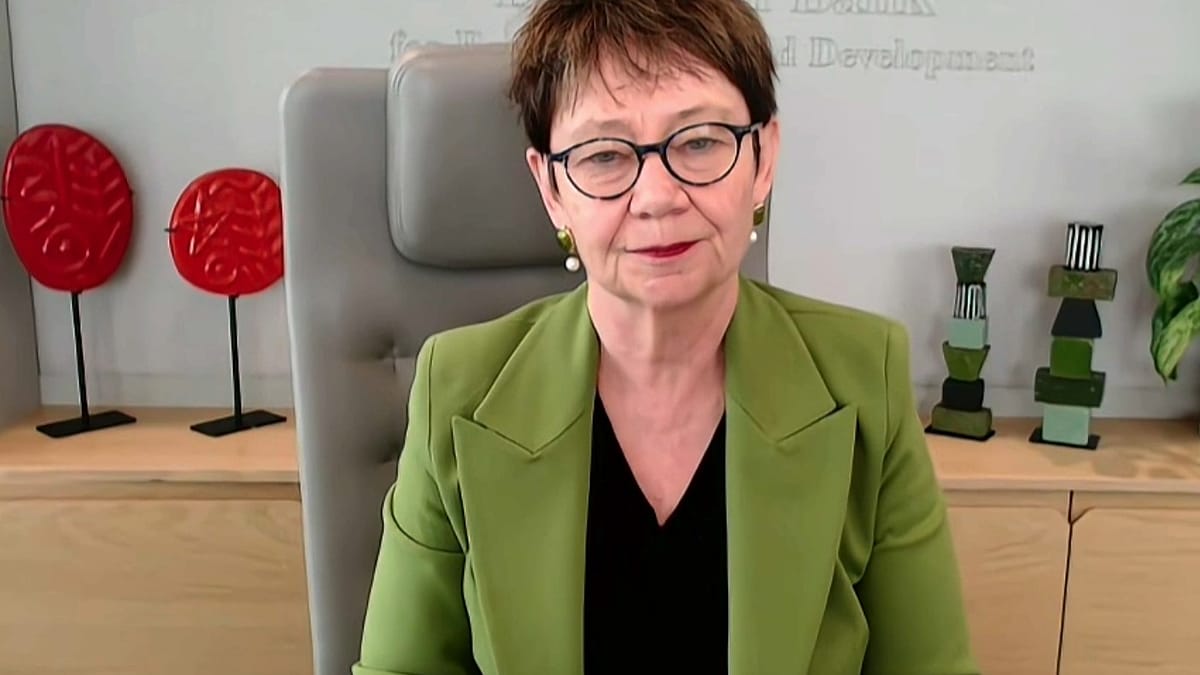
The President of the European Bank for Reconstruction and Development has warned of a “much more serious economic impact” on the EU if the war in the Middle East escalates after diplomatic efforts between the US and Iran to reach a deal fell flat.
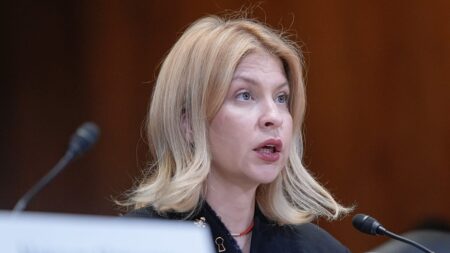
Speaking to Euronews on Monday, Odile Renaud-Basso, who has led the multilateral development bank since 2020, said that while the current scenario in the Middle East risks curbing growth and increasing inflation in the economies in which the EBRD operates, the economic repercussions of a drawn-out war will be “wider and more significant.”
The economic impacts are “directly related” to the soaring price of energy, she added. The effective closure of the Strait of Hormuz since the conflict erupted, coupled with the destruction of key energy sites in Iran and the Gulf, have sent global oil and gas prices climbing and forced governments worldwide to intervene with fuel subsidies and tax cuts.
The EBRD estimates that a scenario in which oil prices continue at around $100 (€85) per barrel could dent growth by 0.4% and increase inflation by around 1.5% in the bank’s countries of operation.
“This doesn’t mean recession, but if the situation worsens, then the impact will be wider and more significant,” Renaud-Basso told Europe Today.
“We are talking about oil prices at $100 (per barrel), but it could go very much above if the situation worsens,” she added. “If the Strait of Hormuz remains blocked for a very long period of time, if there is more destruction of production capacities in the Gulf and so forth (…) then the economic impact is likely to be much more serious.”
Renaud-Basso also said that Europe faces a challenge because its governments face a “much more limited” fiscal space, preventing them from introducing measures that could “counterweigh increases in energy prices” in the same way as they did during the Covid-19 pandemic or the 2022 energy crisis.
Last week, the EBRD announced plans to channel €5 billion in investments in 2026 to countries in the Middle East hit by the economic repercussions of the conflict.
The bank’s initial response will focus on economies directly affected by the conflict, such as Iraq, Jordan, Lebanon, the West Bank and Gaza, as well as neighbouring countries grappling with spillover effects, such as Egypt, Turkey and Armenia.
“When you have private sector banks withdrawing or reducing their exposure (…) we are stepping in, in a way, as a counter-cyclical bank, which is there to continue to support investment,” Renaud-Basso said.
The institution says it is “ready to provide support to all other economies where it operates” that are “affected by the broader economic security issues, as well as emerging macroeconomic impacts.”
Established in the aftermath of the Cold War to rebuild post-Soviet economies, the bank today invests primarily in Central and Eastern Europe, Central Asia, and the Southern and Eastern Mediterranean, supporting the transition to market-oriented economies through private investments.
It has become a major player in investment in Ukraine, deploying a total €9.7 billion in the country since Russia’s invasion in 2022, with a focus on investments in energy security.
Renaud-Basso said that the situation in the Middle East is also having repercussions on Ukraine, including by pushing up energy prices, depleting stocks of anti-missiles equipment and ensuring Russia benefits more from sales of fossil fuels.
Read the full article here