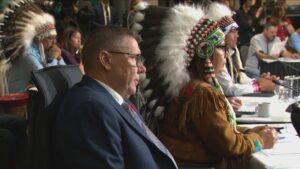



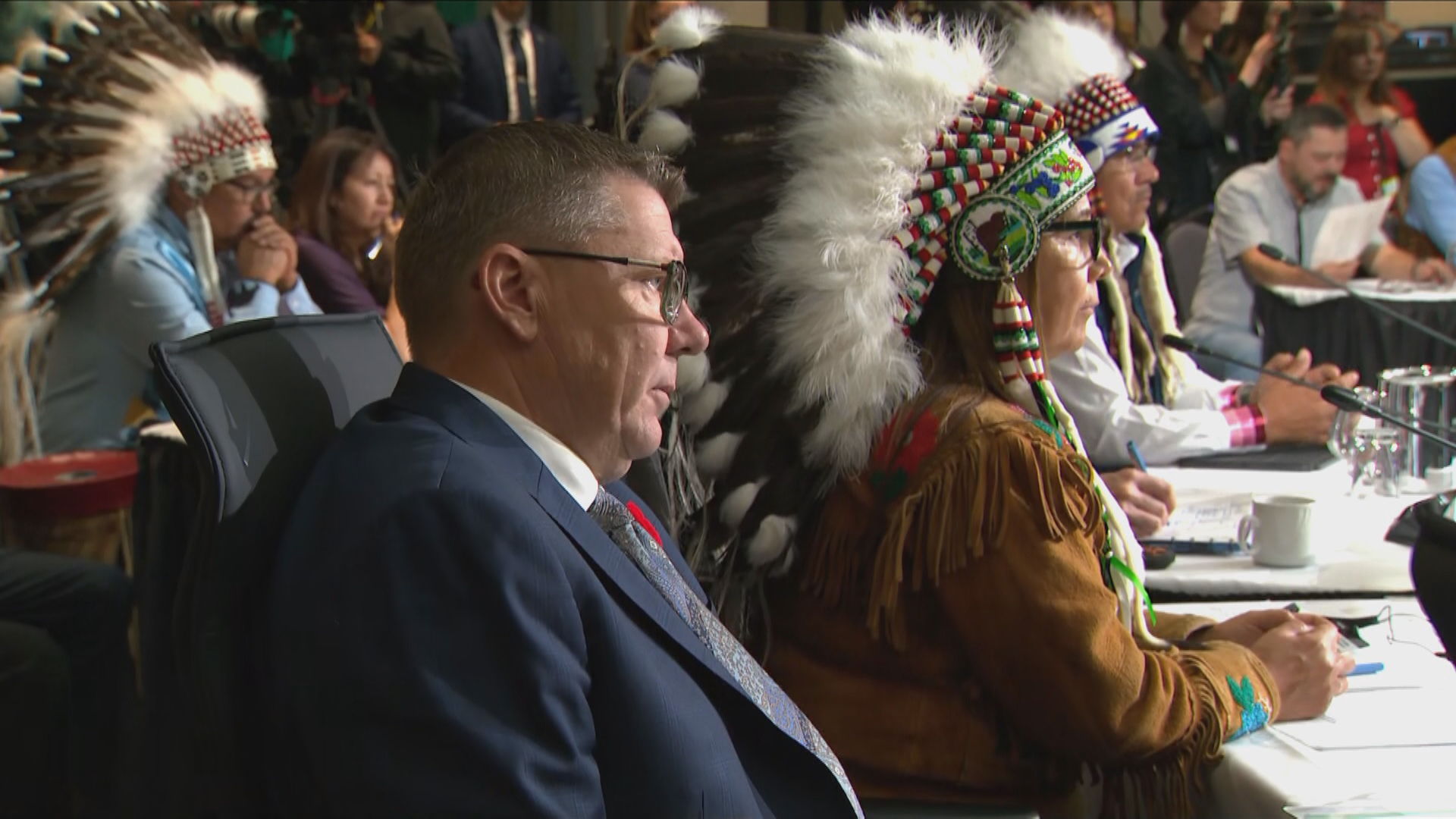
First Nations leaders from Saskatchewan who attended a long-awaited first ministers meeting say they raised several concerns affecting their people.
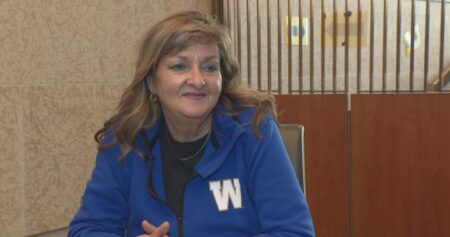
Speaking to reporters afterward, Lac La Ronge Indian Band Chief Tammy Cook-Searson said she was given three minutes to speak. She used them to advocate for a proposed change to the Indian Act that would allow any person with at least one status parent to inherit federal Indian status.
“We have children, grandchildren, members of our communities that are not part of our nation because of this discriminatory policy of the federal government,” Cook-Searson told reporters Monday.
Cook-Searson, acting as Saskatchewan’s regional representative, said she did not hear any commitments from the federal government on the issue but will “continue to push forward.” The bill, known as S-2, has passed the Senate and awaits action from the House of Commons Standing Committee on Indigenous and Northern Affairs.
She also asked Ottawa to consider adding survivors of the Timber Bay Children’s Home, near Lac La Ronge, Sask., to the residential school settlement agreement.
She says she has pushed for this since she first became chief more than two decades ago. At one point, Ottawa was at the table, but the province was not.
Now, Cook-Searson says Premier Scott Moe has “given us his word” that Saskatchewan will return to the negotiations.
“Now we need the feds to come back to the table, so if we can get the two together, the province and the feds. Then we will be able to settle this injustice with the Timber Bay Children’s Home survivors and their families.”
Premier Scott Moe was among the premiers at the meeting but did not make himself available for media comment Monday.
Cook-Searson was joined by several other chiefs represented by the Prince Albert Grand Council, who each raised their top concerns in hopes Ottawa would take note.

Get breaking National news
Get breaking Canada news delivered to your inbox as it happens so you won’t miss a trending story.
For Chief Kirby Constant of James Smith Cree Nation, policing remains top of mind four years after a mass stabbing attack that killed 11 people and wounded 17 others on the First Nation. He wants to see support for First Nations policing to improve public safety in the region.
“Without First Nation Policing, we’re feeling that the RCMP is not fulfilling their requirements to keep our community safe,” Constant told reporters, adding that the service would allow people with similar cultural backgrounds and traditional knowledge to serve their communities.
Some nations protest, saying no one speaks for them
As the meeting was underway, members of the Onion Lake Cree Nation, located approximately 50 kilometres north of Lloydminster, Sask., took to the streets of Ottawa to protest the event.
“No organization or government has the authority to speak for Onion Lake Cree Nation, negotiate our rights, or make commitments on our behalf without our consent,” Onion Lake Cree Nation Chief Pete Chief told Global News in an interview Monday.
Onion Lake formally withdrew from the Assembly of First Nations (AFN) three years ago, after an internal referendum ended its membership.
Chief said his First Nation has no problem with Prime Minister Mark Carney’s development agenda but wants meaningful consultation that goes beyond a closed-door meeting where not everyone is present.
“Come to our lands, come and develop that relationship with us and so that we also can be a part of the development, a part of whatever the project may be,” he said.
Carry the Kettle First Nation also opposed the meeting. In a letter posted on social media, the nation said it has not consented to being represented by the Federation of Sovereign Indigenous Nations (FSIN) or the AFN.
“In the absence of our consent and any rights at law, we request that FSIN and AFN expressly exclude our Nation from any representation today at the Prime Minister and First Ministers,” wrote Carry the Kettle Chief Dwayne (Cliff) Thomson.
FSIN representation unclear
Before the meeting, the AFN said regional representatives would attend. FSIN Chief Bobby Cameron is Saskatchewan’s regional representative, but it is unclear whether he was there, since Cook-Searson presented herself as his proxy.
Global News has asked the FSIN to confirm Cameron’s attendance and has not yet heard back.
Earlier this month, the FSIN announced it would take the federal government to court after Indigenous Services Canada (ISC) served it a final repayment notice for $12.4 million, following a forensic audit in the fall of 2025. ISC later said it would file a statement of claim to recover the money.
First meeting of its kind in two decades
The last time Indigenous leaders met with the premiers and the prime minister of Canada was during the Kelowna Accord talks in 2005, which were centred on socioeconomic gaps in Indigenous communities and were led by then-prime minister Paul Martin.
Carney said Monday it’s “sobering” to consider that this is the first meeting to bring together federal, provincial and First Nations leaders in two decades.
“Our task is twofold. First is to work together to create opportunities for all our peoples, while building a country that is stronger, more sovereign and more independent,” he said.
The meeting may not be the last. Cook-Searson said representatives received “a commitment” from some premiers to meet annually.
Representatives of Saskatchewan’s Métis people were also absent, but the president of Métis Nation-Saskatchewan says talks with the federal government are ongoing.
“We just did our lobbying not very long ago last week and it went very well with the speaker and the speaker’s lounge and got to meet all parties and begin this conversation in regards to the importance of having the Metis be involved,” he said.
With files from The Canadian Press
Read the full article here