




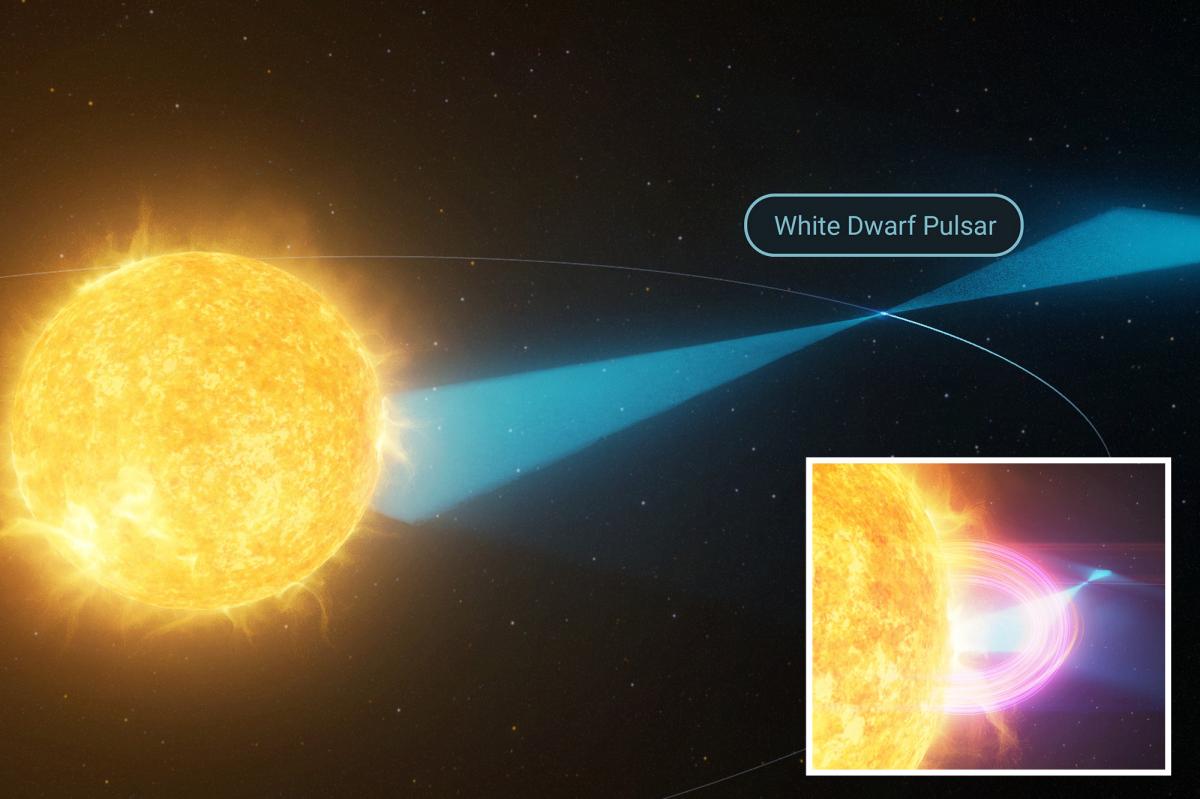
An unusual star system that emits mysterious radio signals every eight minutes has been discovered in deep space.
Astronomers in Australia have linked the regular radio pulses to an unusual pairing of celestial bodies 5,000 light-years from Earth.
One is a dead star that spins every eight minutes, and the other is a star similar to our own sun.
They explained that the newly discovered system, known as GPM J071507−114153, consists of two stars orbiting each other: a white dwarf – the dense core left behind when a star dies – and a G-type star similar to the sun.
It is the first time radio pulses have been detected from a white dwarf orbiting a sun-like star, according to a study published in the journal Nature Astronomy.
Researchers at the International Centre for Radio Astronomy Research (ICRAR) in Perth, Western Australia, explained that such pulses are usually observed in systems with smaller and cooler red dwarf stars, meaning the discovery breaks new ground.
Study lead author Dr Sam McSweeney said: “This is the first time the pulses are clear enough to see the white dwarf moving in its orbit around its companion, so we know that the pulsations are coming from a region close to the white dwarf, or possibly even from the white dwarf itself.”
Dr McSweeney, who made the discovery while working as a researcher at ICRAR, says such types of stellar pairs belong to a broader class of objects known as long-period transients (LPTs), producing radio signals that switch on and off over intervals ranging from minutes to hours.
Around a dozen have been detected since the first was discovered by the same ICRAR team in 2021, and astronomers are still working to understand them.
While several previously discovered LPT systems contain a white dwarf and another star, it has remained unclear which of the two stars was generating the radio pulses.
The research team processed more than 100 hours of radio data at the Pawsey Supercomputing Research Centre to validate and understand the white dwarf motion.
Study co-author Associate Professor Natasha Hurley-Walker says that the pulses emitted by the white dwarf allowed the team to detect stellar flares on the sun-like star, similar to those that create aurorae on Earth.
She said: “As a bonus, we also saw the white dwarf moving behind a region with a strong magnetic field, most likely a ‘stellar prominence’ – which is a large loop of plasma erupting from a star’s surface.
“It’s amazing that by using radio wavelengths we can detect the storms on a star over 5,000 light-years away.”
ICRAR researchers have been at the forefront of discovering the rare systems.
Prof Hurley-Walker said: “We detected this system in a large survey using the Murchison Widefield Array to scan the entire Milky Way visible from Australia.
“We then used the MeerKAT radio telescope in South Africa to determine its precise position.”
After the LPT was located using the radio telescopes, the W.M. Keck Observatory in Hawaiʻi confirmed its association with a G-type star through optical observations.
Dr McSweeney added: “If we are already making such discoveries with precursor telescopes, just imagine how many more star systems we will be able to find, and what a beautifully detailed view of their signals we will have, once the SKAO telescopes are completely built.”
Read the full article here