



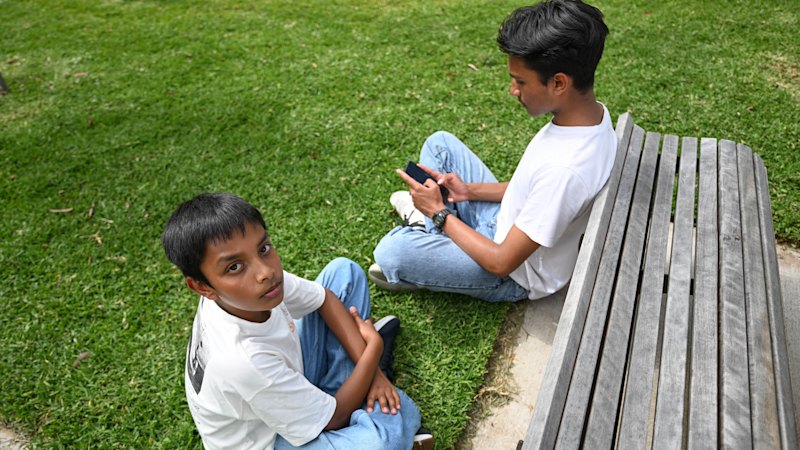
Rehan Rahman, 13, is puzzled about all the fuss around Australia’s teen social media ban.
Six months into the ban, Prime Minister Anthony Albanese is moving to toughen up the laws, while other countries, including the UK, have said they plan to follow Australia’s lead with their own bans.
But Rehan’s life, and the lives of his peers, has changed very little since the virtual walls went up. The ban simply hasn’t stopped them using social media.
“No, not at all, to be honest. It kind of stopped for a bit, I guess, but it all just went back to how it was,” he said. “On the surface, it looks like a good idea. But after seeing it implemented, you can definitely see that it does not have the desired effect. It kind of just wasn’t worth all the planning.”
Rehan’s experience fits among several pieces of evidence that suggest the ban has barely limited the social media use of teens.
Federal government data from March, three months into the ban, found about 70 per cent of children retained their social media accounts, mostly because they simply had not been asked by platforms to verify their age.
A Western Sydney University study in May found a similar number, as did a paper published in medical journal The BMJ this month. Unpublished data from a Flinders University team also comes to the same conclusion, this masthead has learnt.
“It certainly has been a failure of implementation,” said Dr Matthew Stevens, a Flinders University academic who has published a paper on how to evaluate the ban’s success.
“Serious questions need to be asked of the eSafety commissioner and the relevant regulatory bodies about what we’re actually going to do.”
A wall of Swiss cheese
In September 2025, Albanese announced plans for a sweeping and world-first social media ban for children under 16.
“This is all about supporting parents and protecting children,” he wrote in the Herald Sun, after the News Corp papers ran a long campaign calling for a ban.
But even before the turn of this year, concerns were emerging about how such a ban might actually work; more than 140 leading researchers signed an open letter slating the move as “too blunt an instrument” to function effectively.
“Implementing a ban effectively remains a challenge. There are not yet effective techniques for age assurance nor to verify parental consent,” the experts wrote.
Six months in, those concerns appear to have been borne out.
The BMJ study, published earlier this week, found the ban had so far had no effect on the amount of time young people spent on social media.
More than 86 per cent of the 408 survey respondents had used a banned platform in the previous week.
While many people feared children would turn to sophisticated means to escape the ban – such as using a VPN – the BMJ study suggests that hasn’t been necessary. Some 68 per cent of children aged 14 or 15 were using their own account to access social media as usual.
In many cases, the platforms simply required children to declare their age, “which we know is not particularly effective”, said Professor Luke Wolfenden, the senior author of the University of Newcastle’s study.
Australia’s eSafety Commissioner, Julie Inman Grant, appears to agree. She told this masthead this month the ban was like trying to “fence the ocean”.
“We might be able to create some friction and some degree of safety, but it’s a futile exercise if you think you’re totally stemming the ocean,” she said.
In response to questions about the ban’s effectiveness, the eSafety Commission pointed to Inman Grant’s testimony before the senate in May. “Meaningful regulatory impact is rarely achieved in months,” she said, and pointed to gradual improvements in age verification by the platforms.
Mental health
The prime minister has long linked the ban to the allegation social media may be bad for youth mental health. “We know social media is causing social harm for some of our kids,” Albanese told the United Nations last year. “There is a clear link between the rise of social media and the harm to the mental health of young people across the world.”
Experts on youth mental health were less convinced. Rather than a “clear link”, they saw a mess of contradictory evidence.
A coalition of leading young mental health organisations, including Black Dog and Beyond Blue, came out strongly against what was a proposed ban in 2024, and argued it would do little to help children, and actually risked cutting them off from support when they needed it.
Has that evidence shifted?
This month a study of 1239 children and young people tracked since 2012 was published in the Medical Journal of Australia, and revealed higher levels of social media use were associated with small increases in poor mental health outcomes.
“Our findings are suggestive that lower levels of social media use are associated with lower risks for future mental health problems,” said lead author Dr Nandita Vijayakumar from the Murdoch Children’s Research Institute.
The study supported the need for action on social media use, she said.
Because of its design, the study cannot prove social media use causes adverse mental health – but because it tracked mental health over time, it allows the researchers to be “more confident” the actual cause of the change is social media, Vijayakumar said.
The study showed an increase in mental health problems as the children aged – but other studies have shown children’s mental health tends to worsen with age, even before the dawn of social media. And other experts remain sceptical.
“The evidence is still not strong enough to be able to confidentially say social media is not causing the problems we see in young people’s mental health,” said Professor Jo Robinson, scientific director of the Orygen Policy Centre. “The evidence is not strong enough to inform big policy decisions like this.”
Indeed, it remained plausible the ban would be more harmful than helpful to young people’s mental health, Robinson said.
And unintended consequences are starting to emerge.
In parallel with adults, young people now consume much of their news from social media.
While most children are not yet affected by the ban, those who are reported a 51 per cent drop in news consumption, according to Western Sydney University paper published in May.
“There is a very, very strong association between news engagement and civic engagement,” said Dr Tanya Notley, the paper’s lead author. “Taking away news will have a direct impact on that.”
Start the day with a summary of the day’s most important and interesting stories, analysis and insights. Sign up for our Morning Edition newsletter.
 Liam Mannix is an investigative journalist at The Age. Before that, he was national science reporter for The Age and the Sydney Morning Herald.
Contact him via email or Signal (encrypted) liammannix.18
Connect via X, Facebook or email.From our partners
Read the full article here