



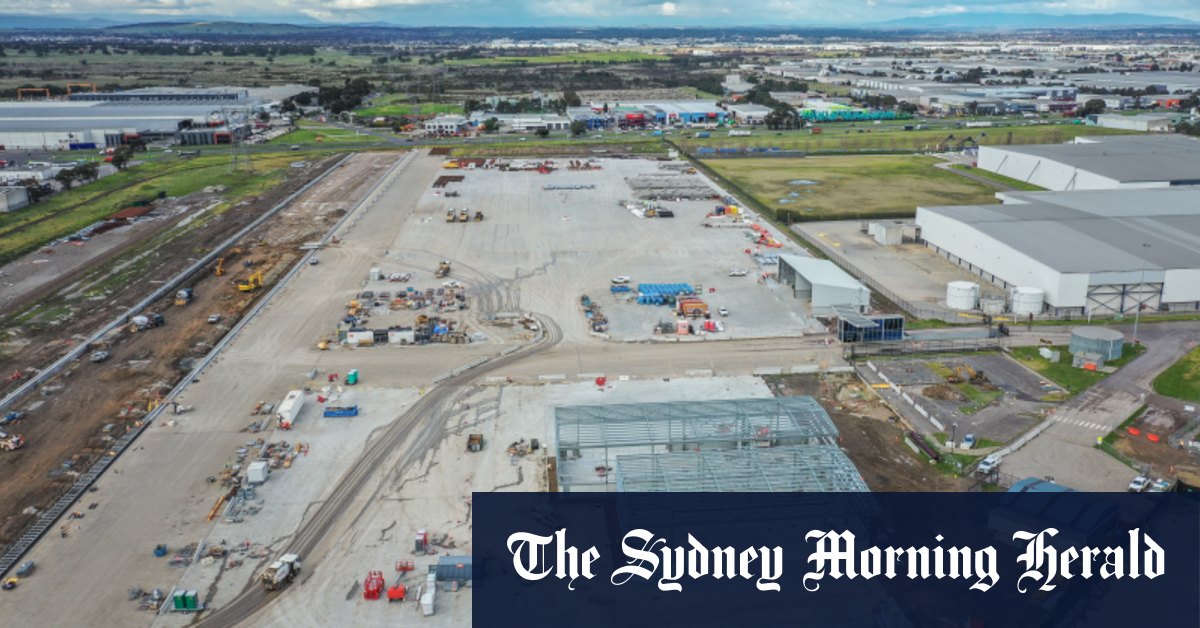
Modelling the ITC commissioned from Deloitte suggests Somerton’s capacity to handle the equivalent of 1 million 20-foot [six-metre] containers when it first opens, with the potential to double that with expansions, would be sufficient to manage all interstate freight until the mid-2050s.
Maharaj said that showed it was not necessary for the Commonwealth to spend over $1.6 billion building another intermodal terminal 20 kilometres further north at Beveridge.
“The capacity is here. We’re not asking the taxpayer to put their hand in their pocket, because an industry super fund is,” he said. “Otherwise, you’re duplicating infrastructure – it’s like building two airports down the road from each other.”
The Morrison government committed $1.6 billion for the Beveridge Interstate Freight Terminal and $280 million for associated road connections in the 2022-23 budget, which it hoped would help it win the marginal seat of McEwen.
The state Labor government had since 2018 been pushing for a terminal at Truganina, in Melbourne’s west. However, in May, the Allan government said it would defer plans for the Western Interstate Freight Terminal “until when it’s needed” and backed proceeding with the Beveridge development.
A Victorian government spokesperson said the state welcomed private sector and industry proposals to handle growing freight volumes.
“We’ll continue working with the Commonwealth, local government and industry as work progresses to establish intermodal terminals and to deliver inland rail.”
National Intermodal CEO James Baulderstone said the Somerton terminal would be complementary to the facility the Commonwealth-owned enterprise was planing for Beveridge, which had up to 600 hectares available for warehouse development.
“It’s a precinct rather than an intermodal terminal,” he said. “If you want a lower cost for rail versus road, it’s in that last mile of pick-up and delivery. So to solve that … you need the customer to be co-located.”
Baulderstone also warned that there was a risk private terminal operators would capture the value delivered by the Inland Rail Project rather than it being passed on to consumers in the form of cheaper products.
Baulderstone said National Intermodal intended to open an initial terminal at Beveridge by 2026 and a main terminal by 2028, which would have capacity for half-a-million container equivalent units a year.
Loading
The volume of freight through the Port of Melbourne, which is already Australia’s busiest port, is projected to grow from about 3 million container equivalent units a year to 4 million by 2032 and to 5 million by 2040.
The Port of Melbourne’s head of intermodal, Charles Cornish, said the port was pleased to see the Somerton terminal progress as part of its efforts to build a network that could move freight away from the port for processing at industrial hubs in the outer city.
“We are keen to see freight shift from road to rail, delivering productivity and environmental benefits,” he said.
Read the full article here