



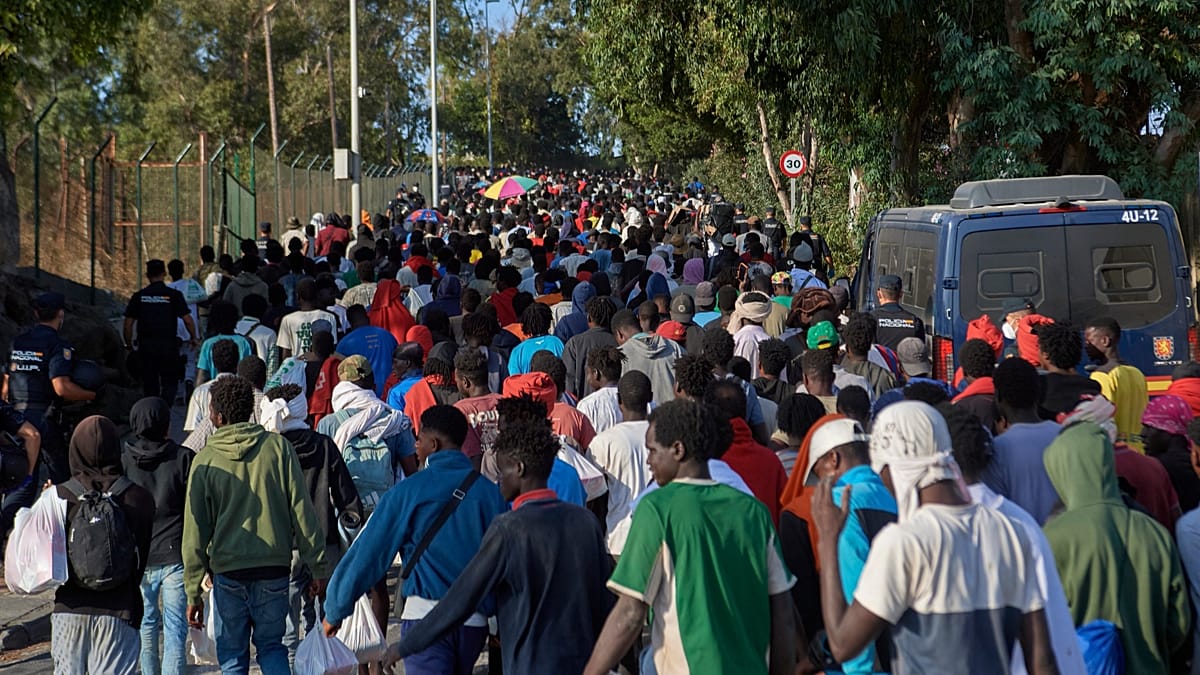
Spain’s National Police and Civil Guard launched a large-scale operation early on Thursday on El Trampolín beach in Ceuta as part of a plan to relocate migrants to temporary shelters.
On Thursday, Spain’s government announced the creation of temporary shelters for 1,800 migrants in the Spanish enclave, in an effort to relieve the humanitarian crisis following last month’s influx from Morocco.
According to local media, around 4,000 people have been staying on the beach. The government, however, said it planned to gradually expand the capacity of the temporary shelters.
The migration ministry said the two new shelters were “temporary reception facilities that will be expanded progressively as the adaptation work on the other planned spaces is completed.”
The move comes after tens of thousands of migrants crossed from Morocco into the Spanish enclave at the end of July. Each year, thousands of migrants from across Africa travel to Morocco in search of a route into Europe, fleeing conflict, poverty and instability.
At least 90 people died on both sides of the border, making it one of the deadliest migration crises to hit the region. Human rights groups have repoted higher tolls.
The majority of those that breached the border have since returned to Morocco, but thousands remain, including unaccompanied children. NGOs have warned that women and girls are particularly vulnerable.
In a U-turn move, Madrid announced plans to transfer 500 unaccompanied migrant girls who arrived in Ceuta to the mainland. The decision contrasts with the European Union’s stance, which supports the return of unaccompanied minors to Morocco.
Conditions have severely deteriorated over time, with migrants that remain in Ceuta sleeping in makeshift camps and dependent on humanitarian organisations for food and other basic necessities. However, many are struggling to access food, water, shelter and sanitation as the city’s resources are overwhelmed.
The aim of the operation is to provide a space for people to stay, who until now have been forced to sleep on the beach or in public spaces.
The operation also seeks to restore the beach. Once it has been cleared, municipal services are expected to carry out cleaning work, while the area will be cordoned off to prevent another camp from being established.
Read the full article here