




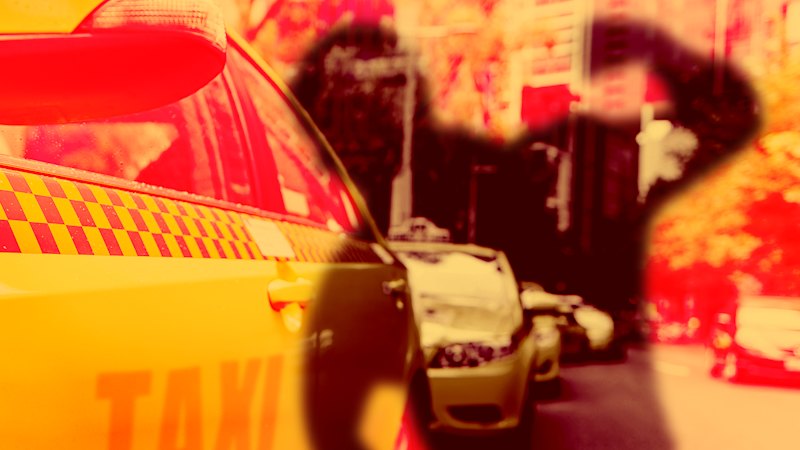
The Saturday morning shift began like any other for Sydney taxi driver *Daniel. But within an hour, the bloodied cabbie suffered a frenzied stabbing attack from his passenger over a fare dispute.
He is among one-third of Australian taxi and ride-share drivers who report some form of abuse, figures show.
Daniel picked up 32-year-old Jack Saddington at 7.30am on September 27 from Strathfield train station and drove him 25 minutes to an apartment block in the inner west suburb of Marrickville.
When his passenger handed over just $5 of the $25 fare, Daniel threatened to call the police, causing an irate Saddington to exit the taxi and punch both side mirrors.
Shaken, Daniel got out of the taxi, but Saddington jumped into the driver’s seat, locked the doors and took the driver’s phone. He tried to start the taxi but failed, before fleeing into a nearby building stairwell where the fare argument continued. It was then that Saddington bit Daniel on his upper arm and stabbed him three times in the arm with a makeshift knife.
Saddington was charged with assault occasioning actual bodily harm and destroying property. He pleaded guilty and was sentenced earlier this month to a maximum of 16 months’ prison with an eight-month non-parole period.
Describing the crime as a “very egregious act of violence … against a vulnerable victim”, Judge Theo Tsavdaridis said Saddington had breached a good behaviour bond and had a violent criminal history.
He noted the man had suffered mental health issues, drug addiction and occasional homelessness.
One third of ride-share drivers experience abuse: union
The disturbing case is not an isolated incident, with a national Transport Workers’ Union (TWU) survey finding one-in-three ride-share and taxi drivers had reported abuse.
In December, a passenger was jailed after severely bashing and threatening to kill a Sydney Uber driver and his family. One month later, a teenage passenger allegedly stabbed a ride-share driver in Sydney’s west over an argument about the car’s Bluetooth.
Passenger-on-driver abuse was the second most-common form of abuse reported to the TWU, following racial abuse. Sexual abuse was the third most prevalent.
The survey of more than 1600 participants was conducted in preparation for a Fair Work Commission (FWC) application on improving conditions and pay, which is currently under consideration.
The union’s national secretary, Michael Kaine, described the problem as “one of the lesser-known kinds of evils of what’s occurring in our community”, adding the actual number of assaults was likely higher due to a fear of losing work for reporting.
Drivers often dealt with “horrific violence” – including physical and racial attacks – without a protected employment relationship. Kaine said many faced automated AI agents or offshore systems when dealing with deactivations or safety issues.
He explained that many ride-share applications rely on customer reviews to determine a driver’s work access. This meant violent offenders could submit false negative reviews that could result in immediate driver deactivation without proper investigation.
This masthead recently reported on a FWC ruling that Uber’s fully automated complaint-handling processes were “illogical”, “arbitrary” and ultimately unlawful.
The case involved a Canberra Uber driver who was sacked because his customer satisfaction ratings and feedback scores were slightly less than 85 per cent.
With TWU’s help, the commission ultimately ordered the driver’s reactivation.
Kaine said the issue extends beyond poor ratings.
One union member reported a passenger assault to police and Uber, but his account was shut down after he received a counter complaint from the passenger.
His account was eventually restored, and he fought in court to receive backpay.
An Uber spokesperson disputed that its “robust” case review processes were largely virtual, saying it was “human-led by a specialist incident response team.
“We never take the decision to remove platform access lightly,” they said. “In many instances, matters are resolved directly with driver and delivery partners before further escalation.”
The Albanese government’s 2024 industrial relations reforms, which legally acknowledged ride-share workers’ rights for the first time, empowered the FWC to set minimum standards and introduce unfair dismissal protections.
Regulator calls violent attacks on drivers ‘deeply concerning’
Point to Point Transport Commissioner Anthony Wing said violent attacks on drivers, while proportionally rare, were “deeply concerning” and that every driver has the right to feel safe at work.
“Safety remains my absolute priority,” said Wing, the independent regulator for NSW’s taxi, hire vehicle, and ride-share industry.
The point to point transport commissioner can take enforcement action for regulation failures, while police investigate criminal violence.
Taxi and booking service providers have a legal obligation over driver and passenger safety, via technology, incident reports, and helping police.
They must notify the commissioner of notifiable offences which include police complaints of assault, sexual assault and physical threats.
Safety improvements made by the regulator included covert and visible enforcement operations, in-app safety audits of Uber and Didi and a trial of Smart CCTV at taxi ranks and high-activity spots. The CCTV trial is under review.
From our partners
Read the full article here