




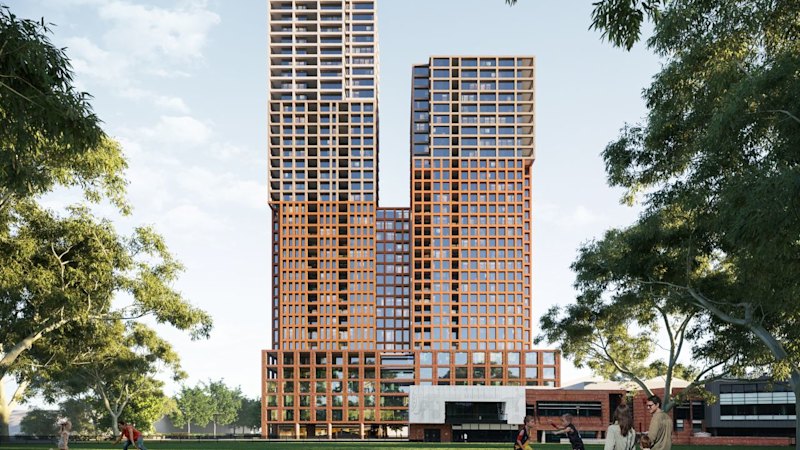
The precinct around Arden train station is set to be a cluster of rental skyscrapers, after the Carroll government gave a fast-track tick to three towers standing 37, 27 and 24 storeys tall.
All three buildings – the first new developments to be approved around the underground station – significantly exceed the height and bulk limits the state government set for Arden just four years ago, signalling it has jettisoned its mid-rise vision.
The Arden precinct is one of the largest and most important urban renewal sites in Melbourne, with 13 hectares of state-owned land, mostly located around the new metro station.
Urban planning experts, residents and rivals across the political spectrum accused the government of abandoning years of planning work for the inner-city precinct at the first hurdle, and said the approvals risk repeating the urban planning failures of Docklands.
A 27-storey, build-to-rent tower was approved on the eastern side of Arden station this week, following the approval of two towers, 37 and 24 storeys tall, on the station’s northern side in July.
The state government had to change the planning scheme to approve the 37- and 24-storey developments because they both exceed building height, form and overshadowing controls for the Arden precinct. The amendment was made at the request of the project’s developer, Arden Village Group.
The planning process for all three towers was fast-tracked, bypassing council and community consultation. Melbourne City Council has objected to all three towers, arguing they will overshadow open space and fail to provide enough affordable housing.
The government had to abandon its original plans to develop a hospital and health precinct at Arden in 2024 due to the risk of electromagnetic interference from underground trains, and has since shifted its focus to building housing for 20,000 people.
But the area is flood-prone, and the flooding risk is only expected to increase due to climate change, adding hundreds of millions of dollars to the cost of building there.
Approved this week, the proposed Arden development by build-to-rent specialist Novus would rise 90 metres, dwarfing any current building in the area and well above the precinct’s 64-metre discretionary height limit.
The $110 million building would overshadow planned open space adjacent to the station. It would contain 250 homes, mostly one- and two-bedroom units, with 10 per cent of dwellings dedicated to affordable housing for 15 years, with tenants given a 25 per cent discount on market rent. Novus will also make a one-off $500,000 contribution to the government’s social housing growth fund.
Melbourne City Council was excluded from the approval process, after Novus applied directly to the state government, using the government’s development facilitation program, which also exempts applicants from issuing a public notice, and removes the right to object.
The council said that although it has no right of review, it opposes the development in its current form because it is too tall, too bulky and that its affordable housing proposal is not genuine as it is “unlikely to create affordable rents for low- to moderate-income earners”.
Instead, it pushed for a 30 per cent discount for 20 years. Melbourne City Council’s deputy mayor and planning portfolio lead, Roshena Campbell, said the government was jettisoning years of taxpayer-funded planning work in pursuit of a high-rise vision that risked “quite frankly, turning Arden into an urban planning failure for years to come”.
The structure plan for Arden that envisioned a lower-rise approach was 10 years in the making and anticipated buildings of 12 to 20 storeys around the station.
The Age revealed on Thursday that an industry super fund-backed joint venture between Hostplus and the Hamton Group has been chosen to develop the wider precinct.
“When we throw that strategic planning work out the window … and when we start approving height limits well in excess of what the structure plan contemplates, when that becomes the norm, you no longer have liveable neighbourhoods,” said Campbell, who has recently been preselected as the Liberal Party candidate for the western metropolitan region.
The Coalition has pledged to concentrate housing growth around the CBD and in outer-suburban growth corridors, ditching Labor’s plan to build up around train and tram activity centres.
Novus’ 25 per cent rental discount for its affordable housing component was inadequate because rental rates in build-to-rent projects are typically 20 per cent more expensive than standard rents, Campbell said.
“A 25 per cent discount on build-to-rent rents is not a true affordable housing outcome,” she said.
Richard Temlett, national executive director at leading property firm Charter Keck Cramer, disagreed with the council’s position, arguing the Arden precinct was a good location for high-density housing, being so close to a new metro station.
Temlett said that developers saw promise in Arden, but that projects were struggling to get off the ground there due to the struggling state of Melbourne’s apartment market, as well as high development costs associated with mitigating flood risk.
Taller buildings in Arden, beyond what the structure plan envisions, are the only way to make projects stack up, he said.
“They have to go higher to be financially viable, but to be honest with you, in an area like that, I would say that’s a good outcome because that is a huge transport infrastructure hub,” Temlett said.
“That’s where a lot of housing needs to go. So I don’t actually have any issues with heights being exceeded.”
At a meeting of the council’s Future Melbourne Committee in July, Novus’ advocate Konrad Bruhn argued the development should be approved in its unadulterated form, warning any loss of height and bulk, or increase in affordable housing could make the project unviable.
Bruhn argued the site “can comfortably accommodate the height and scale proposed”.
“The planning framework strongly favours increased housing in well-serviced locations,” he said. “The only basis for holding it back would be a compelling reason not to, and we say there are none.”
Patrick Fensham, president of the Victorian division of the Planning Institute of Australia, said the state government had ignored years of planning work and community engagement undertaken at significant taxpayer expense.
The ministerial approvals of the three towers set “a worrying precedent and are at odds with good, democratic, community-based planning”, he said.
“To have a one-off decision which ignores all that planning work done in good faith is not a good outcome, and not good practice.”
He said it was of serious concern that the government was approving projects that exceeded the discretionary floor-area ratio for the sites. Floor-area ratios are a measurement of the total floor space within a development site, and are a key way to plan and control population density and anticipate future needs for infrastructure such as schools and parks.
Fensham described the fast-track approval of Arden Village Group’s two-tower development as a worrying case of “site by site transactional planning”, and said it should have been subject to a rigorous public evaluation of costs and benefits.
Greens MP for Melbourne Ellen Sandell said the government was repeating the mistakes of Docklands, and that a lack of open space, schools and affordable housing was planned for Arden.
“Labor is now doubling the number of apartments being built in Arden, but with no increase in open space or schools, and no requirement for these towers to include public or genuinely affordable housing,” Sandell said.
A Victorian government spokesperson rejected the criticisms and said it was building new homes where people want to live, close to jobs, transport and services.
“Local councils are slowing down and blocking new homes being built, we are speeding up the approval of new homes and giving renters more choice to live close to the things that matter to them,” the spokesperson said.
Melbourne Water has said the creek’s levees will have to be raised, retarding basins will need to be built, and pumping stations upgraded to safeguard the precinct from flooding. Those works were estimated to cost developers $217 million, according to a 2022 development contributions plan.
Longtime North Melbourne resident Kaye Oddie lives just outside the Arden urban renewal precinct, and is a member of the volunteer environmental group Friends of Moonee Ponds Creek.
Oddie said those high costs probably influenced the government to allow developers to exceed height and bulk limits.
“Anyone who buys into it and takes on the increased flood risk and development cost is going to want their pound somewhere else, which is either high-rise or wiggling out of public space, you name it, [but] you can’t see it having a positive impact on the area,” Oddie said.
Melbourne Water is due to release new flood modelling for the precinct before the end of the year.
Melbourne Water executive general manager of service futures Chris Brace said the corporation’s top priority was ensuring the precinct has the best available flood modelling and drainage planning.
Start the day with a summary of the day’s most important and interesting stories, analysis and insights. Sign up for our Morning Edition newsletter.
 Adam Carey is an investigative reporter. He has previously been senior city reporter, education editor, state political correspondent and transport reporter. Contact him at acarey@theage.com.au or on Signal at adamlcarey.39Connect via email.
From our partners
Read the full article here