


The NSW government declared a proposal to develop a Blue Mountains site as state significant, allowing it to be assessed under the Housing Delivery Authority pathway, despite knowing it was certified as bushfire-prone land. The day after the decision was made, that certification disappeared.
However, the NSW Rural Fire Service, which is responsible for the categorisation of the land, said the reclassification was not related to the development proposal.
The criteria for the Housing Delivery Authority states a proposal site is to be free of specific environmental hazards and constraints – including not being located on bushfire-prone land.
How we got here
On Monday, the Herald reported on the significant criticism of the development proposed for Narrow Neck Road in Katoomba – a plan that had received more than 700 objections, including from Blue Mountains City Council. There was one constant concern: the nine buildings pose a serious bushfire risk.
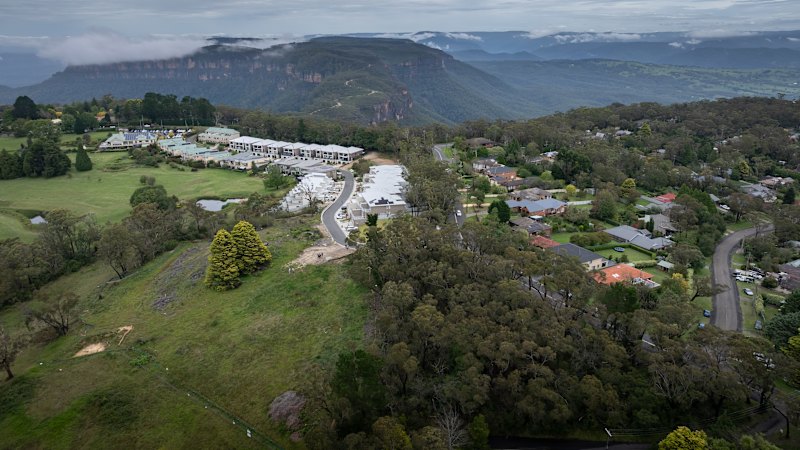
The land, which is located on the former golf course, is three kilometres from the Katoomba town centre and atop a steep slope. The vacant site consists of bushland and more than 1 hectare of cleared land.
In its April council meeting, Blue Mountains mayor Mark Greenhill asked Will Langevad, the council’s director of environment and planning services, when was the bushfire-prone land certification removed from the Narrow Neck Road site.
“When the application was lodged with the Housing Delivery Authority, the land was bushfire-prone,” Langevad told the meeting. “When the Housing Delivery Authority considered the application, it was bushfire-prone. That’s significant because bushfire-prone land is an exclusion, which means it can’t go through the HDA process.
“The land was bushfire-prone when the minister declared the site and the proposal to be a state-significant development. The minister [Paul Scully] understood that the land was bushfire-prone when he made his decision. One day after that decision was made, the RFS amended the plan to remove the bushfire-prone land status.”
Bushfire-prone land is land that has been identified by the local council as subject to a bushfire attack. Maps of bushfire-prone land are prepared by councils and certified by the commissioner of the NSW Rural Fire Service.
What the RFS says
A NSW Rural Fire Service spokesperson said the change in bushfire classification was not related to the development application.
“The process to update the bushfire-prone land map commenced in mid-2024,” they said. “Multiple rounds of review were undertaken between the RFS and the Blue Mountains City Council before being certified on 14 May 2025.
“The subject site is not currently mapped as bushfire-prone land and, as such, development on the site is not required to comply with Planning for Bush Fire Protection.”
The proposed development
It is the first and only housing development proposal in the Blue Mountains to be assessed under the HDA fast-track pathway.
The site was purchased by developer VDM Prime in 2021 for $3.85 million and plans were submitted in 2025 to build nine buildings up to five storeys high, comprising 218 dwellings, commercial spaces and a restaurant. It would also feature 52 serviced apartments, which typically allow for short or long-term stay.
In its submission on the plans, the council said the site continues to adjoin bushfire-prone land and that the proposed development would “put hundreds of people at risk”.
Certain major housing proposals are considered by the HDA for a state significant development assessment pathway against criteria, including potential environmental constraints such as bushfire risk. The authority then makes a recommendation to the minister.
The Minister for Planning and Public Spaces Paul Scully did not respond to the Herald’s questions on why he declared the proposal as a state significant development at a time when the land was still classified as bushfire-prone.
In a statement, he said the proposal will be subject to a rigorous merit assessment that considers bushfire risk and includes consultation with the Rural Fire Service, the council and the community.
“The safety of the community is paramount, and no proposal will be approved unless it meets the required planning and safety standards,” Scully said.
The expert’s view
Former Fire and Rescue NSW commissioner Greg Mullins, who served in the role for 17 years, said he understands the need to build more homes, but said they shouldn’t be built in places prone to catastrophic fires.
“The huge worry for any fire in the Blue Mountains, and I’ve fought every single one of them since the 1977 fires, is evacuation. People panic where they should probably stay in place, you can’t convince them to do it, so they clog the highways [and] it stops fire trucks getting in,” he said.
“[The NSW government is] increasing that evacuation load … and it is a part of Australia where bushfire safety needs to be the No.1 consideration – not having more homes for people.”
 Ellie Busby is a Parramatta reporter at The Sydney Morning Herald.Connect via X or email.
From our partners
Read the full article here