




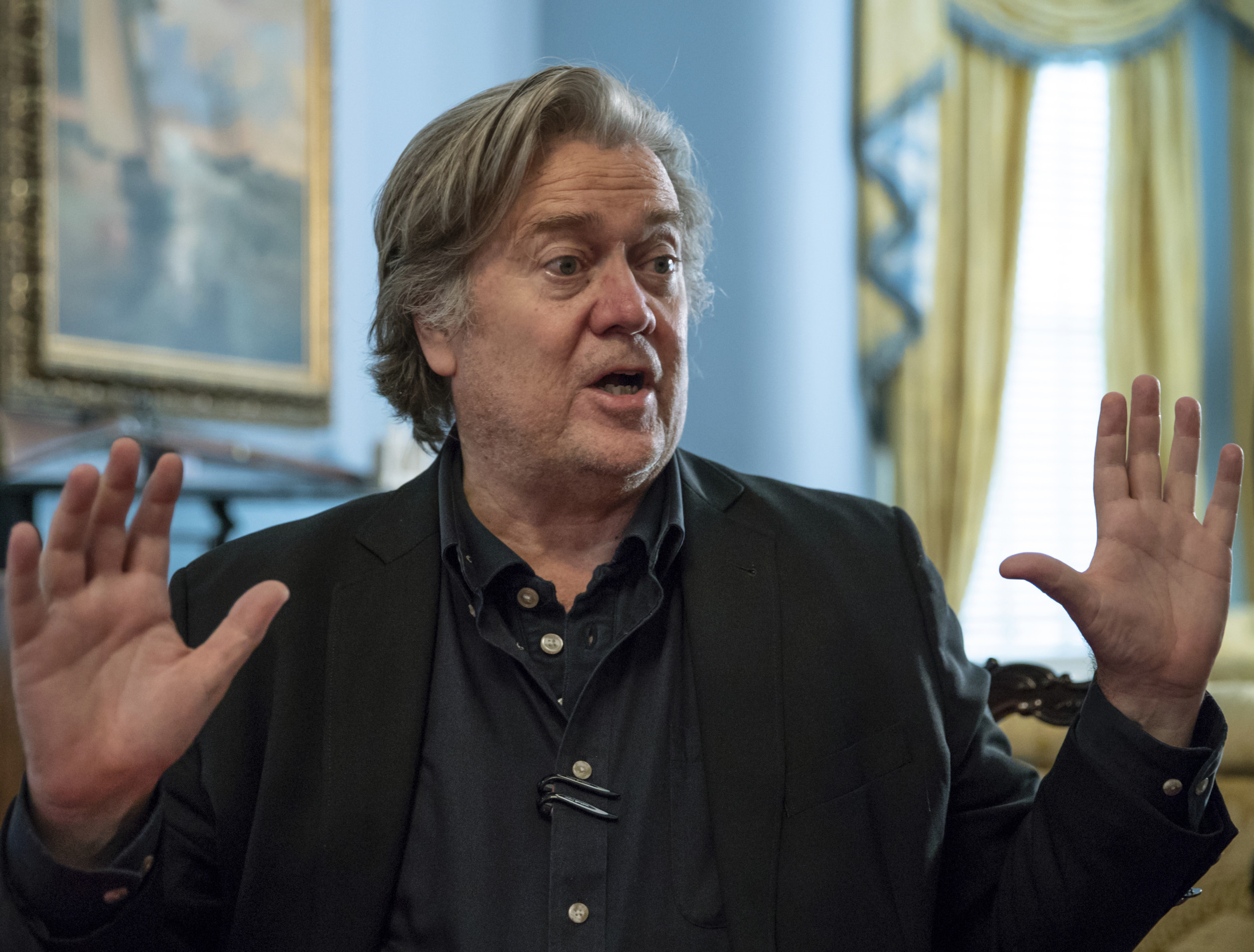
Former White House chief strategist Steve Bannon has admitted he is “very upset” over President Donald Trump’s budget package, which has been dubbed the “big, beautiful bill.”
“I have not changed my mind one bit on this bill. This bill could be a lot better,” Bannon said on his War Room podcast this week. “I’m very concerned about the deficits in the short term…and I’m very upset.”
Why It Matters
During Trump’s first term, Bannon was one of the president’s closest allies. However, he has since been critical of the president.
The legislation’s core feature is a massive extension of the 2017 Trump-era tax cuts. It permanently reduces taxes for individuals and corporations, increases the standard deduction, temporarily raises the child tax credit, and introduces new tax-exempt categories like tips and overtime.
The more than 1,000-page bill passed 215-214 in the House on Thursday following days of negotiations. Republicans Thomas Massie of Kentucky and Warren Davidson of Ohio voted against it, joining every House Democrat.
What To Know
On his podcast this week, Bannon voiced dissatisfaction with Trump’s new legislation, particularly over fiscal concerns. However, he acknowledged that the “big, beautiful bill” may be the best conservatives can expect amid infighting within the Republican Party.
“Given the totality of President Trump’s program, it’s the best you’re going to get for right now,” Bannon said.
Nonetheless, Bannon criticized key elements of the bill, saying “defense spending is too much” and that Social Security taxes in the proposal are “not acceptable.” He added, “You’ve got to increase the taxes. Or not give the tax cut to the wealthy—not for right now, just can’t happen.”
Although he disagreed with aspects of the legislation, Bannon defended the broader economic vision behind it, urging conservatives to “go on offense” and promote the package, especially to the “global capital markets,” which he claimed “don’t understand it.”
He insisted that “President Trump’s proved in the past that his tax cuts drive growth.”
The bill also includes a targeted tax break for seniors receiving Social Security. Specifically, the bill provides a new $4,000 deduction for individuals aged 65 and older, designed to reduce the taxable portion of their Social Security benefits.
It raises the SALT deduction cap for middle-income households, including measures like a 3.5 percent tax on remittances and greater scrutiny of nonprofits.
Regarding health care and social programs, the bill introduces work requirements and cost-sharing measures for Medicaid recipients and tightens eligibility and funding rules for SNAP. It also bans federal Medicaid funds from being used for gender-affirming care and further restricts abortion-related spending.
National defense and border security will also see significant boosts: the bill authorizes an additional $150 billion for military spending and $70 billion for border enforcement, including over $46 billion for new wall construction and high-tech surveillance.
Meanwhile, the legislation also includes a $4 trillion debt ceiling increase, which, according to budget analysts, is expected to add roughly $3.8 trillion to the national debt over the next decade.
The bill, which overall includes about $4.9 trillion in tax breaks, was passed after weeks of negotiations and talks with Republicans, some of whom were concerned about constituents losing critical benefits and others who called for further budget cuts. Fiscal conservatives and deficit hawks have also criticized the bill for its combination of increased spending and tax cuts.
But the unease surrounding the package is not just present among Republican members of Congress; it is also threatening to spill over into the wider MAGA movement.
Bannon has been a critic of the bill on multiple occasions, arguing that it spends too much and adds too much to the deficit, previously saying, “the math simply doesn’t work.”
He has also argued that the Medicaid cuts will harm Trump’s base. “MAGA’s on Medicaid because there’s not great jobs in this country,” he said on his podcast.
Bannon, once a central figure in Trump’s political rise, has repeatedly criticized Trump over the years.
In Michael Wolff’s 2018 book Fire and Fury, Bannon described a 2016 Trump Tower meeting between Donald Trump Jr. and Russian officials as “treasonous” and “unpatriotic.” This led to a public fallout, with Trump stating that Bannon had “lost his mind.” Bannon later expressed regret, clarifying that his comments were directed at Paul Manafort, not the president’s son.
And according to Jonathan Lemire’s book The Big Lie, published in 2022, Bannon allegedly told aides that “Trump would say anything, he would lie about anything,” suggesting that Trump lies “to win whatever exchange he [is] having at that moment.”
A spokesperson for Bannon disputed the accuracy of these claims.
More recently, in an interview with NPR, Bannon expressed skepticism about Trump’s relationships with tech moguls like Elon Musk, Jeff Bezos, and Mark Zuckerberg. He warned that these “tech oligarchs” might influence Trump’s policies in ways that could undermine the populist movement.
He also condemned the Trump administration’s approval of over 135,000 H-1B visas, labeling it “outrageous.” He argued that the influx of foreign workers exacerbates challenges for American tech professionals during economic uncertainty.
What People Are Saying
Steve Bannon said on his podcast: “By the way, people say, hey, with Steve, I have not changed my mind one bit on this bill. This bill could be a lot better. I’m very concerned about the deficits in the short term, but given the totality of President Trump’s program, it’s the best you’re going to get for right now. And I’m very upset.
“I think defense spending is too much. I think that the social security taxes are not, you know, not acceptable, but it’s going to go to the Senate. Then there’s a conference and we’ve got more time to work on this. I do believe, and I stand by this, you’ve got to increase the taxes. Or not give the tax cut to the wealthy, not for right now, just can’t happen.
“And I understand some of these things are not popular and they’re not popular in the White House, but that’s just the reasonable people can disagree. However, I’m the biggest proponent of pushing out the totality of the package, including the tariff revenue, including what the growth rate is.
“They can be backed up because President Trump’s proved in the past that his tax cuts drive growth. We gotta get that entire package and we have to go on offense to be able to sell this, not to the media, and not even politically right now, to the global capital markets, because they don’t understand it. It’s quite evident they don’t understand it, and they get a vote.”
What Happens Next
Trump’s sweeping budget package will now move to the Senate after narrowly passing in the House early Thursday morning.
Some Senate Republicans have already expressed skepticism about the bill’s provisions. Senator Ron Johnson of Wisconsin referred to the House budget plan as a “sad joke,” while Senator Rand Paul of Kentucky criticized the spending cuts as “wimpy” and “anemic.”
Read the full article here