



One morning this summer, a 9-year-old girl from El Salvador picked through colorful markers at a Houston-area shelter for migrant children and crafted a letter to her mom.
“I want to be with you already,” the little girl, M.R., wrote in misspelled, unpunctuated Spanish, adding hearts, a rainbow, and a large “I love you” surrounded by pink and blue dots. “I miss you a lot, mami I love you a lot mami I want to be with you.”
The girl had begged to leave the government-run shelter where she had been held for more than seven months, an attorney for the child said. She’d become distraught, telling her mom on the phone that she felt sad and lonely, that she desperately wanted a hug, that she was getting nosebleeds and thought she had an infection.
Meanwhile, as her mother, Carmen, was going through the process to regain custody, federal immigration officials instead arrested her, sending her to a Louisiana detention center though she had a pending asylum case and no criminal record.
“Both of us are trapped,” Carmen said in a September interview from the detention center. “She’s just a helpless little girl. The process shouldn’t be like this.”
KFF Health News is using only the mother’s first name and daughter’s initials, because they fear government reprisal for sharing their story.
As of September, the 9-year-old was among almost 1,900 children being held at shelters overseen by the Department of Health and Human Services’ Office of Refugee Resettlement, which was tasked by Congress over a decade ago with looking after unaccompanied children to separate their care from immigration enforcement.
Instead, the second Trump administration has reconfigured the resettlement office to aid its deportation campaign. This includes holding children rather than reuniting them with family in the United States, and often using them to ensnare family members, according to interviews with families, lawyers, and child advocates, as well as reviews of court documents. Many children in the office’s care are fleeing violence or abuse in their home countries.
Previously, the resettlement office attempted to prioritize the well-being of children in its care, said Jonathan White, a former federal health official who ran the office’s unaccompanied children program for part of President Trump’s first term. The office is legally required to place children “in the least restrictive setting” and release them “without unnecessary delay,” usually to a vetted parent or other family member who is willing to care for them.
Now children in the office’s custody have become collateral damage as the administration seeks to advance its larger immigration policy goals, said White, a licensed clinical social worker. He said the administration is deliberately reshaping the nation’s shelter system for unaccompanied minors from a child welfare program into a detention program that encourages immigrants to leave the country.
Although fewer kids are now held in the office’s shelters than in past years, those who remain often find themselves trapped for months with no clear way out other than to enter long-term foster care or return to the dangerous conditions they fled, attorneys said. That’s because their potential guardians get detained themselves or are afraid or unable to complete the sponsorship process. Often, attorneys said, the office refuses to release the children even when sponsorship requirements are met, and they have to sue for the kids’ release.
“When a child sees no way out of detention, voluntary departure may no longer feel like a real choice,” U.S. Rep. Andrea Salinas (D-Ore.) said during an Oct. 1 news conference calling attention to the administration’s changes to the unaccompanied children program.
The Department of Homeland Security did not directly answer questions sent by KFF Health News but framed detentions of migrant children’s sponsors by Immigration and Customs Enforcement as part of an effort to prevent kids from being harmed. A federal watchdog in 2024 found that the resettlement office didn’t properly screen sponsors amid a surge of unaccompanied children during President Joe Biden’s term, and news reports have documented incidents of children being exploited after their release from the agency’s custody.
In an unsigned email, DHS reiterated previous statements that “ICE does not separate families” and that the administration is working to locate 450,000 unaccompanied children that came during the Biden administration. It said many of the children were placed with unvetted sponsors who were smugglers and sex traffickers, a claim that has been disputed. It provided a list of 16 cases in which sponsors were arrested in connection with serious crimes, including the rape of an unaccompanied child, drug trafficking, and homicide.
KFF Health News also sent questions to HHS about the case and the resettlement office’s treatment of unaccompanied minors. The agency did not respond.
From child welfare to detention
M.R. spent about two weeks traveling to the U.S. late last year with her older sister, wading across the Rio Grande before being detained by Border Patrol officers in Texas, according to case documents. The sisters hoped to join their mother and a brother who had fled El Salvador a few years earlier and were living in Tennessee. Gang members murdered M.R.’s father, her uncle, and a pregnant cousin, according to Carmen, who feared for her daughter’s safety, too. M.R.’s maternal grandmother in El Salvador hit her and her sister with a belt and open hand while caring for them, M.R. later told a social worker.
Like others arriving in the U.S. alone and without legal status, the girl and her older sister landed in a shelter thinking they would be out in days. Before Mr. Trump’s second term, children typically waited in the resettlement office’s custody for about a month while federal officials screened their relatives or other sponsors. M.R.’s brother, who arrived in the U.S. in 2024, said he stayed in a shelter for 11 days.
The second Trump administration is arresting parents and other trusted caregivers who have come forward to get children released, has created onerous new requirements for sponsors, and has installed a former immigration official with experience in law enforcement as the head of the resettlement office. Average stays stretched to nearly six months, with some like M.R. staying much longer, even when they have qualified sponsors.
Alvaro Huerta of the Immigrant Defenders Law Center said during a July news briefing that a 3-year-old remained in the resettlement office’s custody for 300 days. A 6-year-old girl remained in custody for seven months, Huerta said, after her father was detained while being vetted as a sponsor and then deported. When the mother arrived at an appointment in March to reunite with the girl, he said, they were sent together to an immigration detention center in Dilley, Texas, that has drawn criticism from Democratic lawmakers, advocates, and families who have reported inhumane conditions.
Immigration lawyers say the administration has undermined legal protections for migrant kids while simultaneously fast-tracking deportation. Children, including some as young as 1, are appearing before immigration judges alone because of administration disruptions to legal services.
In some cases, immigration officials are detaining kids after they have been placed with sponsors and are already living in their communities. The administration has also offered children, including M.R., payments of at least $2,500 if they agree to return to their home countries voluntarily.
M.R.’s sister was released when she turned 18, three weeks after her arrival. Courts have blocked the Trump administration’s attempts to transfer to immigration detention people who turn 18 while in the resettlement office’s custody. That left young M.R. on her own in a new country, without her mom, her twin older siblings, or other close family.
Family separation
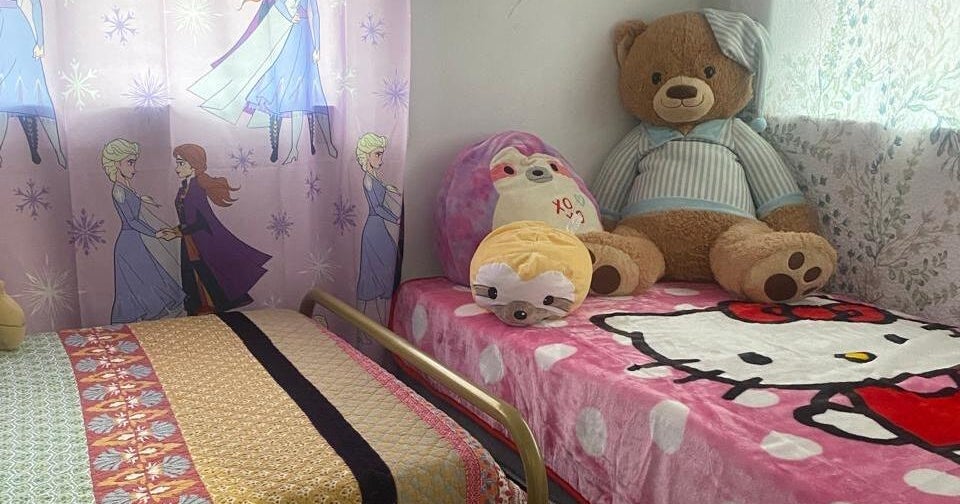
In April, Carmen went to a DNA test appointment, which she was told was the last step she needed to secure her daughter’s release. KFF Health News reviewed a text confirming the appointment at a DHS office. She thought she would soon be reunited with her youngest child. By then she had already presented her tax and salary information, submitted fingerprints, and been visited at home by a social worker. She and her teens prepared the little girl’s bedroom, adorning it with a Hello Kitty bed cover, “Frozen” curtains, and a lamp that projects stars and astronauts on the ceiling. They showed it to M.R. on a video call. She was excited, her brother said.
Without a warrant, immigration officers detained Carmen at the appointment. The resettlement office subsequently rejected her sponsorship application, citing the detention it had helped facilitate.
The girl was crushed.
“She doesn’t have an understanding of why she’s stuck there and why the government would detain her mom instead of reuniting them,” said Alexa Sendukas, managing attorney with the Galveston-Houston Immigrant Representation Project, which is representing the girl. “Our government has completely failed them and has treated them in a way no human being should ever be treated.”
DHS declined to comment on a description of the case of Carmen and her daughter. The agency said it could comment only if it had the names, dates of birth, and noncitizen identification numbers of the people involved.
“When the media refuses to give names, it makes it impossible to provide details on specific cases or even verify any of this even happened or that the people even exist. If you can’t do your job, we can’t do ours,” the agency’s press office responded, without providing the name of a spokesperson as requested.
Reports from the Houston-area shelter show that the girl received counseling. She was not diagnosed with any mental health conditions, though the therapist reported she was sad and cried while discussing her long shelter stay and missing her mom.
Carmen, who talked to her daughter on the phone about three times a week, said the child was struggling. The girl blamed herself, Sendukas said.
Every phone call, M.R. would ask her mom when she’d be released and when they’d be together again. She complained of feeling unwell. She lamented having no one to hug or comfort her, despite all the bad news she’d received, her mom said.
“I felt like the worst mother in the world, because I couldn’t explain to my daughter what was happening, what they’d done to me,” Carmen said.
Situations like M.R.’s are indicative of the resettlement office’s shift to prioritizing immigration enforcement over children’s well-being, White said.
“There is no scenario ever where it’s in the best interest of the child to tell them you’re going to release them to their mom, and prepare them for that, and then use their planned unification as a pretext to apprehend the mom,” he said.
Sural Shah, part of a team of physicians with the American Academy of Pediatrics who have visited several shelters for migrant children over the past year, said many are developing mental illnesses due to prolonged shelter stays.
“It’s heartbreaking,” Shah said, adding that kids are exhibiting anxiety, depression, and stress disorders, leading them to regress developmentally, act out, and harm themselves. Some wet their beds, experience chest pains, or cry out at night. Being stuck in a shelter for months can have long-term health effects like post-traumatic stress disorder, she added.
Some distressed children have also attempted suicide, said Mickey Donovan-Kaloust, legal services director at the Immigrant Defenders Law Center, which has offices across Southern California.
A teenage brother and sister from Venezuela who spent more than a year in a different federal shelter in Texas told KFF Health News that during their stay, they barely left the building and had to follow a rigid routine. The academic lessons they received at the shelter repeated every month, they said, and meals were the same each week. They also complained that they got reprimanded for small things like laughing too loud or having water fights.
When their father was detained during his sponsorship process, the girl stopped eating for days, she said. She showed symptoms of PTSD.
The boy said the experience wore him down mentally and emotionally.
“I was a broken kid,” he said. “I didn’t know whether to laugh when I got bad news, I didn’t know whether to cry.”
An excruciating choice
In detention, Carmen received a deportation order and faced an unthinkable choice: leave her youngest child behind in long-term foster care or return to potentially deadly conditions in El Salvador together, leaving her teens in the United States. Although gang violence is down in the country, Carmen said the people who killed her family members and threatened to kill her are still active in her old neighborhood.
It’s the kind of choice that immigrant families across the country are facing daily, said Jennifer Podkul, chief of global policy and advocacy at Kids in Need of Defense, a nonprofit that represents kids in Office of Refugee Resettlement custody.
In July, Carmen decided she could no longer bear her youngest daughter’s distress. They asked to leave together.
The mom could have appealed her deportation order but was worried about the mental health toll, Sendukas said. Carmen said her daughter told her: “I don’t want to feel alone again like I did at Christmas, like I did on Mother’s Day, and for your birthday. All of those days I’ve felt so alone. I don’t want to go on like this.”
In mid-September, three weeks before her 10th birthday and 281 days after she arrived in the U.S., the daughter was sent with her mother to El Salvador.
The child’s older siblings remain in the U.S. fighting their own asylum cases without their mother. The brother dropped out of high school in Tennessee and, along with his twin sister, moved to live with a relative.
“I just hope other people understand that we’re all fighting for something,” he said. “We were fighting to be together. It wasn’t a dream that hurt anyone.”
Jazmin Orozco Rodriguez contributed to this report.
KFF Health News is a national newsroom that produces in-depth journalism about health issues and is one of the core operating programs at KFF — the independent source for health policy research, polling, and journalism.
Read the full article here