



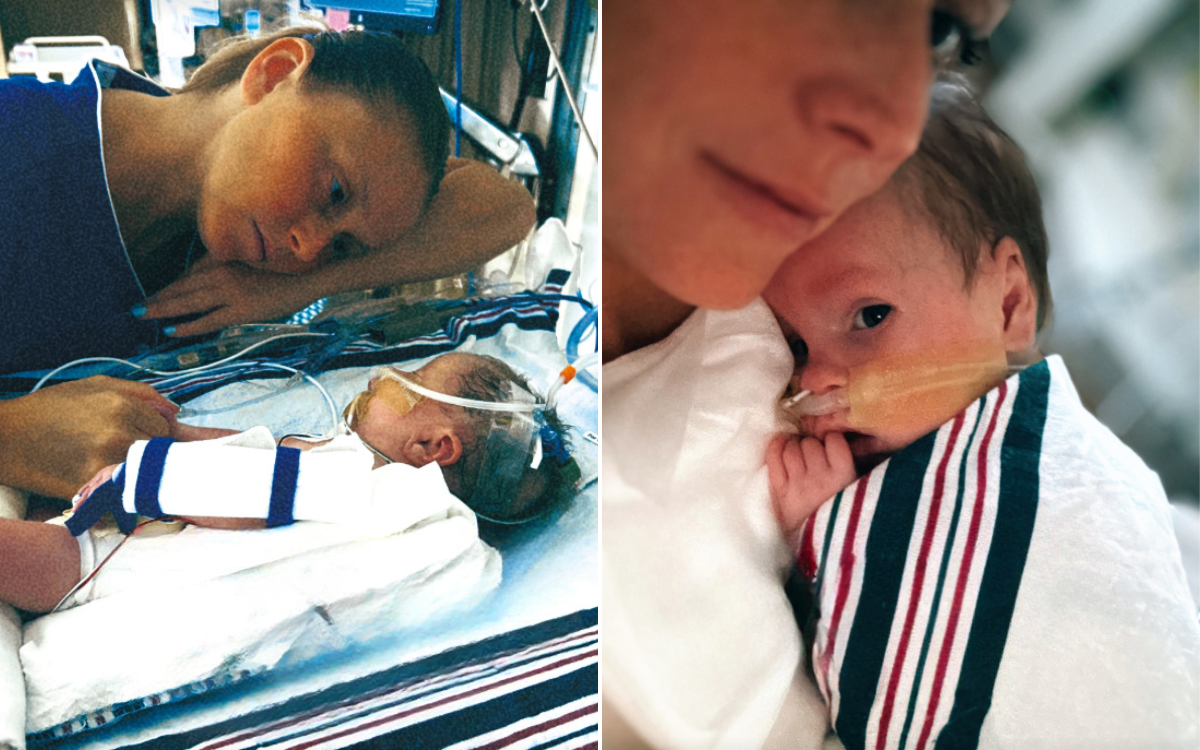
Looking back, Brooke Buckley says her pregnancy with her youngest son, Palmer, always “felt different.”
“Because I had already experienced a healthy pregnancy, I knew what movement was supposed to feel like at different stages,” Buckley told Newsweek. “I remembered the little flutters and movements that begin in the second trimester, so I was always confused about why this pregnancy felt so different. By my third trimester, I had a gut feeling that something was off.”
Doctors attributed her concerns to an anterior placenta and excess amniotic fluid. Non-invasive prenatal testing also showed no issues, but Buckley remained uneasy.
“I remember one obstetrician appointment where, after doing my own research, I tried to connect the excess fluid, breech position and lack of movement to a rare condition I had come across,” she said.
“I was told to stop Googling because something like that would be extremely rare and unlikely.”
There were other warning signs though. At Palmer’s 20-week anatomy scan, he was measuring small, and clinicians struggled to observe him swallowing. His heart rate also dropped several times during the appointment.
As her due date approached, Buckley recalls being reassured that Palmer was a “healthy baby” and no further monitoring was needed.
She remembers every detail of the day he was born. After a planned C-section, she expected the moment she’d seen in so many birth stories: doctors lifting her baby up to her to meet for the first time.
Instead, she watched her husband’s expression change as doctors rushed to assess Palmer.
Palmer had his umbilical cord wrapped around his neck several times, but the greater concern was that he wasn’t crying.
“He was very floppy and wasn’t breathing or swallowing on his own,” Buckley said. “They didn’t know why, but they immediately got to work trying to help him.”
As Palmer was taken from the room, Buckley was overcome with anxiety.
“I never got to see or hold him after he was born,” she said. “The only way I saw his face was through the pictures my husband had taken.”
In the days that followed, Buckley and her husband faced unimaginable questions, including whether they wanted to remove his life support.
At the same time, they were trying to understand a diagnosis they had never heard of: a rare mutation of the ACTA1 gene. According to a 2024 peer-reviewed study published in Human Mutation, ACTA1 mutations remain exceptionally rare, with only a few hundred pathogenic variants documented worldwide.
ACTA1 helps the body produce proteins needed for healthy muscle function. Palmer’s mutation causes profound muscle weakness throughout his body, affecting his ability to move, breathe and swallow. He relies on a ventilator for breathing, a tracheostomy to maintain his airway and a feeding tube for nutrition.
The condition affects skeletal muscle, not cognition, meaning Palmer can still learn, understand and interact with the world around him. What made his case especially rare is the specific genetic variant and the severity of symptoms from birth.
“The way his geneticists explained it to us was to imagine the gene like an alphabet,” Buckley said. “Palmer’s mutation occurred essentially right at the very beginning, which is why his presentation was considered among the most severe. We were also told that his exact variant had only been documented a couple of times before.”
ACTA1 mutations vary widely. Some children walk independently, while others require feeding tubes or respiratory support. Doctors initially warned that Palmer would likely never gain meaningful movement beyond infancy.
Yet at 2 years old, Palmer has defied expectations.
“We were told early on that he would likely never gain meaningful movement or strength beyond infancy, and yet he continues to get stronger, move more and do things we were told he may never be able to do,” Buckley said.
Despite the shock and heartbreak of those early days, Buckley recalls an overriding sense of “hope, and so much love for this tiny, helpless baby who was ours and who we would have done absolutely anything for.”
Any suggestion of removing Palmer’s life support was dismissed. Instead, he spent his first 120 days in hospital, including lengthy stays in the NICU and PICU, undergoing tests, procedures and therapies while his parents learned how to care for a medically complex child at home.
Supported by family, friends and their Christian faith, they persevered through the uncertainty.
“I was strong because I had no other choice but to keep putting one foot in front of the other, and because my strength came from God when I didn’t have enough of my own,” Buckley said.
Two years later, Buckley says the experience has left her family with an “unbreakable closeness.” While there is still no cure or gene therapy for Palmer’s condition, she remains hopeful about his future and the prospect of a happy, fulfilling life.
“Two years later, I can look at Palmer and see how much can exist on the other side of those terrifying first days: joy, growth, hope, laughter and a love greater than anything I could have imagined,” she said.
“You don’t have to figure out your child’s entire future today. Love the baby in front of you, take the next step, and let tomorrow come when it comes.”
Contact Newsweek editors on this story: Rebecca Flood and Emma Lee-Sang
Read the full article here