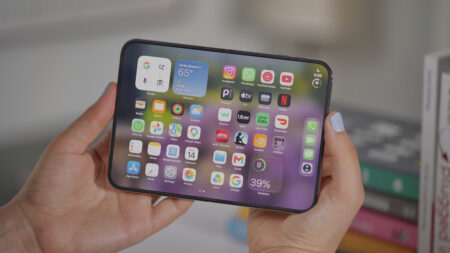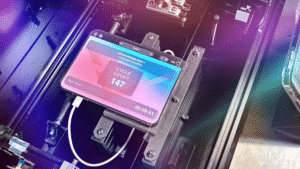



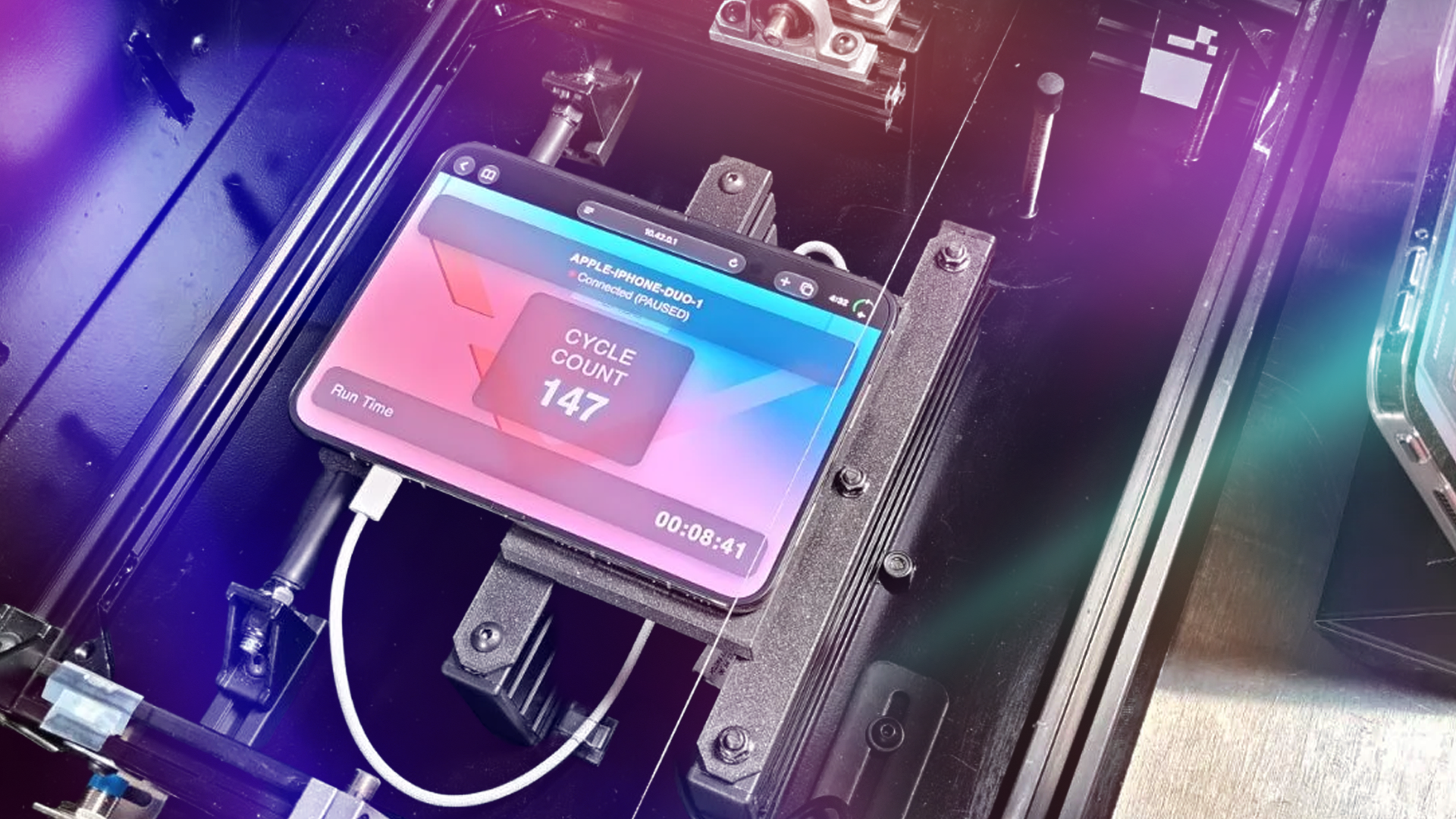
We want to know how many times you can fold an iPhone Duo before it breaks. After waiting over three hours at the Apple store on Friday, we bought one of the coveted iPhone Duo foldable phones in Louisville, Kentucky, and brought it back to CNET’s lab, a bespoke facility where I oversee hardware and software testing as the director of lab operations.
The goal is simple. As of Friday afternoon, my team and I have loaded the iPhone Duo into a proprietary machine we built to test foldable phones like Apple’s and Samsung’s rival Galaxy Fold 8, which we’ve already started testing. I’ve overseen the methodology and build of this testing rig for months in anticipation of Apple’s long-rumored foldable iPhone. (Read on for how CNET tests foldable phones.)
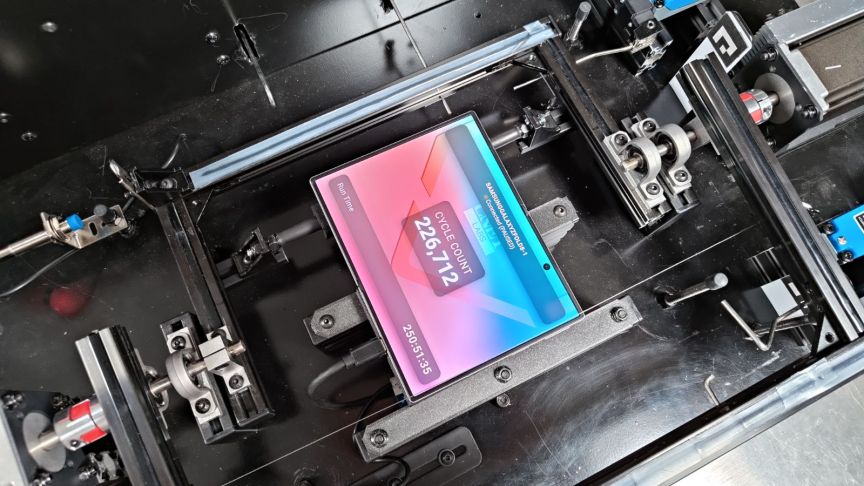
We even named our machine to match its purpose: Meet the Fold-a-Phone.
Now, my team of engineers and testing experts will watch the iPhone Duo open and close, open and close, to rigorously and systematically monitor the durability of Apple’s hinge and two screens.
After all, repeatedly folding a phone with bare hands can only get you so far in understanding the complex forces at play between the magnetics that snap the screen shut and the all-critical hinge.
CNET’s Senior Technology Reporter, Abrar Al-Heeti, has done a beautiful job capturing the iPhone Duo’s pros and cons in her smart, thorough review. Our Fold-a-Phone machine will add a deep data foundation to complement her real-world experience.
Since Apple hasn’t publicly shared claims of the iPhone Duo’s foldable lifespan, CNET’s Fold-a-Phone machine is poised to provide a wealth of valuable data about Apple’s first foldable phone and competing models in the foldable market.
And yes, you’d better believe we will use our treasure trove of in-house data to share status updates and comparisons during our ongoing testing window with the Duo.
Join CNET’s iPhone Duo livestream on YouTube on Monday from 1-5 p.m. ET, where you can follow along live and ask questions about our iPhone Duo testing process.
The importance of this moment is hard to overstate. Apple’s appearance on the foldable smartfold frontier lags Samsung by seven years (the first Galaxy Fold went on sale in the US in September 2019). Motorola and other phone-makers have long experimented with foldable phones in every shape and size, including a trifold accordion foldable phone we first demoed in 2019.
 Matthew Murray/CNET
CNET’s mobile experts, including Al-Heeti and Editor at Large Andrew Lanxon, have discussed the legitimizing effect of the iPhone Duo’s existence on the entire foldable phone landscape, which has previously felt like a new-wave fantasy rather than a mainstream riptide.
In many ways, Apple’s newfound competition with existing foldable phones completes the portfolio. That is precisely why we’re building the Fold-a-Phone now, and why our proprietary machine, methodology and test data will enrich our collective understanding of the capabilities – and yes, limitations – of foldable phones as our true next-generation mobile device.
How CNET’s Fold-a-Phone tests foldable phones like the iPhone Duo
Most current foldable phones are rated for 200,000 to 500,000 folds. As such, we knew we needed to create a robust and adaptable machine that could accommodate book- and flip-style foldable phones of any size, dimension and hinge orientation. (Note: The Fold-a-Phone was not built for trifold phones, which present a unique element to the engineering challenge.)
Moreover, we wanted to test the phone the way people would actually use it. No one just sits around opening and closing their foldable phone at top speed all day. Rather, you open it naturally, spend a few minutes watching a video, browsing a web page, or using an app, close it, and then put it in your pocket. This may happen dozens of times per day.
Mimicking this usage on the Fold-a-Phone limits undue stress on the phone hinge and avoids generating excess heat compared to a test built for speed.
We determined that a cadence of roughly 4 seconds could sidestep technical hurdles while also being reasonably fast. The foldable phone takes 1 second to open, 1 second to fully open, 1 second to close and 1 second to fully close. This cycle counts as a single completed fold. Then, the cycle repeats until either the hinge or the screen gives out.
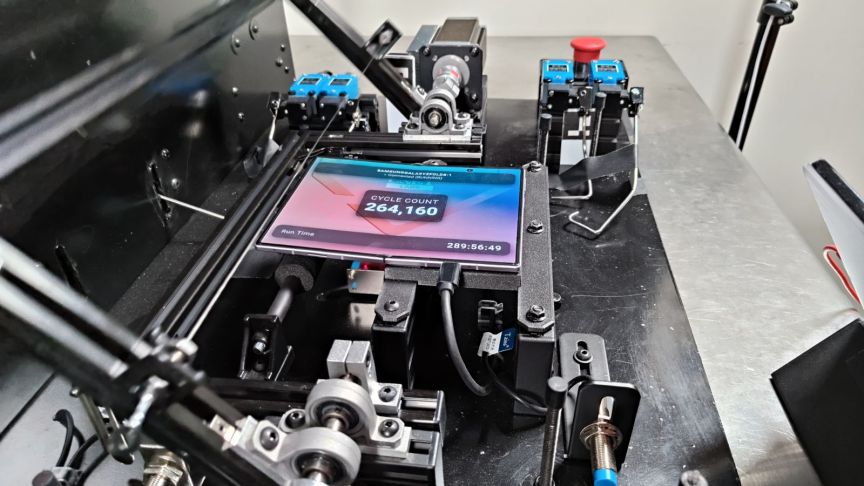
In conceptualizing and building the Fold-a-Phone, our team has used standard, off-the-shelf components to simplify the machine’s development. The essential design consists of two armatures, distinctly designed to perform the opening and closing movements with both force and grace.
 Matthew Murray/CNET
An industrial-grade stepper motor drives each armature, with the host software (running on a connected computer) deterministically adjusting the torque to complete each step of the process while also protecting the phone. If any of the several proximity sensors fail to detect the armature in the correct position, the machine stops immediately.
We also monitor the motors’ power usage to track how well the foldable phone opens and closes over time. We have set up cameras to capture images and video of the test from multiple angles, and we will analyze regular status updates from the computer to determine the current status of the phone and the test.
To ensure we never miss a major development, the entire rig is connected to an EcoFlow Delta 3 Plus power station to guard against electricity outages, and all the output data is saved to multiple locations.
To secure each phone to the machine, we use our CNET Lab Test-winning 3D printer, the Prusa Core One, to 3D-print a custom “sled” that matches each phone’s exact dimensions. We secure the phone to the sled with heavy-duty double-sided tape (yes, it works!) and then screw the sled onto the machine.
There’s always room for improvement. We’re constantly looking for ways to make the machine run more smoothly and quietly without disrupting the folding rhythm.
Apple’s presence is already changing the game and could very well spur innovation in ways we can’t predict today. But until then, our Fold-a-Phone machine will continue to test the iPhone Duo and its competitors, and CNET’s writers will report on how well these individual hinged devices stand up to the challenge – or fold under pressure.

See full bio
Read the full article here