



It’s that time of year: spring is on our doorstep, the jacarandas are about to bloom shades of purple and green leaves are unfurling across the city.
But new tree growth can cause problems, especially when prized views of the Brisbane River or the city skyline are obstructed.
Clashes over trees in Brisbane’s suburbs are not an unusual occurrence. Each year, there are thousands of disputes between neighbours over imposing trees, encroaching roots, overhanging branches and leaf litter.
Some disputes span years, costing thousands of dollars in experts’ reports and legal fees.
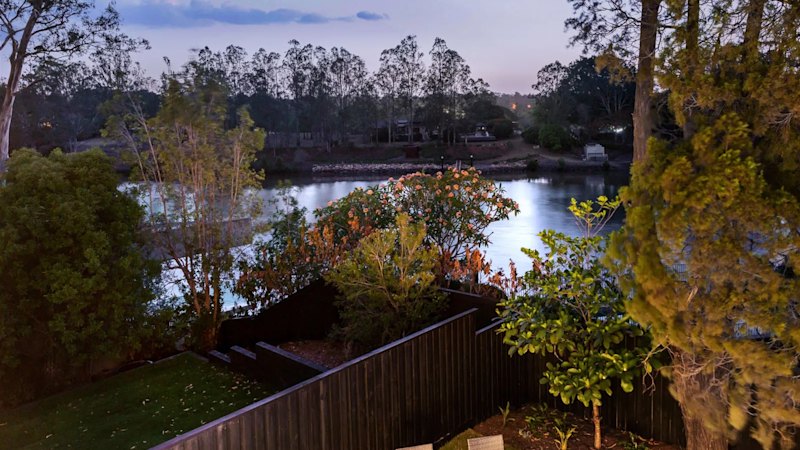
Prominent Brisbane oral and maxillofacial surgeon John Arvier and his wife Louise have been embroiled in a years-long dispute with their neighbours over a number of weeping lilly pillies (Waterhousea floribunda) they planted on the side boundary of their riverfront Graceville property in Brisbane’s west.
The Arviers’ neighbours, Angus and Alissa McDougall, argue the trees obstruct their view of the Brisbane River. The Arviers disagree, saying their neighbours’ view of the river was already restricted when they bought the house.
The neighbours are among hundreds of residents who end up in Queensland’s Civil and Administrative Tribunal each year, arguing over trees.
Over the past five years, 1224 tree dispute applications have been lodged with QCAT – an average of about 245 applications each year.
It takes an average of 98 weeks (nearly two years) for a dispute to be finalised, but many take much longer.
The McDougalls lodged their tree dispute application with QCAT in 2022, about two years after purchasing their $2 million Graceville home.
“It was a very slow process,” Angus McDougall said.
“This was a slow, frustrating process, particularly when you’re the one disadvantaged.”
Their property had a view, albeit a limited one, of the Brisbane River from an upstairs bedroom and balcony. It was a key factor in their decision to buy the house in 2019, QCAT heard.
At the time, the Arviers had knocked down their existing riverfront property and their new home was under construction. They later planted weeping lilly pillies along the boundary for privacy reasons.
Under the Neighbourhood Disputes (Dividing Fences and Trees) Act 2011, the McDougalls were required to demonstrate that the trees have a “substantial impact on their enjoyment and amenity of their views of the river that existed when they purchased their property in 2019”.
They succeeded.
In a decision published last week, QCAT said: “If the subject trees are allowed to grow to a height of above four or five metres up to six metres, as requested by [Louise] Arvier, then the subject trees would be a substantial, ongoing and unreasonable interference with the McDougalls’ view and their use and enjoyment of their property. The subject trees would be a severe obstruction of the view from the McDougalls’ balcony.”
It ruled the McDougalls’ river view could be returned, and the Arviers’ privacy concerns addressed, if the trees were trimmed to be no taller than 90 centimetres above the 2.1-metre-high fence line.
The Arviers declined to comment.
Bamboo can be a menace
This year, QCAT has already handed down at least four judgments about towering and intrusive bamboo.
Tarragindi couple Ian and Megan Brusensky were ordered to trim their bamboo hedge, which QCAT ruled was blocking sunlight to their neighbour’s bedrooms, solar panels and hot water system.
Kenmore resident Michelle Prior ultimately agreed to remove bamboo and trim golden palms, which the tribunal found were overhanging her neighbour’s newly built home and “housing spiders and partially blocking the sun”.
In Bundamba, Cody and Teleah Warwick were ordered to trim their bamboo screen, which their neighbours claimed shaded the verandah of their granny flat and obstructed their view of the horizon and a distant view of Mount Coot-tha.
On the Sunshine Coast, Sandie Lee claimed she had to vacate her Kawana Waters home because the neighbour’s bamboo hedge kept banging against her gutters, shaded her solar panels and leaned over her clothesline area.
Her neighbour, David Wallace, refused to pay for its removal, arguing that Lee’s gutters had been built just 25 millimetres from the boundary line.
Ultimately, QCAT ordered Wallace to trim the bamboo hedge to a height of 1.5 metres, or remove it entirely. He was also ordered to reimburse his neighbour $5260 for the cost of obtaining arborist and surveyor reports.
“There is close proximity between the applicant’s property and the boundary … [but it does not] mean that she is obliged to tolerate substantial, ongoing and unreasonable interference with her use and enjoyment of the land,” QCAT said.
Jan Paterson, president of the Queensland Arboricultural Association, said the location of a plant was generally more consequential than the species itself.
“Trees can become a surprisingly emotional issue because they cross boundaries, affect views and create ongoing maintenance concerns,” she said.
“A small planted tree can become a very large tree, and people don’t always consider its mature trunk, canopy size or root system and their proximity to hardscape and boundaries when planting …
“Planting the right tree in the right location helps avoid mischief into the future.”
Paterson said trade qualified and insured arborists should be engaged to help assess and provide advice on tree-related problems. Tree loppers are generally not trade qualified.
QCAT expects neighbours to make a “reasonable attempt” to resolve their dispute before taking legal action.
“Going to QCAT should be seen as a last resort,” a QCAT spokesman said.
But negotiating over the fence can be challenging.
In one case heard by QCAT this year, Pelican Waters resident Mark Cook asked his neighbour Thomas Simmons what he planned to do about golden cane palms he claimed were pushing over the fence and dropping palm fronds and seeds on his property, as well as attracting bats.
“On March 25, 2025, [Cook] was walking past the fence and saw Mr Simmons, and asked him, ‘What are you going to do about the palms?’ Mr Simmons’ response was, ‘Nothing!’
“He then said, ‘You don’t mind if I chop your palms on my side of the fence line?’
“Mr Simmons’ response was, ‘You touch my palms, I will have the police here immediately.’
“Unfortunately, the conversation declined into name calling from both sides.”
When discussions fail, or are not possible, often solicitors’ letters follow. If that proves futile, free mediation is available through Queensland Dispute Resolution Centres.
If that does not bring about a solution, property owners can take the matter to QCAT, which has had jurisdiction over tree disputes in Queensland since November 2011.
Before the QCAT hearing in May, Simmons cut back the golden palms on his side of the fence. “The closest remaining trunk was half a metre from the fence line,” QCAT said.
But it turned out Simmons had another problem.
“During the course of the hearing, it became apparent that [Cook] had discovered, through the use of a surveyor, that the dividing fence, which was constructed by [Simmons], had been mostly, if not entirely, built across the boundary onto [the wrong] land,” the judgment reads.
Start the day with a summary of the day’s most important and interesting stories, analysis and insights. Sign up for our Morning Edition newsletter.
From our partners
Read the full article here