




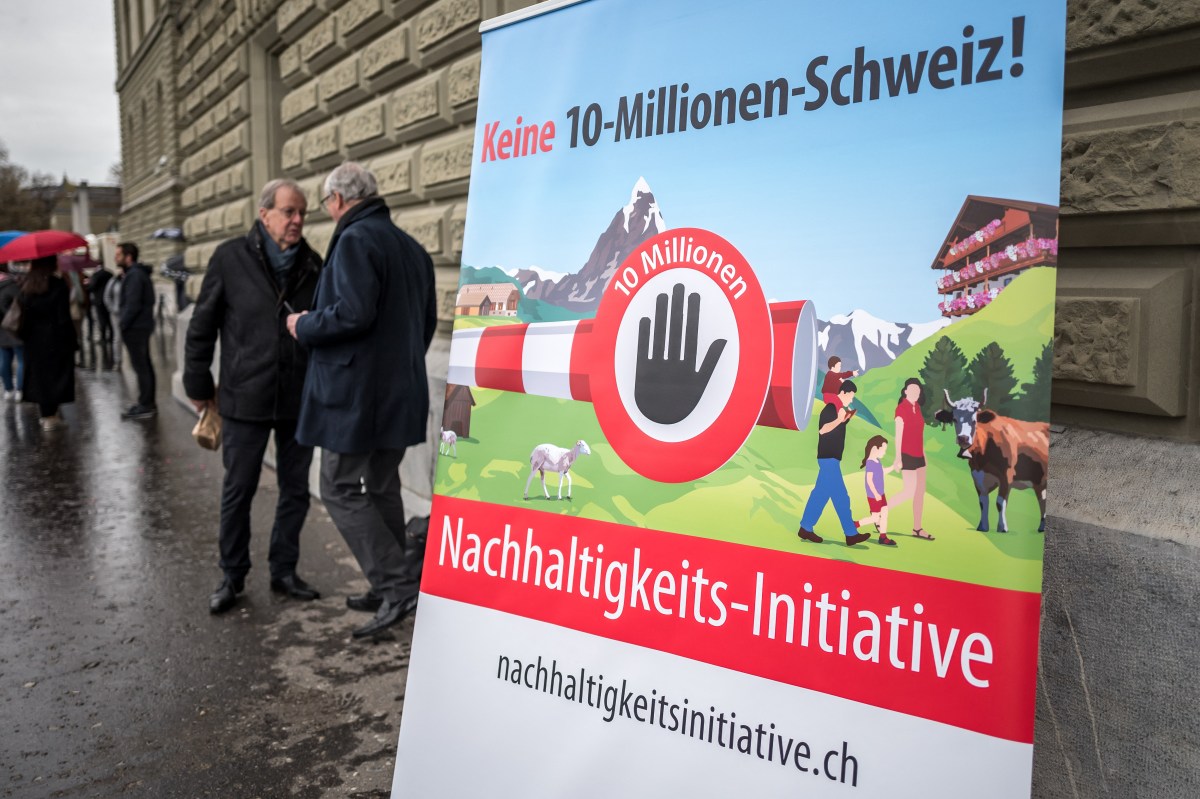
Swiss voters have rejected a proposal to cap the country’s population at 10 million, opting for economic certainty and close ties with Europe over a more radical attempt to curb growth and immigration.
The initiative, backed by the right-wing Swiss People’s Party (SVP), would have required the government to take measures—including potentially ending key agreements with the European Union—if Switzerland’s population exceeded 10 million before 2050.
Mirroring debates across the West, the SVP argued that rapid population growth was straining housing, infrastructure and public services.
But nearly 55 percent of Swiss people voted against the measure on Sunday, according to a preliminary tally of the nationwide referendum reported by Reuters, while 45 percent voted in favor.
Cloé Jans, a senior project manager at the Swiss public opinion research firm gfs.bern, told Newsweek this was because the measure was viewed as “too extreme.”
“While voters broadly share the underlying concerns about population growth, housing costs, and infrastructure strain—or even unconditional economic growth—a majority were not willing to accept the proposed solution,” she said.
She also said campaigners against the measure had successfully raised concerns about the risks the measure could pose to Switzerland’s economy and its relationship with Europe.
The Problem Resonated, the Proposal Didn’t.
While the proposal was ultimately defeated, nearly half of voters backed the measure, suggesting the concerns that drove the initiative remain politically potent even if the proposed solution did not win majority support.
Switzerland’s population has expanded by nearly 2 million people since 2002—from 7.3 million to more than 9 million in 2025—following the introduction of freer movement between Switzerland and the European Union (EU), according to the Federal Statistics Office.
The SVP had framed the initiative as a response to mounting pressure on housing and public services, while warning that continued population growth could undermine Switzerland’s cultural character and traditions.
Indeed, the 2025 UBS Worry Barometer, an annual nationwide survey that tracks Swiss voters’ top concerns, found that immigration was one of Swiss people’s top worries (30 percent), after health issues (50 percent) and the environment (31 percent).
“There is broad concern and even unease,” Jans said. “But the proposed solution was viewed as too extreme and simply not feasible.”
Jans said gfs.bern’s surveys repeatedly find that Swiss voters back close ties with the EU and the free movement of people, but they also want to retain control over who comes to the country and in what numbers.
“And yet there remains a deep instinct to retain sovereign control over who comes in and in what numbers, Jans said, adding that this is “specific to Swiss political culture,” which values direct democracy “at the very heart of national identity.”
Economic and EU Concerns Shifted the Debate
Jans said the campaign against the measure “successfully shifted the debate from everyday frustrations to the potential risks of accepting this proposal.”
The ‘No’ campaign united the Swiss government, most major political parties, business groups and unions, which warned that the proposal could damage the economy and jeopardize Switzerland’s ties with the EU.
Switzerland is not a member of the EU but relies on a series of bilateral agreements that give it access to parts of the bloc’s single market and allow for the free movement of people. Opponents argued the population cap could ultimately put those arrangements at risk.
“The potential threat to the bilateral agreements with the EU, the impact on the labour market and the healthcare system, and the rigidity of a hard population cap all moved to the center of the debate in the final weeks and proved more persuasive,” Jans said.
“Voters are broadly aware of the structural realities in our country,” she said, referring to Switzerland’s labor shortages in certain industries, including healthcare.
“Without skilled workers from abroad, our hospitals wouldn’t be able to function anymore,” Jans said. “Most Swiss people understand this.”
Foreign-trained doctors make up around 43 percent of all physicians working in Switzerland, according to the Swiss Medical Association’s 2025 report.
The vast majority of the 165,386 foreign nationals who moved to Switzerland last year migrated for employment, according to the Swiss State Secretariat for Migration (SEM)’s 2025 migration report. Two-thirds of them are coming from the EU/European Free Trade Association (EFTA).
Swiss people also did not want to risk their relationship with the EU, Jans said.
“In an uncertain world, a small country at the heart of Europe was ultimately not prepared to risk a rupture with the EU, in many ways our closest and most reliable ally,” she said. “For many voters, a flawed status quo was preferable to an unpredictable leap into the unknown.”
Read the full article here