


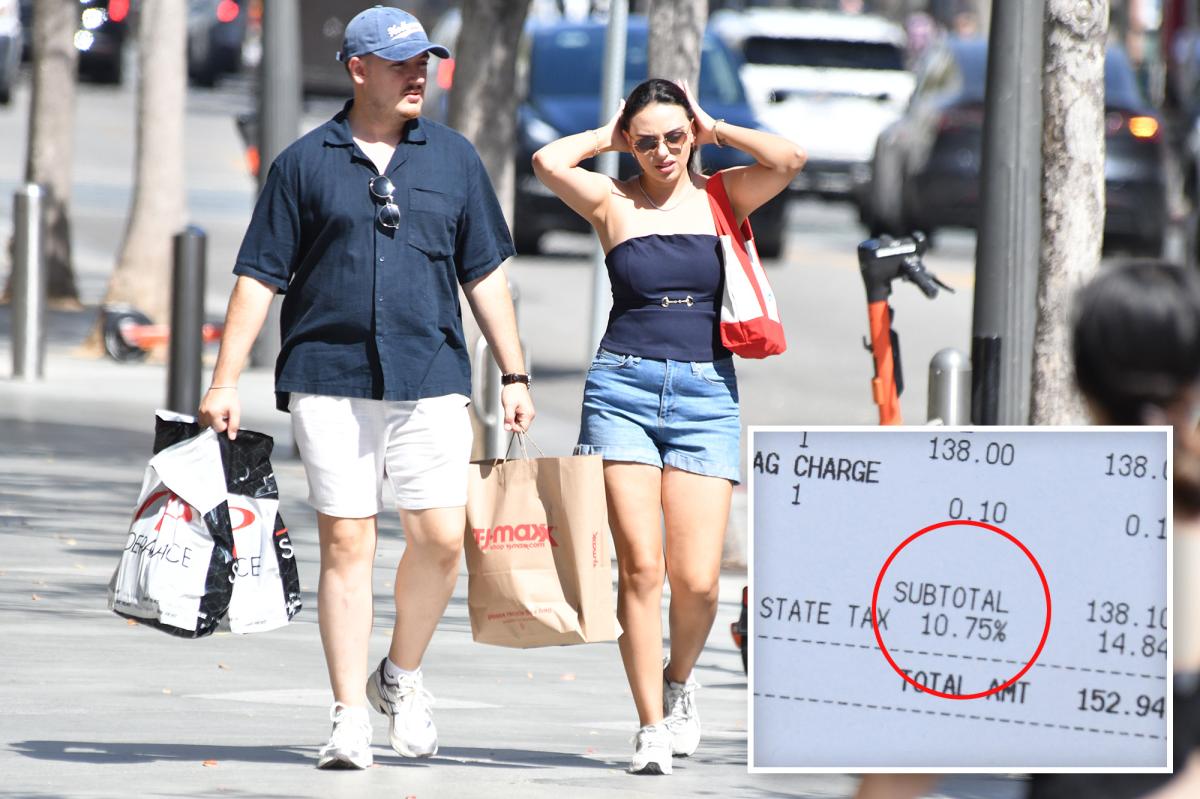
Angelenos started paying one of the biggest sales taxes in the country Thursday – costing some households up to an extra $1,000 a year.
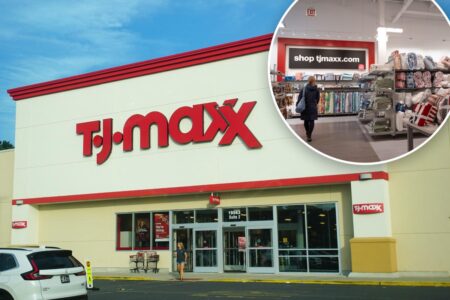
The hike pushes sales tax above 10% on everything from cellphones to cars and clothes to cosmetics, costing shoppers about $1 billion a year.
The countywide rate jumped from 9.75% to 10.25%, rising to 11% in West Hollywood and 11.25% in Santa Monica.
Shoppers in Palmdale are being hammered with an even higher 11.75% rate, believed to be the highest in America.
Critics say voters approved Measure ER – a half-percentage-point sales tax hike – believing the money would plug health care funding shortfalls, with the Los Angeles County Taxpayers Association saying the community had been “deceived” into supporting the measure.
The Democratic-controlled LA County Board of Supervisors put the measure on the June ballot – and it squeaked through by just 25,770 votes, with just over one million voting Yes, imposing the new tax across a county of about 10 million people.
LA County’s new sales tax hit cash registers Thursday, tacking an extra half-cent onto every taxable dollar Angelenos spend after a sneaky $10 million union campaign slammed as “deceitful.”
That’s 50 cents more on every $100 in taxable purchases and $5 more on every $1,000 – so a family that spends $100,000 a year will hand out an additional extra $500. Drive a $40,000 car off the lot, and the tax hike adds another $200.
The tax, which was billed as Measure ER when it was placed on the ballot, saw county leaders promise the money would keep hospitals and clinics “open after Washington slashed health care funding.”
The Democrat-controlled LA County Board of Supervisors, the five-member body that runs county government, put the measure on the ballot.
The board voted 4-1 to send the tax to voters, with Republican Supervisor Kathryn Barger the lone dissenter.
Measure ER squeaked through in June, 50.64% to 49.36% – just 25,770 votes separating the 1,013,747 who backed the measure from the 987,977 who opposed it.
The tax will suck roughly $1 billion a year out of shoppers’ pockets and about $5 billion before the measure finally expires in 2031.
Aidan Chao, chairman of the Los Angeles County Taxpayers Association, said Angelenos voted for Measure ER because of a glossy, deceptive nearly $10 million special-interest campaign backed by health care groups and organized labor.
“They deceived the community into thinking this was a medically focused measure that was all about beating Trump, when in fact it was a new tax that will never go away and will cost families from the low hundreds to $1,000 a year,” he told the California Post.
“It’s not a restrictive short-term health tax; it’s a broad, general forever tax,” he added.
“These taxes are never narrow and short-term; they never go away.”
Download The California Post App, follow us on social, and subscribe to our newsletters
California Post News: Facebook, Instagram, TikTok, X, YouTube, WhatsApp, LinkedIn
California Post Sports Facebook, Instagram, TikTok, YouTube, X
California Post Opinion
California Post Newsletters: Sign up here!
California Post App: Download here!
Home delivery: Sign up here!
Page Six Hollywood: Sign up here!
“This needs to be a wake-up call to Angelenos and Californians that they can’t continue to be bribed. They can’t be for sale.”
Measure ER has inflated the sales tax in cities like West Hollywood and Pasadena to 11% and Santa Monica to 11.25%, as each city already had additional local sales taxes.
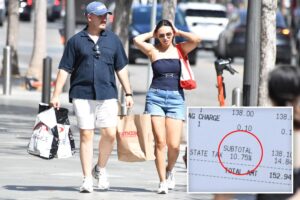
“I’d like to know more about where the taxes go. Obviously, I think everyone would like to know,” Nikita Levin, 27, who was shopping at the Third Street Promenade in Santa Monica on Thursday, told The Post.
For comparison, the sales tax rate is 7% in Miami, 8.25% in Austin and Houston, and just under 9% in New York City.
Restaurant meals get hit, too, while most groceries and prescription drugs are exempt.
Critics argue the tax hits lower-income residents the hardest because it eats up a larger share of smaller paychecks — one reason taxpayer groups and some local Democrats opposed it.
The increase is LA County’s second sales tax hike in less than two years.
Voters approved Measure A, a half-cent homelessness tax, in 2024, amid complaints from some smaller cities that they pay far more into the program than they get back.
Backers pitched Measure ER as a lifeline for hospitals and clinics battered by Medi-Cal funding cuts, with the ballot warning that the county’s four public hospitals could be at risk of closure.
But despite the pitch, there’s actually no requirement for the county to spend a dime of the money on health care.
The tax revenue flows into the county’s general fund, leaving supervisors free to spend it elsewhere.
This made Measure ER easier to pass because it only needed a simple majority, rather than requiring two-thirds of the vote if it was legally earmarked for health care — a threshold ER fell far short of.
Supervisors Holly Mitchell and Hilda Solis led the push for the tax, with Mitchell calling it a “last resort” as the county had already frozen hiring, cut overtime and dipped into emergency reserves.
Supervisor Kathryn Barger wasn’t buying it, warning there was “no certainty that the dollars will be spent as intended” and that residents are “already carrying one of the heaviest tax burdens” of any major region in the country.
Groups that could benefit from the money largely bankrolled the campaign. St. John’s Community Health, the nonprofit clinic network that spearheaded the push, contributed at least $4 million.
SEIU Local 721, which represents county workers, kicked in $200,000 and says the tax will protect thousands of members’ jobs.
The California Community Foundation added $200,000, while the Los Angeles County Medical Association’s political action committee contributed $50,000.
The Yes campaign ultimately raised about $9.7 million, while opponents raised less than $10,000.
Then, a day before the tax took effect, came a new challenge: The Libertarian Party of LA County, which advocates lower taxes and smaller government, sued to overturn it.
The lawsuit won’t stop shoppers from paying the higher tax, but it has frozen the county’s ability to spend the money while the legal fight plays out. The revenue must instead be held in escrow pending the outcome of the case.
Scott Meyers, a Republican running for Congress in California’s 30th District, which includes parts of LA County including Burbank, Glendale and the Hollywood Hills, blasted Measure ER as “yet another ballot proposition that was deceitfully advertised.”
“It was marketed as a promise of direct assistance to emergency rooms and emergency medical technicians. Instead, the taxes raised go directly into the County’s general fund. It’s yet another tax on money we’ve already been taxed on.”
“It appears most voters are more willing to surrender their earnings to government than to ever ask how their government is spending their money.”
Read the full article here