



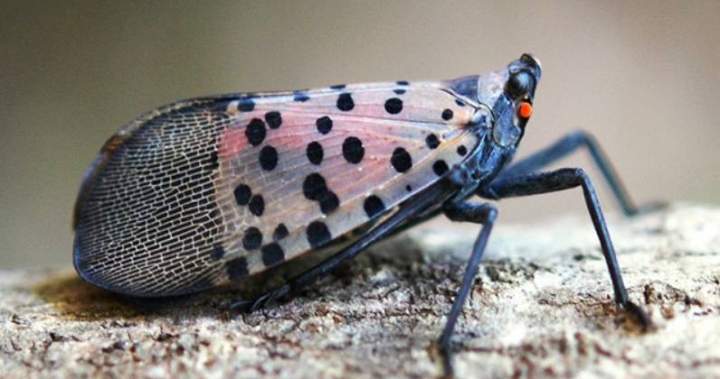
An invasive species of insect known as the spotted lanternfly has been confirmed in Canada, according to the Canadian Food Inspection Agency (CFIA), which is urging Canadians to take action if they spot it or its egg masses.
Although all previous documented reports of the spotted lanternfly in Canada have either been an unconfirmed “sighting” or “interception” (live or dead specimen collected), this announcement marks the first time the insect has fallen under the “detection” label, meaning confirmed alive in the Canadian environment through official CFIA surveys.
In a press release from Thursday, the CFIA says it confirmed its first detection of spotted lanternfly in Canada on Sept. 15 in Windsor, Ontario.
Spotted lanternflies feed on more than 100 species of trees and plants, the CFIA says, but the only significant agricultural impact observed so far has been on grapes.
This means wineries in Canada could be impacted if the infestation spreads to vineyards.
The CFIA says it is conducting surveillance in the area surrounding where the spotted lanternflies were spotted to determine the full extent of the infestation and what the next steps will be.
Spotted lanternflies have been regulated in Canada since 2018, and to help prevent further spread of the invasive species, the CFIA says restrictions have been put in place to stop movement of regulated materials like plants that could be infested.
The CFIA says, like with some other invasive species, there are many “human-assisted” ways the spotted lanternfly could have been introduced into Canada.
Those include movement on cargo and containers, camping gear and outdoor equipment, patio furniture, cars and trucks, and the movement of plants and plant materials.
It’s for these reasons the CFIA is urging Canadians to check any objects stored outside while travelling to infested areas, including vehicles, patio furniture, tarps, yard and garden items and sports equipment as they may find the insects or their egg masses. The agency suggests checking around yards as well because spotted lanternflies could be on trees and plants.
The CFIA also suggests that anyone travelling back from infested areas of the United Stated should check their car, camper, trailer or RV before making the return trip, as well as any camping gear or equipment before returning to Canada.
In order to more easily identify a spotted lanternfly or its egg masses, the CFIA suggests learning about its various life stages.

Get breaking National news
Get breaking Canada news delivered to your inbox as it happens so you won’t miss a trending story.
The spotted lanternfly lays egg masses during the late summer, and those egg masses can survive winter temperatures and hatch in the spring, the CFIA says.
If you see a spotted lanternfly or its egg masses, the CFIA says, “Spot it? Snap it, catch it and report it.”
Anyone who thinks they may have seen a spotted lanternfly or its egg masses should take a photo or video, the CFIA says.
Collecting a specimen is also advised, if possible, including catching an insect or scraping the egg masses and placing them in a sealable container.
Once all available photos, videos and specimens are gathered, those persons should submit a report immediately to the CFIA.
© 2026 Global News, a division of Corus Entertainment Inc.
Read the full article here