




The idea came to Neil Walshe in the neon-lit aisles of a pokies room on a night out with mates.
Watching the whir of symbols and numbers, Walshe, who recalls a brief curiosity with poker machines when he was 18, suddenly felt bewildered by the mechanics of the games.
“I realised that there’s no losing sounds,” he says.
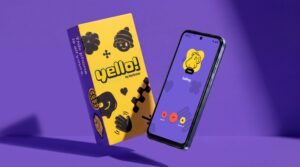
It gnawed at Walshe, an advertising creative director, so much so that he decided to create a poker machine with a distinct losing sound on every spin.
“If pokies machines actually played what’s going on, you’d know before you sat down that you’re probably going to lose money here,” he says.
More pokies than ATMs are in Australia, a country that loses between $13 billion and $16 billion every year on the machines.
NSW accounts for the bulk of those losses, with $9.3 billion gambled in that state last year. The latest data for Queensland shows $3.43 billion lost in 2023-24, from $39 billion spent.
Walshe is attuned to consumer behaviour through his line of work, but his stance on pokies is more than just a side quest into the human psyche.
About a decade ago, a relative lost $150,000 in a year gambling on the machines.
“It busted their family up, and it was devastating,” he says.
“I’ve been very angry at them for a long time, but now I start to see the evil in the machines rather than the people.”
Poker machines are curated to hook players, explains Monash University gambling policy researcher Charles Livingstone.
The combination of lights, sounds and colours stimulate the brain, conditioning it to associate winning with pleasure.
“In front of a machine, what you’re doing is subjecting yourself to a couple of types of ‘reinforcement’ … something that conditions your behaviour so that you become habituated,” he says.
“One is called operant conditioning, developed by B.F. Skinner in the 1950s. He discovered that if you reward an animal, including a human, with an intermittent, unpredictable reward in response to a certain task … they are much more consistent at the task.
“If you sit in front of a poker machine, you see exactly that happening to you.”
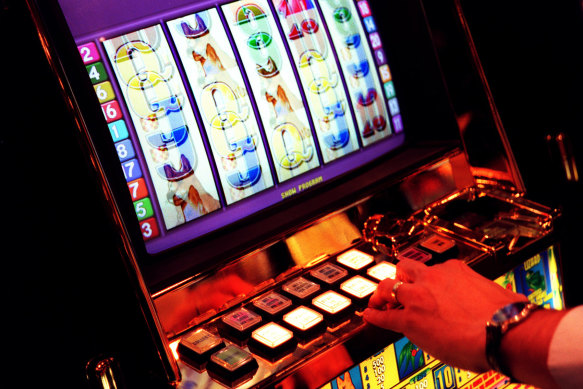
Livingstone says the visual and aural stimuli, alongside the promise of reward, affect the flow of neurochemicals into the brain.
“What these stimuli do on the poker machine is they stimulate the flow of dopamine. In well-designed slot machines … that flow of dopamine becomes effectively constant.
“That has the capacity to effectively addict you. You become very conditioned to keep doing this thing.”
To compose the losing sounds, Walshe partnered with sound designers from Rumble Studios, producing six options based on psychology.
“Studies show that a descending minor key heightens unease in people,” sound engineer Jeremy Richard explains in a video promoting the project.
“Which is why we took inspiration from video games, especially the sound you hear when you die.”
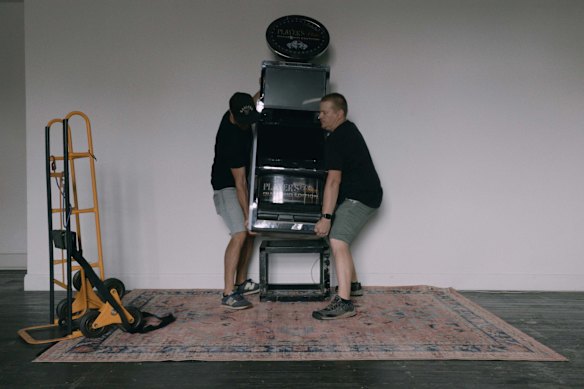
The real hurdle was finding a machine that could be rigged for the experiment.
“It was impossible to find one,” Walshe says.
“I had to reach out to people who, I thought, were dodgy, and they got me in touch with someone who could get hold of a pokies machine.
“It did rock up in an alley on the back of a ute, and I had to shuffle it into the garage really quickly.”
Players to test the machine were sourced from a post in his local Facebook community group. They were warned the algorithm had been modified “to be less addictive but just as fun”, but were not told losing sounds had been added to the game.
Of the participants surveyed after the test, 80 per cent said they felt happy before the sound was turned on; 20 per cent excited.
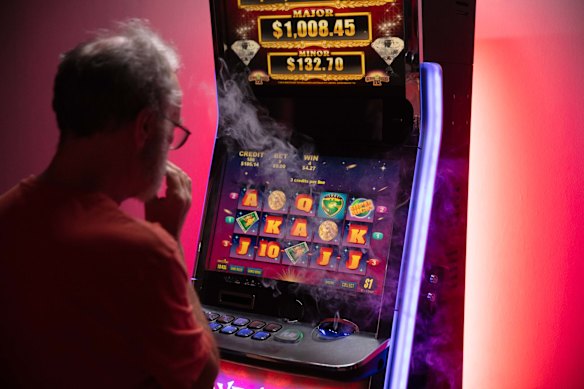
While playing with the losing sound, 60 per cent said they felt bored; the remaining irritated or anxious. All respondents said the sounds made them more aware of their losses compared with regular machines.
“I could not enjoy or have the same fun or hope to win the next game due to so many losing sounds,” one participant said.
“It feels like the next one [is] going to be another loss and I did not want that, so this why I wanted to stop.”
Another wrote that they “tended to ‘block out’ the losing sounds” after a while, but conceded they were “effective at making me realise that I had a losing spin that would cost me $$$”.
Gambling reform advocate Kate Seselja lost half a million dollars to pokies over 15 years, an addiction that nearly cost her her life.
“It doesn’t matter what parameters you set, what mindset you go into a venue with. As soon as you’re in front of that product, you are absolutely captured and hijacked in a way that doesn’t make sense to how you were before that encounter,” she says.
“The life before sitting in front of a machine and the life that emerges after … changes in an instant.”
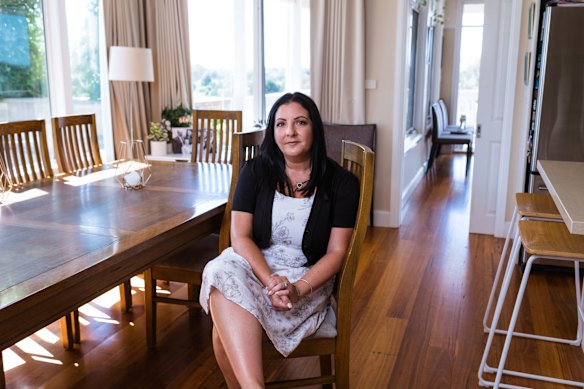
Seselja was 18 years old when she wandered into the gaming room of a club and played the pokies for the first time.
“I stayed away from drugs because I didn’t want to accidentally die from a drug overdose … not realising that pokies machines were way more addictive than any drug,” she says.
“You’re five times more likely to take your life from gambling harm than any other addiction. That’s where I think the real crime is, that the industry is allowed to say that it is harmless entertainment. It’s the furthest thing from that.”
Queensland has nearly 41,000 pokies machines spread across more than 1000 sites, with research showing these tended to be concentrated in the most disadvantaged communities.
While governments publicly express disdain for the harm caused by gambling – the Crisafulli government is investing more than $17 million in harm-reduction services – actions can be contradictory. The Queensland government makes more than a billion dollars in revenue on pokies each year. When planning for Brisbane’s Queen’s Wharf, the former Labor government made special provisions to allow more machines.
Through her work with Gambling Harm Lived Experience Experts (GHLEE), Seselja says she hears from people daily considering taking their own lives as a result of gambling.
“I had to talk two 70-year-old women out of taking their lives last week. I talked to a 57-year-old woman today. [There are also] young men, old men. It doesn’t discriminate.”
Human suffering and the well-researched nature of gambling’s addictiveness has kept Seselja close to the industry.
Where Walshe has launched a campaign calling for losing sounds to be added to pokies, Seselja wants each state and territory to introduce loss limits on machines of $100 a day, $500 a month and $5000 a year.
“How dare the government support these things built for wealth extraction en masse … they have a responsibility to protect the people of their state, and they have neglected that in favour of a predatory industry and a tax revenue stream that is bathed in blood,” she says.
“I’m supportive of Neil’s design … but the thing that public health data supports is loss limits.
“That actually stops the creation of addiction, as far as people being able to pour unlimited amounts of money into a machine that conditions you to keep running back to the ATM … that’s the process we have to stop. That will save lives.”
Start the day with a summary of the day’s most important and interesting stories, analysis and insights. Sign up for our Morning Edition newsletter.
Read the full article here