




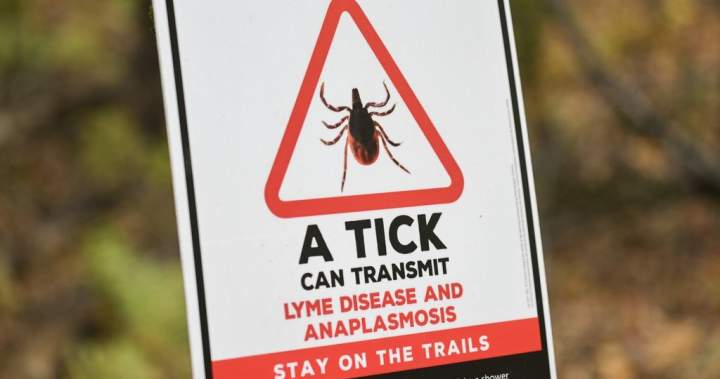
A new paper published in the Canadian Medical Association Journal urges doctors to consider anaplasmosis as a possible diagnosis for patients with unexplained fever as tick-borne illnesses rise in eastern Canada.
Senior author Dr. Michael Quon, an internal medicine specialist at The Ottawa Hospital, and his colleagues described the case of a 79-year-old man who had a fever, chills and generalized weakness that caused him to fall last summer.
Although the patient didn’t remember having a tick bite, he lived in a rural area in eastern Ontario where tick-borne disease is endemic and often spent time in the woods.
In hospital, the patient had a low blood cell count and developed shortness of breath, mild kidney injury and myocarditis, which is inflammation of the heart muscle.
Doctors gave him the antibiotic doxycycline to cover a range of possible bacterial infections, including anaplasmosis, a lesser-known illness carried by the same blacklegged tick that spreads Lyme disease. They are also known as deer ticks.
Doxycycline is the first-line treatment for both Lyme disease and anaplasmosis, Quon said.
The patient quickly improved and ultimately made a full recovery. Lab results came back after treatment had started, confirming anaplasmosis.
“It’s really important to be talking about this infection because we’re observing it more and more in clinical practice, in internal medicine, and it’s new,” Quon said in an interview.
“This is not an infection that we encountered even five years ago in the hospital.”
Quon said he wanted to publish the case study because the initial symptoms of anaplasmosis — such as fever, tiredness, headache or gastrointestinal issues — are very general and could be caused by a wide variety of illnesses.

Get weekly health news
Receive the latest medical news and health information delivered to you every Sunday.
But he wants physicians to specifically consider anaplasmosis in regions with a growing prevalence of blacklegged ticks, which range in size from a poppyseed to a sesame seed, including much of eastern Canada.
That’s because anaplasmosis is “highly treatable” with doxycycline.
If left untreated, anaplasmosis can cause serious complications, including myocarditis, brain inflammation, acute respiratory distress and kidney failure.
Doctors should ask patients about their outdoor exposure and whether or not they have used protective measures such as using insect repellent containing DEET or inspecting themselves for ticks, Quon’s paper, published Monday, said.
But they should also keep in mind that 50 to 75 per cent of patients diagnosed with early Lyme disease do not remember their tick bites, so the same challenge is likely with anaplasmosis, he said.
Quon’s main message to physicians is to start doxycycline right away if anaplasmosis is a clinical possibility rather than waiting for a positive lab test, “because the risk of (disease) progression is significant.”
Jules Koffi, a senior epidemiologist with the Public Health Agency of Canada, said the prevalence of blacklegged ticks has been rising in this country from Manitoba eastward, but especially in Ontario, Quebec and Nova Scotia.
With that comes an increase in tick-borne diseases, including both Lyme disease and anaplasmosis, he said.
Among ticks collected for examination in 2024, six per cent tested positive for Anaplasma phagocytophilum, the bacteria that causes anaplasmosis, Koffi said.
That’s up from three per cent in 2022, he said.
Koffi said it’s important for physicians to consider both anaplasmosis and Lyme disease as possible diagnoses and noted a couple of telltale signs that can help distinguish the two.
“Lyme disease often presents with an expanding rash in its early phase while anaplasmosis usually presents as a flu-like illness without a rash,” he said.
Plus, patients with anaplasmosis often have a low blood cell count.
However, patients can also be infected with both tick-borne illnesses at the same time, Koffi said.
Despite the increase in tick-borne illnesses, they still remain relatively rare and doctors emphasize they don’t want to discourage people from spending time outdoors in the summer.
“Please keep going outside,” said Dr. Jeffrey Pernica, an infectious diseases specialist at Hamilton Health Sciences’ McMaster Children’s Hospital.
The best thing people can do is take simple precautions, he said, including wearing insect repellant containing DEET or Icaridin.
Doing tick checks on yourself and your children is important, Pernica said.
Ticks can sometimes “crawl into inconvenient places,” so don’t forget to check your genitals and have someone look at your backside, he said.
Giving kids a quick bath every day is a good way to check them for ticks.
“As long as you check yourself for ticks every day, the probability of getting these more unusual tick-borne infections plummets dramatically,” Pernica said.
Removing ticks from your skin as soon as possible reduces the chance of getting a tick-borne disease.
“A tick has to be on you for more than 24 to 36 hours to get Lyme disease,” he said.
Although it’s not yet clear how long it takes for a tick to transmit anaplasmosis after it latches on to your skin, Pernica said pulling it off within a day means the probability of getting infected is likely “very, very, very small.”
The Public Health Agency of Canada advises using fine-point tweezers to grasp the tick as close to the skin as possible and slowly pulling it straight out, without twisting. Then, wash the bite area with soap and water or an alcohol-based sanitizer.
People can take a photo of the tick once it’s out and submit it to eTick.ca to have it identified, the agency said, noting that doing so can also help with tick monitoring efforts in Canada.
Read the full article here