




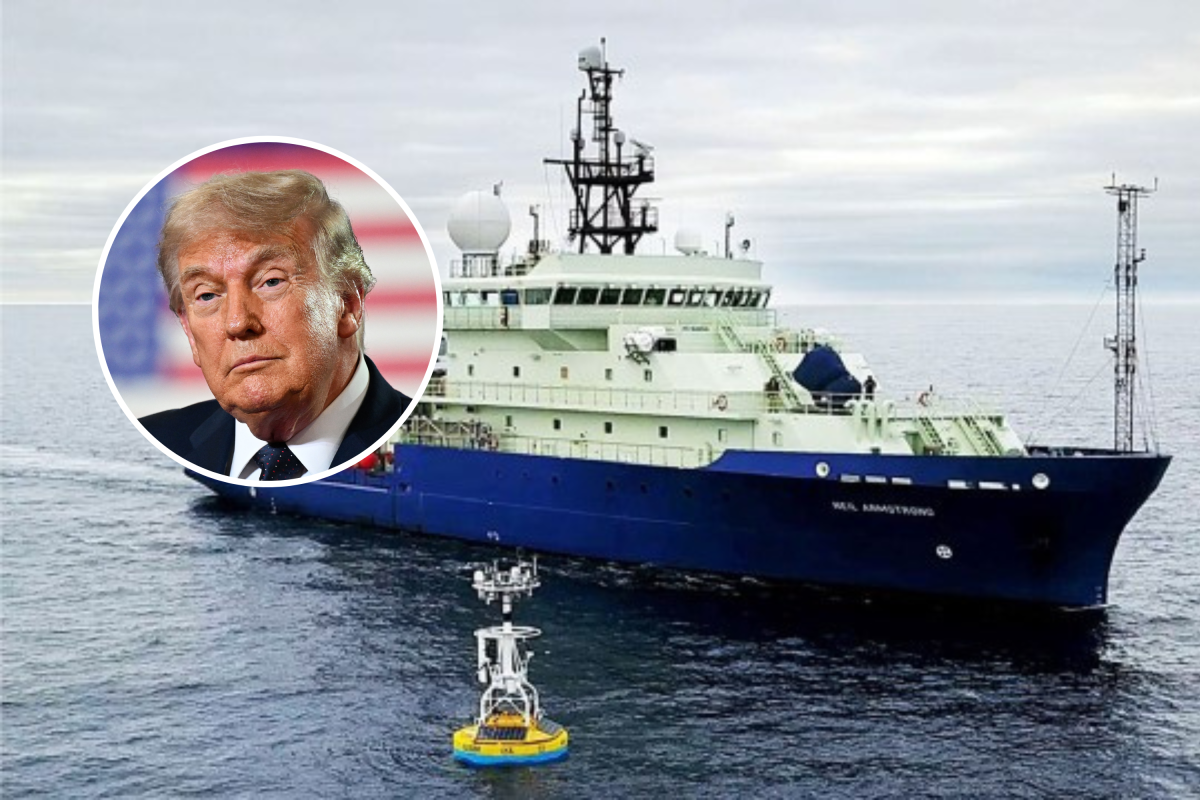
The Trump administration has moved to significantly cut back a $368 million ocean monitoring system that scientists have relied on for a decade, ordering the removal of hundreds of instruments that have tracked ocean conditions across the Atlantic and Pacific.
The system, known as the Ocean Observatories Initiative (OOI), was launched in 2016 as a long-term effort to provide continuous, real-time data on ocean temperatures, carbon absorption, circulation patterns, and coastal impacts, with an expected life span of roughly 25 years. The National Science Foundation (NSF) said in May it had begun a major “descoping” of the project, which will involve phasing out several key observing arrays and removing in-water infrastructure over the coming months, ending real-time data collection in those regions as equipment is recovered.
The announcement comes as scientists increasingly rely on continuous ocean data to track climate-driven changes, including warming waters, shifting currents and rising coastal risks, raising concerns that ending the system will create gaps in long-term records used to understand those trends. Critics, including former government scientists, have framed the move as part of a broader pattern of reductions to federal science programs under the Trump administration, arguing that cutting or eliminating large-scale research initiatives risks undermining U.S. scientific capacity and global leadership, The New York Times reported.
The NSF, which oversees the program, is an independent federal agency responsible for funding science and engineering research. While it operates independently, its leadership is appointed by the president and its budget and priorities are shaped through the federal administration and Congress.
OOI Descoping: What We Know
The NSF announced the major “descoping” of the OOI in May, a shift that will scale back much of the system’s in-water infrastructure, which comprises more than 900 instruments. According to the official announcement, the plan calls for the removal of equipment from four major observing arrays—Endurance in the northeast Pacific Ocean, off the coasts of Oregon and Washington; Pioneer, in the Atlantic Ocean off the U.S. East Coast; Irminger Sea, in the North Atlantic Ocean between Greenland and Iceland; and Station Papa, in the Gulf of Alaska in the Northeast Pacific.
The descoping will be carried out in phases over roughly 15 months, with recovery efforts already underway at some sites and others scheduled for completion through 2027. As equipment is removed from each location, the associated real-time data streams and observing capabilities are expected to end.
Despite the implications, the NSF stressed that it was not canceling the OOI, and that all previously collected data would remain available.
“As part of its ongoing stewardship of its research infrastructure portfolio, the U.S. National Science Foundation communicated to Woods Hole Oceanographic Institute (WHOI) on May 8, 2026, that it planned to adjust the scope of its support for select elements of the Ocean Observatories Initiative,” an NSF spokesperson told Newsweek. “NSF is not cancelling the Ocean Observatories Initiative. All previously collected OOI data will remain accessible through the OOI Data Center.
“The decision to descope aligns with NSF’s wider strategy of a nimbler approach to prioritize support for evolving scientific priorities and emerging technologies, as well as smart lifecycle management within its research infrastructure portfolio. NSF remains committed to ocean science and will continue working with the scientific community on high-priority research objectives. Our decision was based in part on the recommendations of the science community outlined in the 2025 National Academies of Science, Engineering, and Mathematics report, Forecasting the Ocean: The 2025-2035 Decade of Ocean Science.”
The decision has drawn heavy criticism from environmental nonprofits, such as Oceana, which focuses on protecting and restoring the world’s oceans.
“Understanding what is happening with our oceans is critical to understanding and predicting things happening both in the ocean and on the land,” Oceana senior campaign director Gib Brogan told Newsweek, adding that the data collected through the initiative is used to help influence the understanding of fish and wildlife, climate, weather, and coastal flooding, among other things.
“This reckless dismantling of these tools is irresponsible and is going to undermine our ability to predict and prepare for what’s coming in the near future and in the long-term,” Brogan said.
Many of the OOI instruments are in deep places that are “very tough for humans to get to,” Brogan said, stressing their locations serve a vital role in providing baseline information about what’s changing in the world’s oceans.
California Governor Gavin Newsom also commented on the decision.
“The Trump administration is DISMANTLING the network of buoys that help California monitor for major tsunamis and earthquakes. Cool,” Newsom’s press office posted on X.
What Happens Next
The “descoping process” is already underway at the Endurance Array, with final recovery set for this month, NSF said in the announcement. The Pioneer Array will be recovered in June 2027, with the recoveries of the Irminger Sea and Station Papa Arrays also set for the summer of 2027. Although the NSF spokesperson stressed that previously collected data would remain available, the NSF announcement said the OOI Data Center would continue operating only through September 30, 2028.
Brogan said the decision is “just the latest in the trend of cuts we have seen in the Trump administration.”
“It seems this administration is looking for every opportunity it can to cut science and undermine the value of science,” he said. “We are certainly concerned about this.”
He issued a plea for Congress to step in to ensure “this cut and other cuts to ocean science don’t happen.”
As the transition moves forward, officials have encouraged scientists to continue drawing on the program’s existing data record, highlighting its ongoing value even as large portions of the network are dismantled.
Read the full article here