Americans are carrying more debt than ever before—and rising costs tied to the conflict in the Middle East could further hit household finances.
Household debt climbed to a record $18.8 trillion in the first quarter of the year, according to the Federal Reserve Bank of New York, as Americans continued to grapple with elevated borrowing costs, stubborn housing expenses and higher everyday bills.
Since the first quarter, escalating tensions involving Iran have added fresh financial pressure through rising energy costs and growing economic uncertainty, raising fears that already-strained households could face even steeper monthly expenses in the months ahead.
Americans are already devoting a growing share of their income to essentials, from housing and insurance to utilities and car payments. Higher oil prices and elevated Treasury yields risk worsening borrowing costs across the economy, potentially increasing pressure on mortgages, credit cards and other loans.
U.S. taxpayers could also face billions of dollars in additional interest payments if Treasury yields remain near the levels reached after the start of the Middle East conflict, the U.K. newspaper Financial Times reported.
A new report by doxo, a Seattle-based financial tech company, found that the average U.S. household now spends $2,095 per month on essential bills, about 30 percent of median household income.
The analysis examined costs across 13 common household bill categories, including mortgages and rent, auto loans, insurance, utilities, health insurance, mobile phone service and cable or satellite bills.
Where Americans live increasingly determines how financially squeezed they feel.
The gap between the country’s most- and least-expensive states has widened sharply in recent years. Households in the highest-cost states now pay as much as 38 percent above the national median in monthly bills, while residents in the most affordable states spend up to 47 percent less.
Where Do Americans Pay the Highest—and Lowest—Bills?
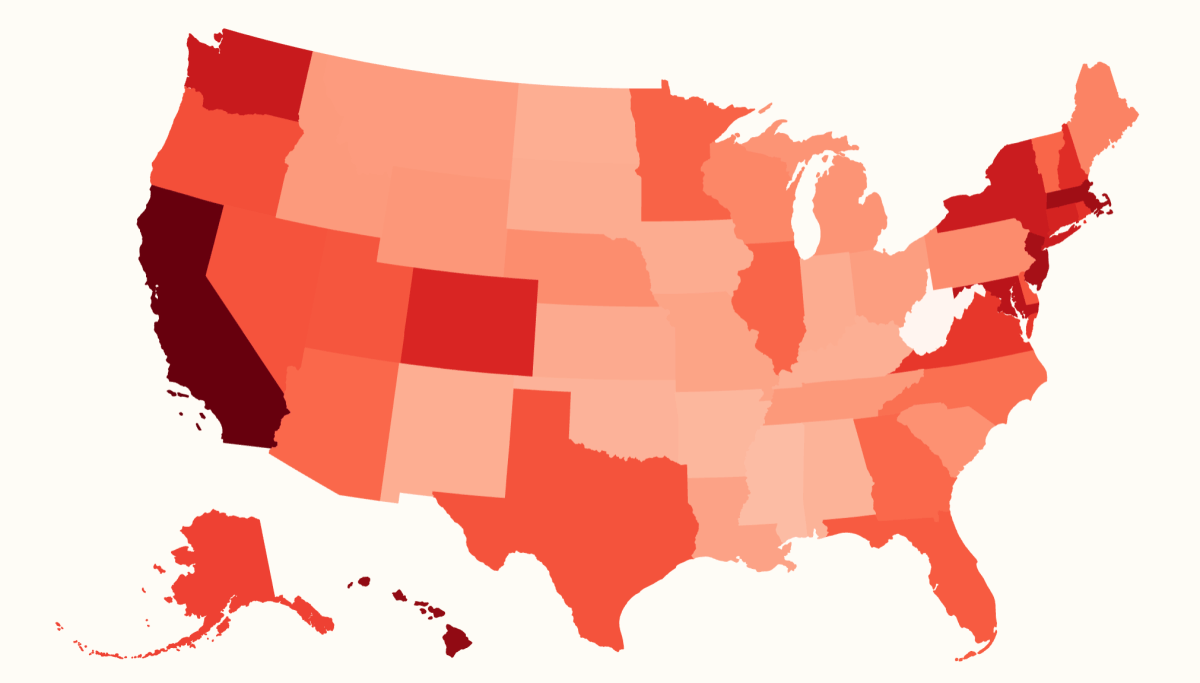
California ranked as the most expensive state for household bills overall, according to doxo. Residents pay a median of $2,892 per month—equal to about 33 percent of household income.
Hawaii followed at $2,735 per month, also consuming roughly 33 percent of household income.
Massachusetts ranked third, with households paying a median of $2,668 monthly, or about 30 percent of income.
At the other end of the spectrum were states with lower housing costs and cheaper overall living expenses.
West Virginia had the nation’s lowest median monthly bills at $1,116, equivalent to 22 percent of household income.
Mississippi ranked second lowest at $1,547 per month, followed by Arkansas at $1,580.
Housing Costs Continue To Drive Financial Pressure
While inflation, higher borrowing costs and rising fuel prices continue to strain budgets, housing remains the biggest financial burden for many Americans.
Home prices surged during the pandemic as strong demand collided with a severe shortage of available homes. Prices have continued climbing since then, while mortgage rates have more than doubled from their pandemic-era lows of around 2 to 3 percent.
Property taxes have also risen alongside home values, while renters have faced worsening affordability in many parts of the country.
For many households, housing now represents the single largest monthly expense.
In California, households paid the highest mortgage payments in the nation, at $2,643. Next came New Jersey ($2,511), Hawaii ($2,474), Massachusetts ($2,346), New York ($2,286), Connecticut ($2,119), Washington ($2,084), Colorado ($2,038), New Hampshire ($2,001), and Maryland ($1,889).
Households in West Virginia paid the lowest monthly mortgage payments in the nation at $1,024, followed by Arkansas ($1,099), Mississippi ($1,107), Alabama ($1,118), Indiana ($1,140), Kentucky ($1,181), Oklahoma ($1,207), Iowa ($1,228), Ohio ($1,267), and South Carolina ($1,271).
When it came to rent, monthly payments were highest in Hawaii ($2,068), California ($2,028), Massachusetts ($1,783), New York ($1,713), Washington ($1,705), New Jersey ($1,704), Colorado ($1,684), Maryland ($1,669), Florida ($1,583), and Virginia ($1,564).
Monthly payments were lowest in West Virginia ($870), South Dakota ($916), Arkansas ($921), North Dakota ($937), Mississippi ($946), Kentucky ($955), Iowa ($959), Alabama ($987), Oklahoma ($998), and Wyoming ($1,004).
Read the full article here