




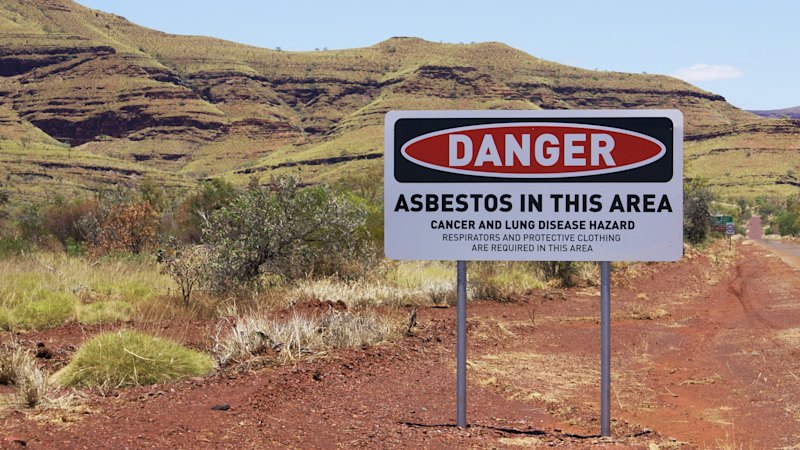
There was a time, decades ago, that Wittenoom was at the centre of mining activity in Western Australia’s Pilbara region.
As the only Australian mine to produce blue asbestos, it played a pivotal role in the proliferation of the hazardous material in households across the nation.
However, 60 years ago this year – the same year iron ore giant Rio Tinto sent off its first shipment from Dampier to Japan, setting in motion another thriving resources industry in the Pilbara – Wittenoom’s mine closed amid mounting evidence of the health impacts of asbestos, but primarily due to declining profits.
Today, the WA government urges travellers to avoid the now-degazetted ghost town, which is perched on the northern edge of the Karijini National Park. Social media-driven interest in the hazardous site is an ongoing headache for authorities.
In February, Banjima traditional owners launched legal action against the WA government, hoping to force it to clean up the asbestos contamination – including mountains of tailings – that has stained their country.
And it’s not just the tailings at Wittenoom haunting WA. Anyone living in a house built before the mid-1980s is warned their home is “highly likely” to contain asbestos.
The WA-based Asbestos Diseases Society of Australia reports there are more than 4000 deaths a year nationally due to asbestos-related diseases.
So, will WA – or Australia, for that matter – ever truly be free of the legacy of our love for asbestos?
“I think asbestos is, to a certain extent, here with us to stay.”
Dr James Watson
It is a question Dr James Watson grapples with in his book, Asbestos Nation: The story of the most dangerous dust in Australia.
Speaking to this masthead prior to the book’s launch last week, Watson said while asbestos was “all over the place” in Australia, it was “highly concentrated” in WA and NSW, where the mineral was largely mined.
“Western Australia has an interesting history in that it has the largest mine, Wittenoom, but Wittenoom had a diminished economic importance in the Australian asbestos industry,” he said.
“So James Hardie, over on the east coast in Sydney, by and large doesn’t want to buy the asbestos from Wittenoom.
“It’s because the asbestos from Wittenoom is too expensive, in part because you have to get all these workers interested in working in the middle of nowhere, they all get paid pretty high wages … and there’s also the transport costs of just how do you get all this asbestos from the middle of nowhere down to Perth, and then from Perth all over the country.
“Wittenoom’s importance in the asbestos industry is … it’s an attempt by the Western Australian government to develop that northern part of Western Australia.

“By and large, that mine in Wittenoom relies mostly on subsidies, it doesn’t really survive on its own profits because it’s not selling enough asbestos to James Hardie or to anyone else to make enough money in all this.”
Watson, a historian at the Australian National University who wrote his doctoral thesis on the social history of asbestos, first got turned onto the topic during his time working as a paralegal for an asbestos legal team in Sydney.
There, he researched the history and flow-on effects of asbestos’ use in building materials across the nation, including attending bedside hearings of people with late-stage mesothelioma who were too sick to attend court.
His book, published by Melbourne University Publishing, tells for the first time the complete history of how asbestos became embedded in our lives, and examines why the material remains a major public health, environmental and political issue today.
“There’s still about 6 million tons of asbestos in the built environment in Australia,” he said.
“It’s one of those things, at any time that a state or Commonwealth government has tried to think about the problem of how to actually do this, they’ve kind of always chickened out.”
Watson recalls the efforts of National Library staff in Canberra pushing for asbestos to be removed from the building, and the Hawke government’s subsequent discussions on how much it would cost to get rid of it from every public building in the country.
The estimated figure? About $7 billion – a lot to spend in 1983 Australia. And that’s just to remove the asbestos, not taking into account any rebuilding needed.
“And so their de facto policy on asbestos just becomes, ‘Every time someone – a union, activist, journalist, whoever – creates a fuss about asbestos, we’ll respond to it on a case-by-case basis, but we’re not going to have a big issue’,” Watson said.
“It’s a really sort of ubiquitous problem. Asbestos would probably be in a third of the Perth homes at this point, essentially, and it would be very hard to go and systematically remove all of it.
“So I think asbestos is, to a certain extent, here with us to stay.”
Watson predicts mesothelioma cases will decline, as long as asbestos isn’t reused in workplaces and people avoid places like Wittenoom, but it will require constant vigilance.
“People will just have to be aware, every time they want to do home renovation, they’ll have to play it safe; they’ll have to get in experts, they’ll have to wear safety gear,” he said.
“But that will be a toxic issue to deal with for the foreseeable future.”
Start the day with a summary of the day’s most important and interesting stories, analysis and insights. Sign up for our Morning Edition newsletter.
Read the full article here