


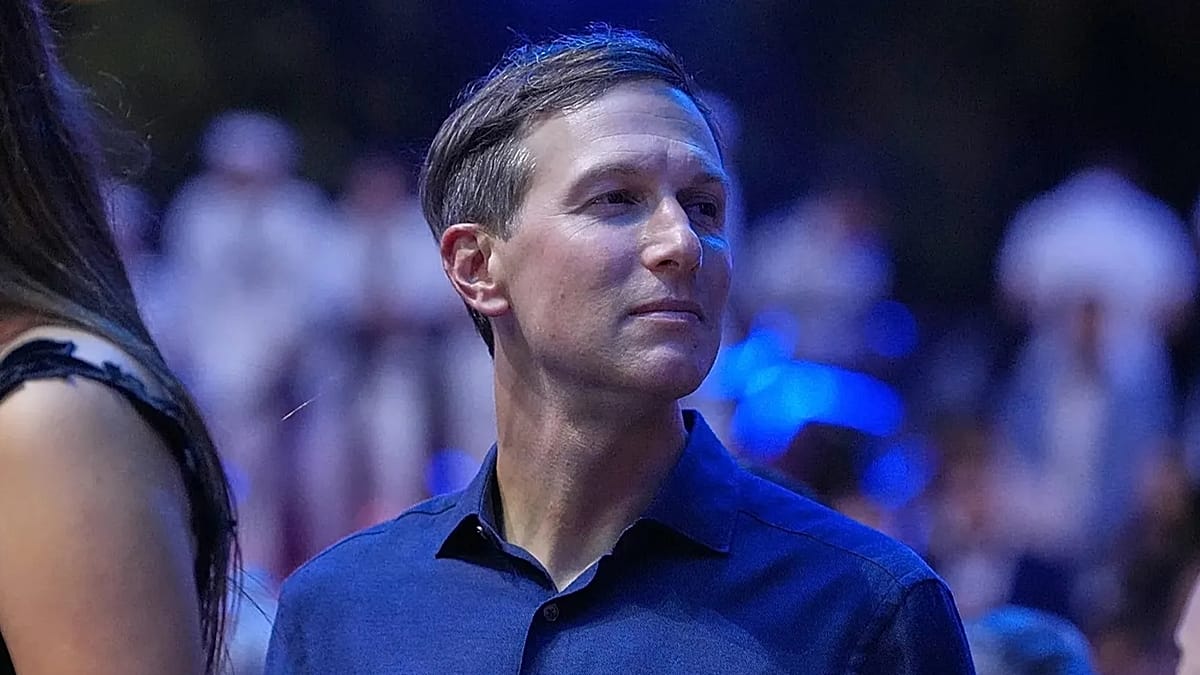
On Monday, dozens of Foreign Ministers from all over the world came together to discuss Gaza’s recovery under the auspices of the Palestine Donor Group (PDG). Among them, appearing by video link, was a controversial US businessman who has no official position in the government, but is ultimately running the show.
The participation of Jared Kushner, son-in-law of US President Donald Trump, carries significant weight, several people familiar with the matter told Euronews.
Kushner is a key player in the international effort to rebuild the Gaza Strip. He holds a central role in the Board of Peace (BoP), the contentious body chaired by Trump that is set to oversee the reconstruction of Gaza with almost unlimited powers.
The EU does not approve of the BoP and does not want to legitimise it, but one way or another, everyone seeking to operate in Gaza has to deal with Kushner.
Influence, not money
Kushner’s intervention at the PDG meeting was limited, according to diplomats. He mainly highlighted the US role in Gaza’s reconstruction, praising the cooperation with other countries and insisting on the need to disarm Hamas as the first step to kick-off the strip’s recovery.
One EU diplomat described his speech as “very choreographed” and not particularly substantial, but his mere presence represented a significant step forward for the EU’s plans in the region. The reason is simple: any European initiative in Gaza will ultimately have to engage with BoP representatives.
During the conference, the PDG launched the “Team Gaza Initiative”, a new programme bringing together EU and non-EU countries to provide €883.6 million in financial contributions for “early recovery actions” aimed at supporting Gaza’s civilian population.
France, Germany, the United Kingdom and Japan have pledged funding, alongside the European Commission, the European Investment Bank and the World Bank. Australia, Canada and Ireland are expected to announce additional contributions in the coming days.
The initiative, however, remains far below the estimated cost of rebuilding Gaza over the next decade, which the EU and the United Nations put at around $71 billion.
The US has not joined the programme, which EU officials insist is “not in competition” with the BoP’s long-term reconstruction plan.
Each partner will be able to channel its own funding through the mechanism of its choice. However, EU officials have ruled out member states financing projects through BoP-controlled bank accounts.
Šuica’s victory
Kushner was invited to the conference by EU Commissioner for the Mediterranean Dubravka Šuica, who has invested significant diplomatic effort in building ties with him since the first – and so far only – BoP meeting last February in Washington.
Back then, Šuica was widely criticised for participating in the controversial inaugural gathering as an observer, with French Foreign Minister Jean-Noël Barrot even claiming she had no mandate to represent the EU.
But the visit eventually paid off. Šuica’s ability to forge relationships was instrumental in securing Kushner’s participation nine months after, according to an EU official.
While the US declined to attend the previous PDG meeting last November, Trump’s son-in-law accepted the invitation, which according to a non-EU country diplomat is not a minor achievement.
While the EU has not endorsed the BoP – which has attracted only a limited number of member states so far – Brussels is seeking to avoid confrontation.
“Only collective effort can help rebuild Gaza,” Šuica said after the meeting, stressing the need for cooperation among all actors involved on the ground. The day after, she also met in Brussels Nickolay Mladenov, the former Bulgarian foreign minister who is now BoP’s High Representative for Gaza, that dialogue with the body remains ongoing.
Kushner’s bridge to Israel
Kushner’s importance also lies in his ability to strengthen contacts with Israel, which retains the final say over any reconstruction projects in Gaza.
He has been Trump’s peace envoy, helping broker a ceasefire between Israel and Hamas in Gaza last year, and had served as lead negotiator for the US in brokering the 2020 Abraham Accords, which normalised diplomatic relations between Israel and several Muslim-majority nations such as Morocco and the United Arab Emirates.
Middle Eastern governments, meanwhile, view the US as the only global power with sufficient leverage over Israel to help unlock progress on the ground.
On Monday, Šuica announced the first two recovery projects to be implemented in Gaza with Israeli approval, focusing on water infrastructure and solid waste management. EU officials expect more projects to follow.
The EU remains the largest provider of humanitarian assistance to the Palestinian people, having contributed €1.65 billion to the Palestinian territories since the outbreak of the war between Israel and Hamas on 7 October 2023. Since 1994, the bloc has provided nearly €30 billion in aid to Palestine, according to European Commission figures.
Read the full article here