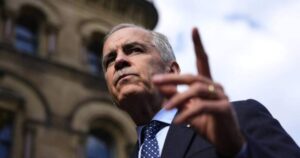


Washington DC: A few months ago in Honolulu, the Trump administration’s point man for AUKUS – who rarely speaks publicly – gave a broad-brush appraisal of why Donald Trump strongly supports the agreement.
AUKUS, which marks its five-year anniversary this week, was more than a one-off deal, Adam Korzeniewski told the audience. It was “a mentality”, a way of thinking that could be applied with other partners.
“AUKUS is the spearhead, it’s the canary in the coalmine, it’s the future model of interoperability between different allies,” he said. “If we can’t figure this out with Australia and the UK, then what are we doing?”
Trump believed AUKUS was “completely in line with his national security strategy”, Korzeniewski said. That document, rewritten in November 2025, stipulates the US will build a military capable of denying aggression anywhere in the First Island Chain around China.
But it won’t do this alone. The strategy says America’s allies must step up: spend “much more” on collective defence, allow the US greater military access to their ports and other facilities, and invest in capabilities that deter aggression. AUKUS ticks all of those boxes.
As for the question of what the US would expect of Australia in the event of a conflict with China, Korzeniewski had little doubt that Canberra would play its part. “Australia joined us in the Vietnam War,” he said. “I’m not really that concerned about Australia’s willingness to join in a good fight if one comes up.”
Korzeniewski is an AUKUS liaison officer in the State Department, who moved to the role in February. A political appointee of the Trump administration, he is a bridge between the bureaucracy and the politicians. His previous job was White House liaison during the dismantling of USAID.
His remarks to the Security and Defence Plus forum in Honolulu, which have not been previously reported, add context to Trump’s oft-cited declaration that AUKUS is “full steam ahead”.
Those three words, uttered by the US president when Prime Minister Anthony Albanese visited last year, have become gospel for both US and Australian officials. The phrase is repeated so often that it tends to invoke eye-rolls among Australian correspondents in Washington. But Trump has said little publicly about why he values AUKUS so highly.
For opponents of the agreement in Australia, Korzeniewski’s remarks will bolster perceptions that the US is using AUKUS to establish a strategic foothold here. This was reinforced by the Pentagon baulking at recent suggestions that the presence of US submarines at HMAS Stirling near Perth might be limited to five years. In the view of AUKUS opponents, this is not in Australia’s interests.
But all three AUKUS governments – in Canberra, Washington and London – believe their interests are aligned. And in the five years since it was announced at a virtual press conference (during which Joe Biden memorably referred to Scott Morrison as “that fellow down under”), AUKUS has survived a change of government in each country.
The political consensus could not be clearer, even if there is lingering uncertainty among voters. Polling by the United States Studies Centre in May showed more Australians support the country acquiring nuclear-powered submarines than oppose the idea, and more people believe AUKUS will make Asia safer than not.
But about 45 per cent of Australians felt the government had not adequately explained the need for AUKUS. A fifth said the pact should be cancelled.
“This is moving forward,” Korzeniewski said in Honolulu. “There’s not going to be any great revisions. Things may change after first contact with the enemy – which may be our bureaucracies in this case – but this is a fact. This is going to be something that’s done at some point. People are welcome to criticise, but we’re not paying any heed to the critics.”
The Trump administration was not paying any attention to AUKUS critics, he added. “Everybody’s entitled to their own opinion. Oftentimes these folks that write these opinions have contrary interests, or maybe they get the facts wrong.”
Sitting beside Korzeniewski on the Honolulu panel in May was Greg Wilcock, Australia’s consul-general for the US in Hawaii, formerly the Department of Foreign Affairs and Trade’s assistant secretary for US policy. He made the point that the best way to arrest public doubts about AUKUS was to demonstrate tangible results.
Wilcock argued AUKUS did not undermine Australia’s sovereignty. “Any government, including in Australia, is going to reserve its room for manoeuvre in exercising sovereignty about how its country is used, about how its sovereign assets are used,” he said.
“The good news for the United States and Australia … is that we have so driven – and we have driven very hard – our operational integration and our policy integration. And that makes it much less difficult to have an honest, outcomes-focused conversation about how we are going to exercise that sovereignty for joint effect.”
The Albanese government stresses it has given no undertaking about participating in any conflict. “We’ve given no commitment publicly or privately,” Defence Industry Minister Pat Conroy told this masthead in Washington DC in July. “A decision to enter a conflict will be a decision of a future sovereign elected government.”
Rather than any lack of political will, the real impediment to AUKUS fulfilling the promises of five years ago is the dire state of the American and British defence industrial bases on which Australia will rely.
As this masthead reported in July, the production rate of Virginia-class submarines has flat-lined at 1.1 to 1.2 boats a year, according to the Pentagon, and billions of dollars from US and Australian taxpayers have not yet made a difference. The rate needs to climb to 2.33 a year to meet AUKUS commitments.
Meanwhile, the US is pivoting towards its next generation Columbia-class submarines and new Trump-class battleships – which will also be nuclear-powered, as The Australian reported earlier in August.
The UK side arguably faces worse headwinds. Retired rear admiral Philip Mathias, a former director of nuclear policy with the UK Ministry of Defence, told this masthead earlier this year of the “parlous state” of Britain’s nuclear submarine program, with the country barely able to operate its own fleet.
After five years, AUKUS is full steam ahead on rhetoric and goodwill. Substantial legal changes were made to allow the three nations to share their prized systems and technologies, and Australia is preparing for nuclear submarines with tens of billions of dollars in shipyard investments.
But it is yet to achieve improvement in the industrial bases, nor capture the imagination of a sceptical public – the people footing the bill.
Get a note directly from our foreign correspondents on what’s making headlines around the world. Sign up for our weekly What in the World newsletter
 Michael Koziol is the North America correspondent for The Age and Sydney Morning Herald. He is a former Sydney editor, Sun-Herald deputy editor and a federal political reporter in Canberra.Connect via X or email.
From our partners
Read the full article here