




Everything is getting more expensive bit by bit, and it’s not just gas or grocery prices. T-Mobile just increased the price of a pair of fees that get added on top of what customers pay for their mobile phone plans, and it’s not the only carrier doing this.
Over the past year and a half, the big three US cellular providers have raised prices in small ways that may not seem consequential month to month, but add up over the year.
More costly fees, taxes and plans
For a while, a lot of carriers’ plans rolled taxes and fees into them as a competitive advantage — when you know you’re paying a fixed amount each month, it’s easier to budget. Unfortunately, those days are over, at least among the big three US carriers: AT&T, T-Mobile and Verizon.
The new fee increases are so small that you probably won’t notice them on your bill. Effective Oct. 12, T-Mobile’s Regulatory Programs and Telco Recovery fees increased for every line on a customer’s account. For voice lines, it’s an increase of $1.00 for the combined fees (previously $4.49 a month, now $5.49 a month). Mobile internet lines, such as those for smartwatches or tablets, went up $0.50, from $2.10 to $2.60 a month.
T-Mobile previously raised the cost of these fees in April 2025, from $3.49 to $3.99 and $1.40 to $1.60, so in a year and a half, customers are paying $2 more per voice line and $1 more per mobile internet line per month.
Even if your plan has a multi-year price guarantee, that applies to the main plan itself, not miscellaneous taxes and fees that are added on top of the plan’s cost. Carriers can, and do, increase those fairly regularly.
For Roger Entner, analyst and founder of Recon Analytics, the problem isn’t that carriers regularly raise fees like this. It’s that they spread out the increases.
“I don’t understand why they [don’t] only piss you off once a year, but instead sometimes choose to piss you off four times a year,” Entner said in a conversation with CNET. “It doesn’t make sense unless you want to be hated.”
T-Mobile isn’t the only one that’s increased these fees. AT&T raised its Administrative and Regulatory Cost Recovery Fee from $3.99 to $4.99 per line in August; that was after a December 2025 increase from $3.49. Verizon raised its fees in August 2025, from $3.50 to $3.78 per month for voice lines and from $1.60 to $3.97 per month for data-only lines.
As for the prices of the plans themselves, they’ve been relatively consistent. The exception is Verizon, which announced holiday deals in December 2025 and carried the pricing all the way through August when it announced the Simplicity plan. The myPlan plans, which include Unlimited Welcome, Unlimited Plus and Unlimited Ultimate, now cost $10 more per line for new customers than they did at the beginning of 2026.
Are these costs enough to inspire customers to look elsewhere? “We’ve done research on what makes people [switch carriers],” Entner said. “Five dollars and below doesn’t matter. People shrug it off. … Where the outrage [would be] is if your price would go up by $15, $20, and nobody’s doing that.”
Retiring legacy plans
When AT&T revamped its unlimited phone plan lineup in March this year. It also announced that prices would be increasing for many of its “retired” plans, as much as $20 for an account (not per line). Then, in August, the increases were applied to more legacy plans, which included the ones that the new 2.0 plans had just replaced a few months earlier.
At the time, an AT&T spokesperson said, “This increase reflects the real cost of continuing to deliver the speed, reliability and support our customers expect every day.” I think it’s also safe to say that this type of increase can also serve as an incentive for customers to migrate to current plans.
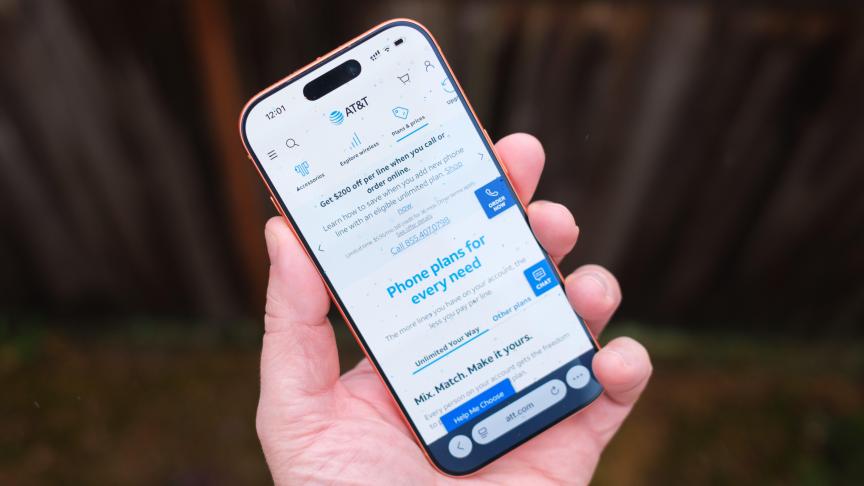
AT&T’s mobile app.
Jeff Carlson/CNET
In June, however, T-Mobile announced it would unilaterally move some customers to new plans in order to get their old ones off the books. Although T-Mobile said that most plans would be comparably priced to what the customers were paying before, in some cases it meant increases of up to $6 per line per month.
The new plans were variations of T-Mobile’s existing lineup, such as Experience More with Appreciation Savings versus the straight-up increase that switching to the Experience More plan entails.
The move wasn’t optional, and at least one customer filed an informal complaint with the FCC. That’s one step below a formal complaint, which would involve fees and lawyers.
Price guarantees have almost evaporated
In April of last year, Verizon made a big deal about offering a three-year price guarantee on all of its plans. However, the guarantee slipped away in August when the company introduced its Simplicity plan. T-Mobile one-upped Verizon with a five-year price guarantee on its plans, which is now available only on the Experience Beyond 2.0 and Experience More 2.0 plans.
The people who signed up for plans under those terms still enjoy the price protection, but customers looking to jump to a new carrier won’t necessarily get the same deal now.
For existing customers, price guarantees can also act like handcuffs. If they want to move to another Verizon plan, for example, they’ll have to give up that price stability.
Looking at the bigger picture, though, wireless service has gotten cheaper
When I was researching for this article, I came across one written by Entner for LightReading that takes a longer-term view of wireless pricing. It highlights that we’re actually paying less for phone service now than we used to. In “Inflation mostly skipped the wireless bill,” Entner uses industry and government data to show that wireless service has gotten cheaper in real terms since 2007 (the year the iPhone was released).
“The dollars that you spend, yes, it’s going up,” Entner said in our conversation. “When we calculate it as part of your wallet share, [the] percentage of your monthly disposable income, it goes down.”
How can you save money on your phone bill?
A couple bucks in fees here and there doesn’t sound like a lot, but if you have four lines on an account, for example, that’s an extra $8 per month you weren’t paying before. And for people looking for the most economical plan, it’s a larger percentage of their phone bills.
So what options are there to offset the increases or reduce your monthly expense?
One option is to shop around for a prepaid plan. Companies such as Cricket, Mint Mobile and Visible run on the carrier’s networks and can cost less, especially if you’re currently paying for perks such as streaming services or hotspot data you’re not using. (Those three are all actually owned by the big three: Cricket is AT&T, Mint Mobile is T-Mobile and Visible is Verizon). Another option is US Mobile, which lets you choose whichever network is strongest in your area.
A single line on T-Mobile’s Essential Saver 2.0 plan, for example, costs $50 and includes 50GB of high-speed data. Mint Mobile’s 12-month Unlimited plan works out to $30 a month when you prepay $360 for the entire term, and it also includes high-speed data that may be slowed after you use 50GB. It includes up to 20GB of mobile hotspot usage, too.
Although it’s a bigger one-time lift, prepaying for an entire year for a plan like this means you won’t have to wonder how much next month’s bill will be.
You may not be in a position to switch providers, particularly if you’ve financed a phone from your current carrier. But you may be able to drop back to a less expensive plan with fewer features.
Verizon’s Simplicity plan at $45 a month, for example, is $20 less expensive than its Unlimited Welcome myPlan for a single line. (Verizon touts the $30 a month price, but that’s just for new customers who bring their own phone with them.) And Simplicity actually gives you better performance, because you can connect using the faster 5G Ultra Wideband (or 5GUW) if your phone has the hardware for it; Unlimited Welcome is limited to regular 5G speeds.
But Simplicity has an important catch: If you have a multi-line Verizon plan and one person switches to Simplicity, every other line must also switch to it. For a family of four, that means paying $180 a month (at the $45 rate), which is $10 more expensive than the Unlimited Plus myPlan and includes less high-speed mobile hotspot data.
As another example, AT&T’s modular Build-A-Plan costs as little as $15 a month when you bring your own unlocked AT&T-compatible and eSIM-capable phone. That gives you just 1GB of data — and that’s it, but you can add more data and hotspot capability for additional costs.
Then there’s the free option. If you don’t mind ads and the restriction of using a single app for all your communications, TextNow gives you calling, texting and data for email, maps, ride-sharing and finance apps. Unlimited data and calling plans can be purchased for the day ($3), week ($9) or month ($36).
If you’re thinking of switching providers, don’t forget that each one has limited programs to let you test out the speed and coverage in your area. T-Mobile offers a free three-month Network Pass, Verizon has a 30-day “trial” program and AT&T has its own 30-day eSIM free trial program.
It’s never fun to find the bill for your wireless phone service — an expense that feels like a modern necessity — is going up. But there are plenty of alternative options that can save you money, if you know where to look.

See full bio
Read the full article here