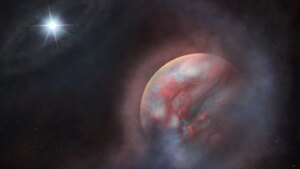



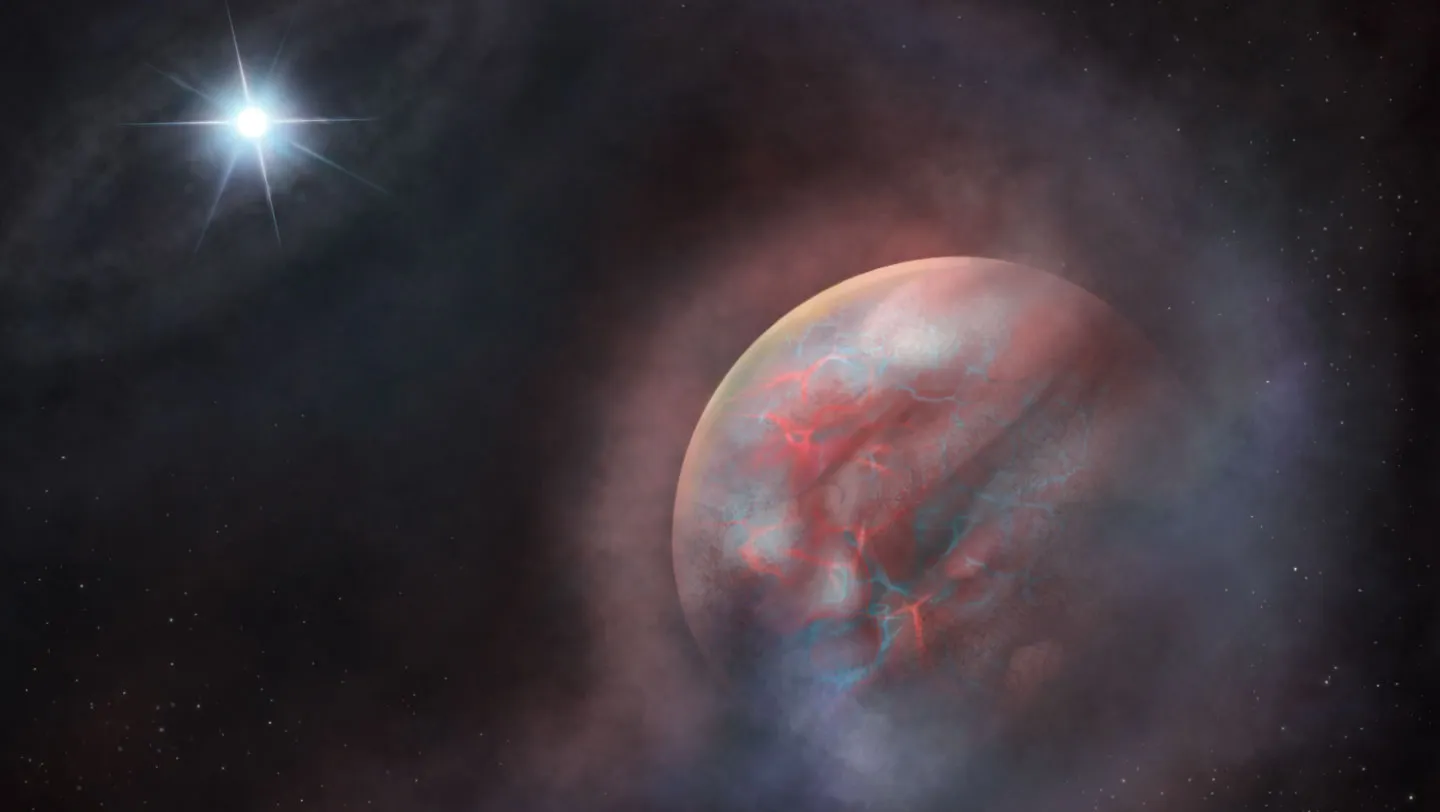
A dead star’s wreckage may be the birthplace of a new planet.
The existence of second-generation planets was predicted theoretically more than 15 years ago. But this “phoenix” world, if confirmed, would be the first actually spotted, scientists report October 5 in Nature Astronomy.
“A phoenix is reborn from the ashes of its predecessor, and this planet is formed from the ashes of the star,” says astronomer Jamie Williams, of the University of Warwick in Coventry, England.
The finding suggests planetary systems can have a second life even after their stars die.
Before this discovery, this planet formation process has been “more like a hypothesis, more like speculation,” says planetary scientist Zifan Lin of Washington University in St. Louis, who was not involved in the new work. “This is the first time we’ve seen evidence for that process.”
Williams and colleagues found signs of the planet in the atmosphere of a white dwarf called HS 0209+0832. White dwarfs are the small, dense cores left behind after low-mass stars — like our sun — puff up into red giant stars at the end of their lives, ultimately blowing all the outer material away.
These stellar corpses are so dense that most chemical elements sink into their centers, leaving them with pristine atmospheres composed of almost entirely hydrogen and helium. But astronomers have found that between a quarter and half of these stars are “polluted” with elements like silicon and iron, which are found in rock.
These elements probably come from shattered planets that the star devoured as it expanded. “They can be probes into the interiors of planets,” Lin says. Astronomers have also found whole planets that seem to have survived their stars’ demise and still orbit the remaining white dwarf. Ironically, some astronomers think these dead stars could be prime hunting grounds for signs of extraterrestrial life.
HS 0209+0832 was a known weirdo. When the Hubble Space Telescope observed it in 1999, astronomers could tell that the white dwarf contained a mysterious mix of chemicals, but they couldn’t identify them. Since then, there have been more detailed studies of how certain atoms would show up in stellar atmospheres, Williams says.
Reanalyzing those observations showed that the white dwarf contains only trace amounts of silicon and almost no iron, Williams and colleagues found. But it does include a ridiculous amount of niobium. This hard, silvery metal, used in jewelry, rocket systems and superconductors, is rare on Earth and had never been seen in a white dwarf.
“We’ve never observed anything in the universe that’s this niobium-rich before,” Williams says. “We were quite confused at first.”
A clue to how it got there came from the element’s origins. Niobium forms in the slow neutron-capture process, or s-process, which mostly occurs in certain red giant stars as they shed their atmospheres and die. Iron nuclei transform into heavier elements in a series of accretion and decay that can take thousands of years.
Material ejected from a dying star could have coalesced into a new planet full of s-process elements, Williams says. Then the resulting white dwarf could slowly sip on the new planet’s atmosphere, leaving a fresh coat of niobium and other s-process elements on the white dwarf’s face.
To support this idea, the team looked at observations of HS 0209+0832 taken with the TESS space telescope, which hunts exoplanets by observing small changes in the light of their stars as planets orbit. The white dwarf’s brightness changes with a period of about 4.4 days, the team found. That’s too slow to be related to the white dwarf’s own rotation.
But it could be explained by a gas giant planet orbiting very close to the star, about 4 percent the distance from the Earth to the sun or 6 million kilometers. Williams imagines it as a silvery version of Jupiter.
“We’re not really sure, if it’s not a planet, what it is,” he says. “A planet is the most reasonable explanation.”
Our sun will one day meet the same fate as HS 0209+0832’s predecessor. We don’t know enough about second-generation planets yet to say whether our solar system could end up with one after the sun dies, Williams says. “But I think it’s definitely possible.”
Read the full article here