



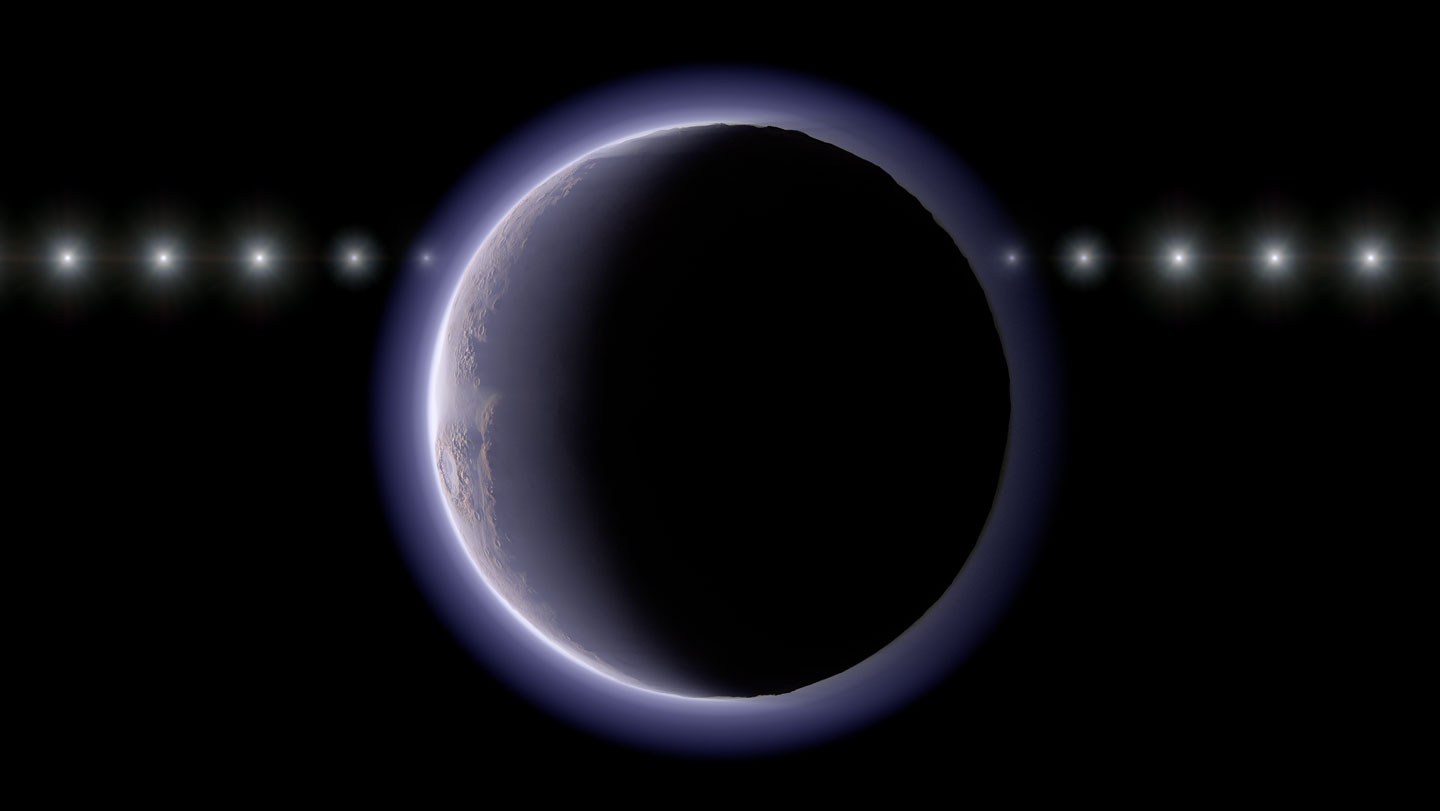
A small solar system denizen farther from the sun than Pluto may be shrouded in a thin atmosphere. If confirmed, it would be the first object of its size known to host even a tenuous atmosphere.
“This discovery suggests that small icy worlds beyond Neptune may not be as inactive or unchanging as we often assumed,” says observational astronomer Ko Arimatsu of the National Astronomical Observatory of Japan in Mitaka. “Until now, Pluto was the only trans-Neptunian object with a confirmed atmosphere.” He and his colleagues report the observations May 4 in Nature Astronomy.
The team tracked the small body — dubbed 2002 XV93 — using a network of telescopes in Japan. On January 10, 2024, telescopes in three locations recorded it moving in front of a distant star. For other solar system bodies, the details of such tiny eclipses, called occultations, have revealed the presence of atmospheres — and even rings.
If 2002 XV93 were bare, the star would have appeared to blink out and reappear sharply. But Arimatsu and colleagues saw the star’s light fade and recover gradually over about 1.5 seconds. That smooth dimming is best explained by starlight passing through and being refracted by a tenuous atmosphere, with a pressure about one ten-millionth that Earth’s, Arimatsu says.
“I was genuinely surprised,” he says. The object is about 470 kilometers wide, roughly as wide as the Grand Canyon is long — so small that its gravity should be too weak to hold on to gas for long. The atmosphere should dissipate in thousands of years unless something resupplies it, the researchers estimate.
The gas could have been released recently, maybe by an impact from an icy body like a comet, and the astronomers just happened to be looking at the right time. Or the body may release gas regularly through icy volcanoes.
One occultation can’t completely rule out other explanations, such as dust, Arimatsu notes. The observations also couldn’t tell what the atmosphere is made of or how high above the body’s surface it extends.
“Future observations will be important,” Arimatsu says. If the atmosphere fades over the next few years, that could mean it was transient and kicked up by an impact. If it persists, or varies seasonally, that favors the volcano scenario.
Read the full article here