



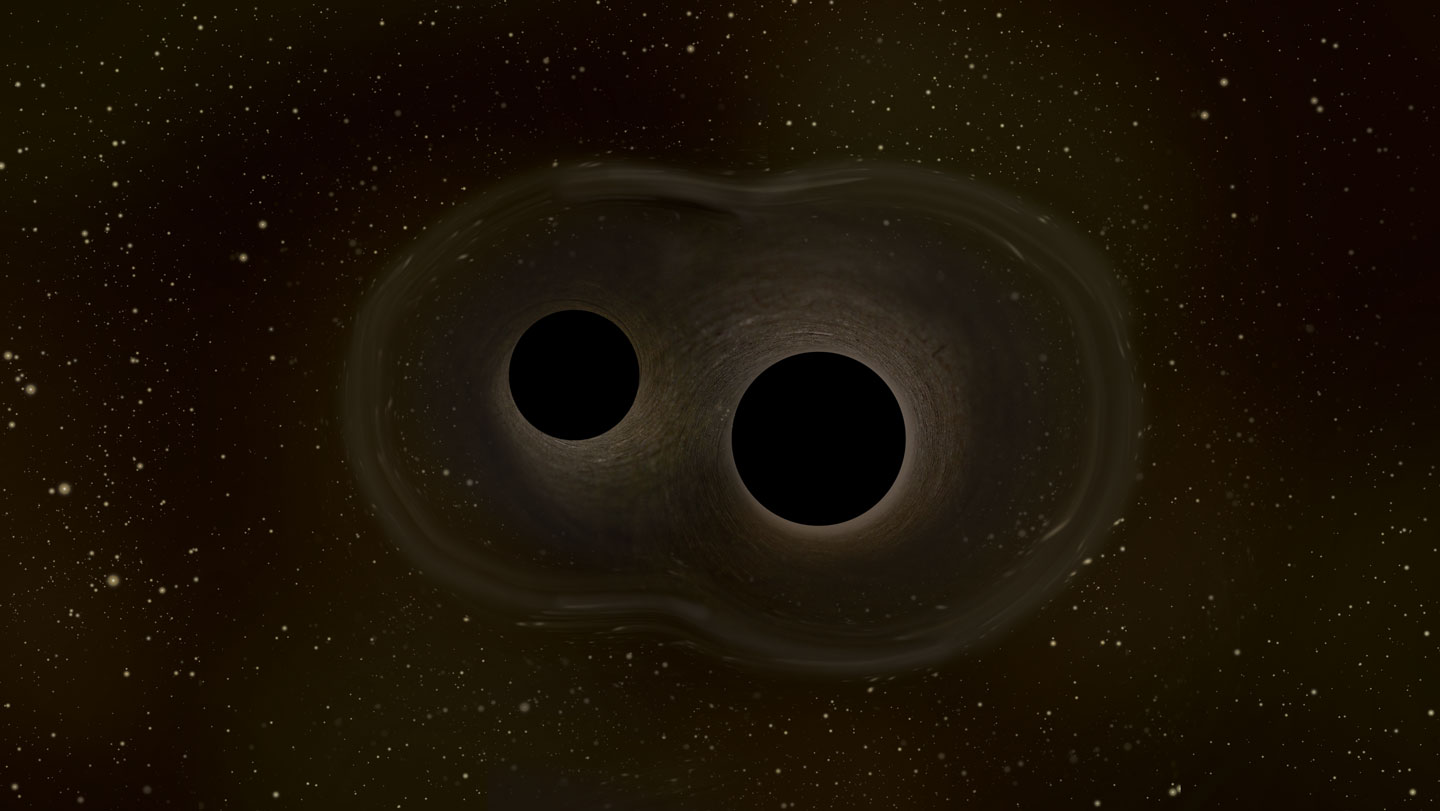
In a galaxy 4.4 billion light-years away, scientists may have discovered the most massive pair of black holes ever found. Together, the behemoths have an estimated mass 60 billion times that of our sun, at least double that of next most massive black hole duo.
The black hole suspects lurk in a dark region devoid of starlight 3,200 light-years across in the middle of a galaxy called Abell 402-BCG. In 2018, scientists found the galaxy had an unusual void. At the time, they suspected the darkness was caused by a dust cloud that blocked the light of the stars within it.
Now, new observations from the James Webb Space Telescope and the Very Large Telescope of the European Southern Observatory, published April 23 in the Astrophysical Journal Letters, reveal that the gap is actually star-free. Instead, the new observations suggest, the void is home to a pair of dancing ultramassive black holes spiraling into one another.
When galaxies collide, all their contents — black holes included — get smooshed together. Due to their gravitational attraction, the central black holes in these galaxies spin closer and closer until they merge into a larger black hole. This chaotic tango of black holes sends any nearby stars flying out of the cosmic ballroom.
The scientists suspect Abell 402-BCG is in the midst of this process, having previously collided with another galaxy. MIT astronomer Michael McDonald and colleagues estimate the black hole pair has likely been together only a few tens of millions of years, making it a new relationship in astronomical terms.
But this black hole tryst isn’t likely to last long. The duo is destined to merge and when they do, they will likely form one of the largest black holes known in the universe. Individual black holes with masses exceeding 60 billion times that of the sun have been found only a few times before.
Both the black holes’ masses and the stage of the merger make the sighting rare. Scientists will use these results to better understand how often supermassive black hole mergers take place and how they shape the galaxies around them.
Read the full article here