



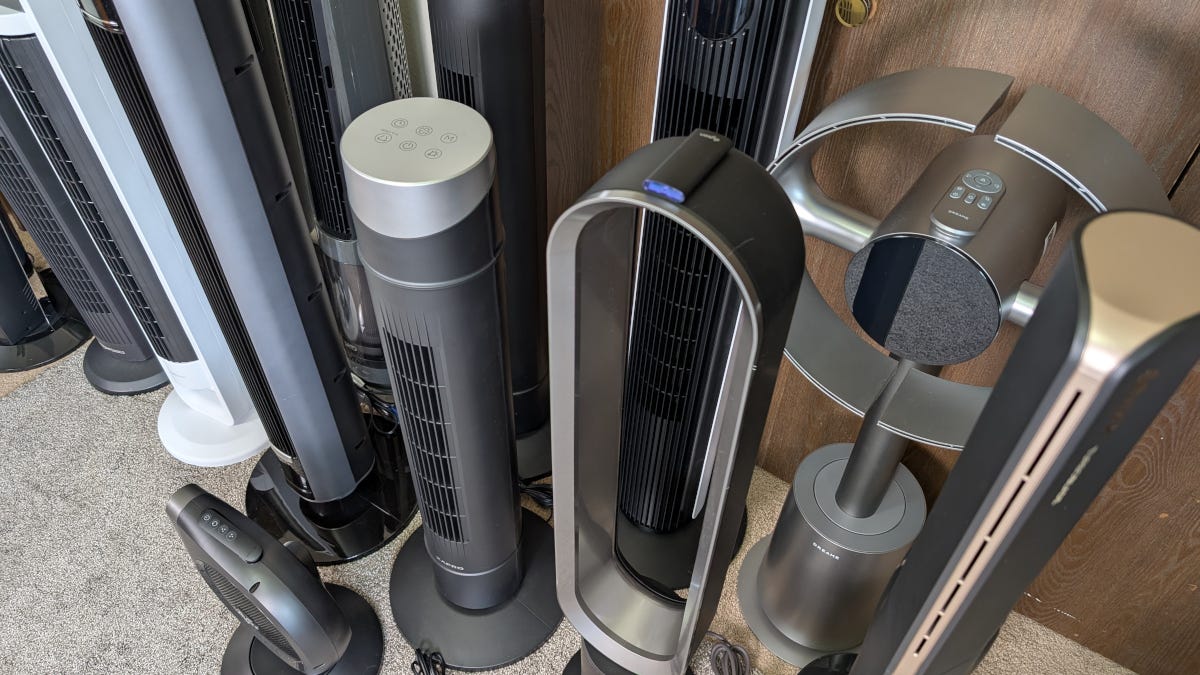
I tested 14 of the latest tower fan models, most of which arrived as review samples from manufacturers.
John Carlsen/CNET
As I planned my tower fan tests, I thought about why people use fans. For example, airflow, loudness and energy efficiency are immediately obvious criteria, but I considered other ways tower fans can be comfortable. Ultimately, I decided that air texture and sound profiles (white noise and device sounds) were also important.
There are 10 total points possible for each test criterion. Here’s how I calculate the product scores:
- Airflow (20%): You’ll get the maximum cooling effect with higher airflows — measured in feet per minute on an anemometer — because it helps sweat evaporate faster.
- Air texture (15%): How a tower fan feels is a game changer for people who are sensitive to airflow like I am, but my texture test is very subjective because I lack the resources to study whether turbulence is the deciding factor. While I evaluated medium and high speeds, I didn’t test the low speed in this category. This is because some of the low speeds were almost imperceptible, like Dyson and Levoit, while faster fans from Amazon Basics and OmniBreeze weren’t much different than the medium speeds.
- Loudness (15%): Even if a tower fan sounds nice, being overly loud can grate on the senses, especially when you or a child is trying to sleep. I measured this in decibels (dBa) across low, medium and high speed settings.
- Sound profile (15%): What a fan sounds like in terms of white noise, and the ability to turn off interface sounds greatly enhances the user experience. Evaluating white noise is the subjective half of this test, while the ability to mute and disable device sounds forms the objective half.
- Energy efficiency (15%): The average energy consumption of tower fans, measured in watts, isn’t particularly high, but it adds up on your electric bill. This is doubly true when running multiple fans 24/7.
- Price (10%) and features (10%): These round out the remainder of the score, but generally depend on static specifications rather than qualitative testing.
Airflow: Speed
While airflow speed is important in terms of providing an objective comparison point between tower fans, it also affects the air texture, loudness and white noise, so it weighs more heavily than other categories in my scoring.
I previously used an anemometer to test handheld vacuums and car vacuums, but it was difficult to log data over time. (Plus, a particularly powerful vacuum damaged it.) For tower fan testing, I upgraded to an app-enabled anemometer for more automatic logging.
For this test, I used speed in feet per minute instead of volume in cubic feet per minute to keep the test simple enough to leave time for other testing. For example, using cubic feet per minute would triple the test time as I’d need to measure the airflow in more than one place. Likewise, it requires knowing the area of each fan’s air outlet, which is more difficult to determine on the narrow outlets of bladeless fans. Using FPM means I have a reasonably balanced comparison between fans of all types and sizes, even if I lose some of the nuance that comes with measuring volume.
My airflow testing uses a simple tunnel — courtesy of Dreame’s massive shipping box — to isolate airflow between the fan and the anemometer. Initially, I used clear plastic to seal one end around the fan so only the exhaust blew through the tunnel, but it interfered with bladeless fans like the Dyson. So I added a second test with the tunnel unsealed. Because I did two kinds of tunnel tests for low, medium and high speeds, this means a total of six one-minute tests per fan. I tested each speed continuously for one minute, giving enough time between each test for speeds to level out. Across 14 fans, that’s over 5,000 second-by-second data points.
Unsealed-tunnel testing: In terms of pure power, the Dreo TurboCool is the undisputed champion. Not only did it produce the highest median speeds in the medium and high categories, but it was the only tower fan with a maximum speed above 1,000 FPM (1,043 FPM). Across the three speeds I tested, it had a median speed of 689 FPM, making it the only fan to surpass 600 FPM.
Zafro 42, Dreo Smart, OmniBreeze and Zafro 36 all produced exceptional airflow above 500 FPM, while the Vornado OSCR37 came in at 492 FPM. None of the other fans came in above 400 FPM, with the Midea, Levoit and Vornado Strata in the 300s. All of the bladeless tower fans produced lower airflow overall than the traditional models. Part of the reason for this is the relatively tiny air outlets on bladeless fans, making measurement more difficult. Dyson and Lasko tied for the lowest median airflow — 197 FPM.
Sealed-tunnel testing: In general, most of the fans performed worse in the sealed-tunnel test, so it plays almost no role in the scoring. However, Midea (472 FPM median) and Amazon Basics (453 FPM median) performed better when sealed. I suspect these fans handle back pressure more effectively, but it doesn’t really affect day-to-day use outside these isolated tests. Lasko and Vornado Strata didn’t consistently do well in sealed-tunnel tests, but did better at low and high speeds, respectively.
Airflow: Air texture
When temperatures are mild, I’d argue that how the air feels on your skin at lower speeds is more important than how fast it blows.
High airflow is only part of the equation for an excellent tower fan — the texture of the airstream matters just as much. Unlike wind speed, my texture test is purely subjective — it’s simply how consistently I enjoyed the breeze from a tower fan at medium and high speeds.
Although the bladeless tower fans from Dyson, Dreame and Shark didn’t perform as well in terms of raw power, they produced the most comfortable air textures at medium and high speeds — 10 out of 10. The Vornado Strata 8 Omni and Levoit Classic also earned perfect texture scores on both settings. While Dreo TurboCool earned 9 out of 10 in both categories, it achieves a 10 when the misting function is active. Lasko WhisperForce earned a perfect texture score at medium speed, though its max speed was slightly more turbulent.
This isn’t to say the other fans were uncomfortable, as Midea and Zafro generally felt nice, while Dreo Smart and Vornado OSCR37 lost some charm at top speed. However, the wind from OmniBreeze and Amazon Basics — the only fans under $40 — was only passable.
Sound profile: Loudness
In terms of volume, none of the tower fans surpassed 60 dBa on the highest speed setting, meaning they’re unlikely to drown out a
I used my trusty sound meter to measure the loudness of each fan from 39 inches away (1 meter). While this is a good distance for testing, most people place fans farther away, so your experience will likely be quieter than these results. I reduced noise as much as possible in my home office for this test, which meant leaving the AC off on a hot day and taking occasional breaks to cool the room as the indoor temperature reached into the 80s.
On low speeds, most of the fans weren’t loud enough for the sound meter to register a result — it can’t measure below 30 dBa. However, Midea (39 dBa), OmniBreeze (41 dBa) and Amazon Basics (42 dBa) were more audible, but not all that loud.
The standouts during medium-speed tests were Shark (39 dBa), Vornado Strata (41 dBa) and Levoit (42 dBa), because they were equal to or better than the worst performers in the low-speed test. OmniBreeze was the loudest in this test, producing 54 dBa, while Dreo Smart and Amazon Basics both came in at or just above 50 dBa. In general, I found most fans under 50 dBa to be more than quiet enough for a bedroom at night.
Although none of the fans was quieter than 50 dBa in the high-speed test, Amazon Basics (51 dBa), Vornado Strata (51 dBa), Shark (53 dBa), Dyson Cool (54 dBa) and Zafro 36 (54 dBa) were all equal to or quieter than the loudest models of the medium-speed tests. Both Dreo models were the loudest in this test at 59 dBa.
Sound profile: White noise
While I’ll admit my subjective ear isn’t ideal for rating white noise on fans like the Dyson Cool, I’ve extensively used white noise daily for well over a decade to help me sleep.
If you rely on the noise a tower fan makes almost as much as its ability to blow air, you can relate to how some fans have idiosyncrasies like wobbles, whines and hums that spoil otherwise great white noise. Fans with fewer of these, or where they were pleasant, earned more credit.
The tower fans with the cleanest, most enjoyable white noise were Dreo, Dyson and Levoit. I’m particularly fond of Levoit’s respective hum and whoosh on low and high speeds. Dyson’s pleasant hiss was similarly outstanding as was the loudness of Dreo’s white noise. While Midea’s slight wobble and Zafro’s humming oscillation on low speeds were nearly as pleasant, the overall white noise quality is excellent.
Vornado Strata, Shark TurboBlade, Dreame, Lasko and Amazon Basics all had various wobbles, whines and hisses that stood out as I listened. Short-term white noise is good, but might grate on the nerves of people with sensory sensitivities after a while. Vornado OSCR37’s whine and wobble were even more distracting. Still, the worst white noise profile was OmniBreeze, which has a whir and a whine that are borderline annoying, especially because the whine changes pitch when you turn on the oscillation.
Sound profile: Beeps and clicks
Loud beeps and overly clicky remotes can break focus and disturb light sleepers.
Another sound consideration beyond white noise and loudness is how the tower fan sounds when you’re controlling it. The gold standard is a fan that has beeps, but also allows you to disable them until you want them again: a persistent mute function. Dreo, Shark, Levoit and Zafro all have this setting, though Zafro retains a startup chime, even if you unplug the fan to move it to another room. Dreame has a semi-persistent mute that resets when changing outlets.
Dyson, Lasko and Vornado all lack beeps entirely, but this removes an audio feedback option that might benefit people with visual impairments.
While OmniBreeze has a mute function, it resets every time to turn the fan off, which I’ve found very distracting. Midea lacks a mute function entirely.
Another thing I listened for was how clicky a remote was, again giving more credit to silent remotes like those of Vornado and OmniBreeze. Dyson and Shark’s remote made noise, but it was relatively quiet. However, most tower fan remotes landed in the moderately clicky category — Dreo, Zafro, Levoit, Midea and Dreame — they aren’t loud by any means, but noticeable. Lasko’s remote felt the loudest and had a harsh click that I found unpleasant.
Energy efficiency
I used Tapo P115 smart plugs to monitor each fan’s energy draw in low and high modes during the other tests.
While tower fans aren’t necessarily energy hogs compared to other cooling methods, having more efficient devices can save a fair amount on energy bills, particularly when using multiple fans in a household.
The average power draw on the lowest fan speed was 9 watts, with the Vornado Strata 8 Omni (1 watt) earning the prize for most efficient, even if it’s a small fan. Lasko, Levoit and Zafro weren’t far behind at 2 watts of energy draw. Except for Midea (20 watts), Amazon Basics (21 watts), OmniBreeze (24 watts) and Vornado OSCR37 AE (36 watts), the other fans all came in below 6W on low.
Vornado Strata (13 watts) and Levoit Classic (19 watts) maintained dominance in the highest-speed testing as well, with Zafro and Dreo Smart falling below 25 watts. Amazon Basics, Dreo TurboCool, Lasko and Midea form the center of the pack, mostly keeping close to the average of 34 watts. Shark, Dyson, Dreame, OmniBreeze and Vornado OSCR37 AE were the least-efficient models in this test, averaging 49 watts.
Tower fan test results
| Tower fan | Median airflow | Texture | Max loudness | White noise | Beeps and clicks | Max power consumption |
|---|---|---|---|---|---|---|
| Zafro 36 | 532 FPM | 9/10 | 54 dBa | 9/10 | 9/10 | 20 watts |
| Vornado Strata 8 Omni | 335 FPM | 10/10 | 51 dBa | 8/10 | 9.5/10 | 13 watts |
| Levoit Classic 42-inch | 335 FPM | 10/10 | 55 dBa | 10/10 | 9/10 | 19 watts |
| Dreo TurboCool 765S | 689 FPM | 9/10 | 59 dBa | 10/10 | 9/10 | 40 watts |
| Shark TurboBlade | 236 FPM | 10/10 | 53 dBa | 8/10 | 8/10 | 48 watts |
| OmniBreeze Wi-Fi | 551 FPM | 7/10 | 57 dBa | 6/10 | 8/10 | 50 watts |
| Amazon Basics 28″ | 453 FPM | 6.5/10 | 51 dBa | 8/10 | 4.5/10 | 30 watts |
| Dreame MF10 | 256 FPM | 10/10 | 56 dBa | 8/10 | 8/10 | 45 watts |
| Dreo Smart 554S | 591 FPM | 7.5/10 | 59 dBa | 10/10 | 9/10 | 25 watts |
| Dyson Cool AM07 | 197 FPM | 10/10 | 54 dBa | 10/10 | 9/10 | 50 watts |
| Lasko WhisperForce | 197 FPM | 9.5/10 | 57 dBa | 8/10 | 8/10 | 31 watts |
| Midea Detachable | 335 FPM | 8/10 | 56 dBa | 9/10 | 6.5/10 | 36 watts |
| Vornado OSCR37 AE | 492 FPM | 8/10 | 55 dBa | 7/10 | 9.5/10 | 50 watts |
| Zafro 42 | 591 FPM | 8.5/10 | 56 dBa | 9/10 | 9/10 | 25 watts |
Read the full article here