



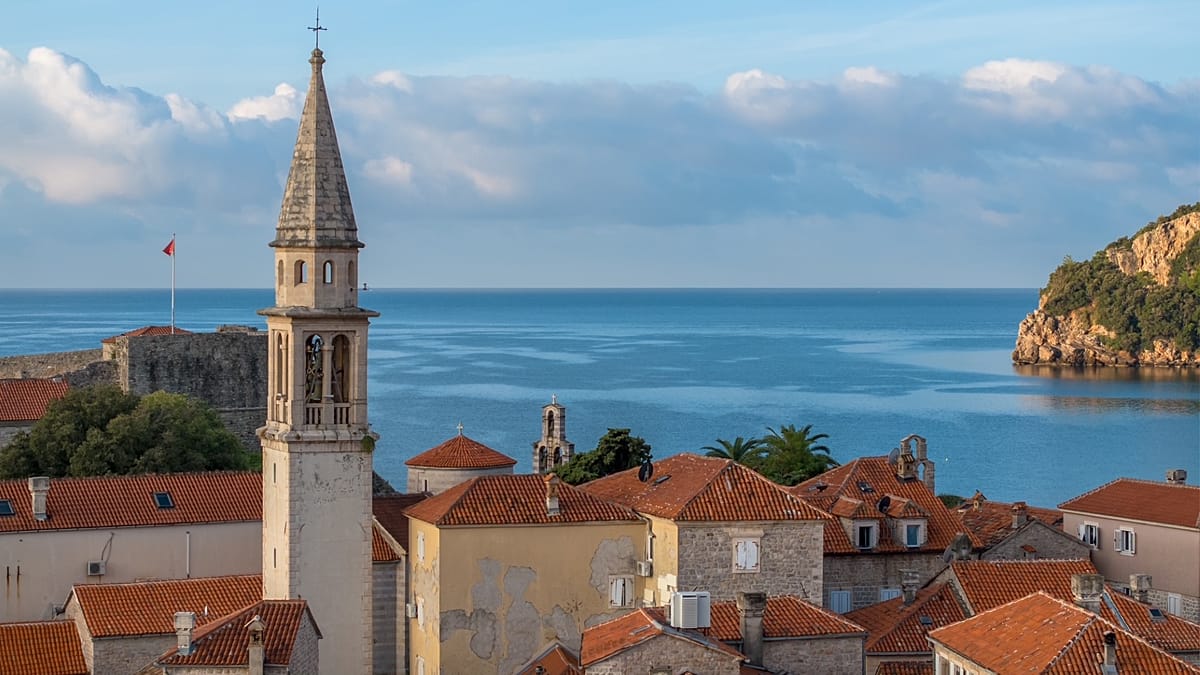
There is something both disconcerting and fascinating about the road trip to Budva in the height of summer.
On one side lies the Adriatic, surprisingly calm, blue and bright. On the other, almost clinging to the shoreline, rise Montenegro’s mountains. Between them runs a road that in July and August seems unable to cope with the sheer number of cars, buses and tourists heading to one of the destinations that is most rapidly gaining prominence in this part of Europe.
Budva is one of the clearest examples of that transformation. The city combines a walled medieval old town with beaches, hotels, restaurants, terraces and a vibrant nightlife.
During the summer months its streets fill with tourists and, when the sun goes down, much of the seafront promenade takes on a different personality.
Music, bars, packed terraces and groups of young people roaming the city until the early hours create an atmosphere that, for a Spanish traveller of a certain generation, may feel surprisingly familiar.
Here it feels like the holidays never end: music spilling out of venues, crammed terraces, restaurants, clubs, families strolling along the seafront and young people intent on stretching the night out.
This is the other face of Montenegro, in contrast with the calmer image projected by its mountains, bays and small coastal villages.
And yet just a few minutes’ walk are enough to enter a completely different setting. The heart of Budva is still its Stari Grad, the old town. Behind its walls lies a maze of narrow stone streets, small squares, churches, restaurants and shops that speaks of the long history of a place considered one of the oldest settlements on the Adriatic.
Exploring it at sunset reveals the duality that probably explains much of Budva’s tourist success: you can spend the morning on the beach, wander a medieval town in the afternoon and end the day having dinner or a drink in a resort that in summer hardly seems to sleep.
Major hotel chains move in
The boom in Budva and Montenegro’s coast has not gone unnoticed by the big international hotel chains. Among them is Spanish group Iberostar, which has strengthened its presence in a country keen to establish itself as one of the Adriatic’s up-and-coming tourist destinations.
The company currently operates four properties in Montenegro, two of them in Budva, a significant presence in a market that is still small compared with other major Mediterranean destinations but increasingly attractive for international tourism.
One of the clearest examples of this bet is the Iberostar Waves Slavija 5*, 1.5 kilometres from Budva’s old town. From its rooftop, home to an infinity pool and the Rooftop Bar, you get sweeping views over the city, the Adriatic and the mountains that frame this stretch of coastline.
But Iberostar’s presence matters beyond any single hotel. The establishment of a Spanish chain with four properties in the country is also a sign of the transformation that Montenegro is undergoing as an emerging tourist destination in Europe.
The coast is rapidly evolving towards a more international hotel offering, especially around Budva, while trying to preserve precisely what sets it apart from other Mediterranean destinations: the extraordinary proximity between the Adriatic, historic towns and a mountainous landscape that begins almost where the sea ends.
Sveti Stefan: From fishing village to tourist icon
Just a few kilometres from Budva lies one of Montenegro’s most recognisable images.
Sveti Stefan is a small historic settlement built on an islet linked to the mainland by a narrow isthmus. Its outline of stone houses and reddish roofs, surrounded by the waters of the Adriatic, has become one of the country’s great postcard views.
What for centuries was a small community tied to fishing underwent a profound transformation from the mid-20th century onwards to become an exclusive tourist enclave and one of Montenegro’s international symbols. The views from the coast and nearby viewpoints offer one of the most spectacular scenes on the Adriatic.
Here too you find the contrast that accompanies travellers along much of their journey through Montenegro: the almost motionless sea set against an extraordinarily rugged, mountainous coastline.
A paradise caught in summer traffic
Driving that coastline also reveals one of the main problems created by Montenegro’s rapid tourism growth. In summer, getting around by road can be unbearably slow.
The coastal road carries an enormous volume of traffic and jams are common. Journeys that look short on the map can take much longer in July and August.
For those arriving by air, Budva has an important advantage: Tivat airport is just a stone’s throw away, offering an easy gateway for holidaymakers heading to this part of Montenegro’s coast.
Another challenge Montenegro faces as tourism grows strongly is entry into the country via the border with Croatia. On average, travellers crossing it by road take around two hours to get through in the height of the summer season.
It is hardly the best calling card for a country that aims to integrate ever more closely with Europe and that receives a large proportion of its visitors via the roads that connect it with its neighbours.
Montenegro is one of the most advanced candidate countries in the negotiations to join the European Union. Its future accession could also transform the experience of those travelling by road through this part of the Balkans.
For a relatively small territory that is increasingly dependent on tourism, easing border bottlenecks and improving infrastructure will be essential if it wants to absorb a growing number of visitors without undermining the traveller’s experience.
All the signs suggest those visitors will keep coming. Montenegro brings together many of the ingredients that have turned other Mediterranean destinations into tourism powerhouses: beaches, climate, heritage, gastronomy and a spectacular coastline concentrated into relatively few kilometres.
On top of that it offers a landscape hard to find elsewhere in the Mediterranean, where the sea and high mountains seem to be constantly competing for the same space.
Budva is probably the most intense expression of all this. It can feel noisy, crowded and chaotic in the peak summer weeks. Its traffic tests your patience and its nightlife is a long way from the image of peaceful retreat that some travellers might associate with Montenegro.
But that is precisely where part of its character lies. Budva is a medieval town on the Adriatic that turns into a major holiday resort when summer arrives. There is something of a Balkan Riviera about it and, at times, something of that Spanish Mediterranean of the 1990s when the nights seemed endless.
Today, the arrival of international hotel groups such as Iberostar shows just how far Montenegro is entering a new tourism phase. Between sea and mountains, between medieval walls and music-filled venues, Montenegro is now seeking its place among Europe’s major holiday destinations. And Budva seems determined to be at the forefront.
Read the full article here