



Calgary city council has approved a new plan aimed at reducing the city’s water demand through a series of measures, including an outdoor watering schedule.
Calgary’s 2026 Water Efficiency Plan targets a 20-per cent reduction in the city’s per capita water demand by 2040 through a series of measures and infrastructure investments.
According to city administration, Calgary achieved “significant reductions” in its water demand under the previous water efficiency plan, but efforts have since plateaued.
Rehana Rajabali, the city’s manager of natural environment and adaptation said the previous plan from 2005 included “low-hanging fruit” like water-efficient fixtures and appliances.
“A lot of the low-hanging fruit has been plucked,” she told council. “So that’s why the current measures under this water efficiency plan have to be more innovative.”
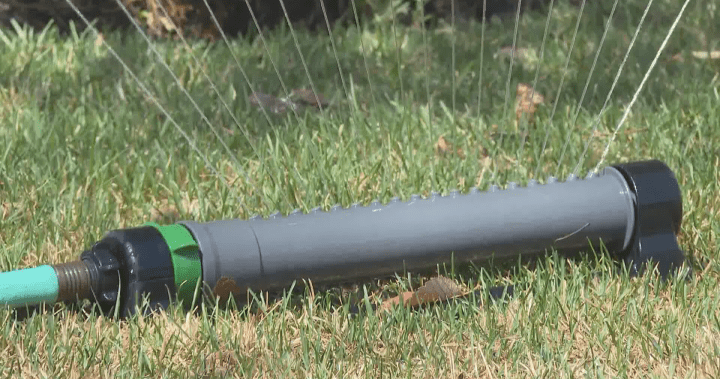
The plan has 11 items to cut down on water demand, including infrastructure investments to repair leaking pipes, an accelerated water meter replacement program, and an outdoor watering schedule that sets designated watering days based on residential addresses.
Under the schedule, odd addresses can water on Wednesday, Friday, and Sunday, while even addresses can water on Tuesday, Thursday, and Saturday. Outdoor watering would be limited to between 7 p.m. and 10 a.m. to reduce evaporation.
According to city officials, lawn and landscape watering is one of the “biggest drivers” of peak summer water demand, which can be up to 40 per cent higher than an average winter day.

Get breaking National news
Get breaking Canada news delivered to your inbox as it happens so you won’t miss a trending story.
“The lawn and landscape schedule helps everyone take turns so we can spread out water demand throughout the week,” Rajabali said.
Council voted 10 to 5 in favour of the plan with councillors Rob Ward, Landon Johnston, Mike Jamieson, Kim Tyers and Dan McLean opposed.
Ward 10 Coun. Andre Chabot said Calgary is late to the game when it comes to using an outdoor watering schedule as a method to curb demand.
“Right now we’re still in a very precarious position with regards to peak demand during the summer, so this would help to maybe reduce that peak demand,” he told reporters.
“We’re actually behind everyone else on this. Others started implementing similar policies back in 2012.”
There was an attempt by Ward 6 Coun. John Pantazopoulos to make the outdoor watering schedule voluntary, but the amendment was narrowly defeated.
“We’re not in an emergency situation, we’re not in a drought situation, and outside of that I don’t think it’s appropriate to ask for those mandatory measures,” said Calgary Mayor Jeromy Farkas, who supported both the plan and Pantazopoulos’ amendment to make the measures voluntary.
Officials said the city will take an “education-first approach” as Calgarians adjust to the new outdoor watering schedule.
“We’re not going to be draconian in the enforcement side of things,” Chabot said. “It’s trying to encourage people to do the right thing.”
The plan expands city authority to issue stop-use orders and in specific instances disconnect water service — issues Ward 12 Coun. Mike Jamieson said he heard concerns about from residents.
“I don’t think this is really a water problem, it’s an infrastructure problem,” he told reporters. “I think there’s a little bit of hypocrisy here.
“I think the city needs to do its part to improve our 22 per cent water loss before we start telling Calgarians when they can and cannot use their water.”
Water Services director Nancy Mackay told council the ability to disconnect is standard utility practice that has existed in Calgary for 20 years, and that the measure has only been used once in the last decade.
According to Mackay, the move would not apply for the outdoor water schedule.
“This additional stop-use order is only about restrictions level three or four when we’d be in an emergency situation and we’d need quick action.”
When it comes to leaking pipes, the plan includes nearly $354 million over the upcoming four-year budget to manage water loss.
According to the plan, the target is to reduce water loss from approximately 22 per cent of treated water in 2024 to 18 per cent by 2030.
© 2026 Global News, a division of Corus Entertainment Inc.
Read the full article here