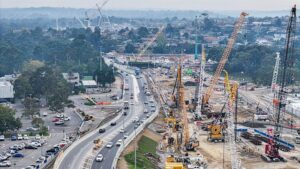



“If we want to develop something sustainable, these autonomous vehicles must be connected with the vertical columns based in public transport, like, for example, the Metro [Tunnel],” he said.
Rueda also suggested EV charging points on city streets be limited, even as electric cars proliferate while societies try to reduce the carbon footprint of petrol-fuelled vehicles that are adding to climate change.
Salvador Rueda speaks to more than a dozen planning and design experts at RMIT University on Tuesday.Credit: Alex Coppel
“Don’t put the charger in the public space for electrical vehicles. For me, it must be forbidden,” he said.
Rueda’s idea is grounded in the belief that “a public space is for people”.
Instead, he proposed EV charging points be concentrated around homes, particularly apartments, so groups of battery-laden vehicles could operate “like a node” and power other services.
Loading
In November last year, Energy Minister Chris Bowen announced new standards had been approved to allow for vehicle-to-grid charging in Australia. In other words, EVs can now be used as a big household battery.
“Because every car has a battery, it is possible to implement a new energy network,” Rueda said.
“We can also develop other strategies to capture the solar energy and accumulate it in these places, to make every territory self-sufficient.”
Rueda, one of the pioneers behind Barcelona’s car-free “superblocks”, said city planners needed to “assure the future” with sustainable and efficient design.
“The future is coming with robots. It is coming with the autonomous vehicles,” he said.

Barcelona has several car-free super blocks.Credit: Alamy
“We need to redesign the networks. It’s very important to define what are the vertical columns of public transport for liveability in our cities.”
Rueda was director of the Urban Ecology Agency of Barcelona for two decades until 2020.
Barcelona gradually created three superblocks from 2016 to 2019, leading to an ambitious proposal to eventually develop more than 500 across the city. Each covers an area of about 400 metres by 400 metres with residential blocks of 150 metres by 150 metres.
Loading
A review of academic studies of the design concluded the innovative model addressed environmental, climate, liveability and health concerns in cities.
“The superblock model can be considered an important public health intervention that will reduce mortality and morbidity and generate cost savings for health and other sectors,” the review in the Environmental Research journal found last year.
Get the day’s breaking news, entertainment ideas and a long read to enjoy. Sign up to receive our Evening Edition newsletter.
Read the full article here