




Budget-conscious phone shoppers could be in for a struggle, and they have AI to thank for it. With memory costs continuing to rise, there could be 22% fewer phones under $400 on the market for the rest of this year and into 2027, according to a new report on Tuesday from technology research and advisory group Omdia.
While premium phones such as the iPhone 17 Pro Max and Samsung Galaxy S26 Ultra, priced well above $1,000, continue to push the envelope of affordability, consumers with tighter wallets willing to forgo fancy features opt for cheaper phones. But if makers of these under-$400 devices are driven out the market, phone buyers with the least economic cushion could be hardest hit.
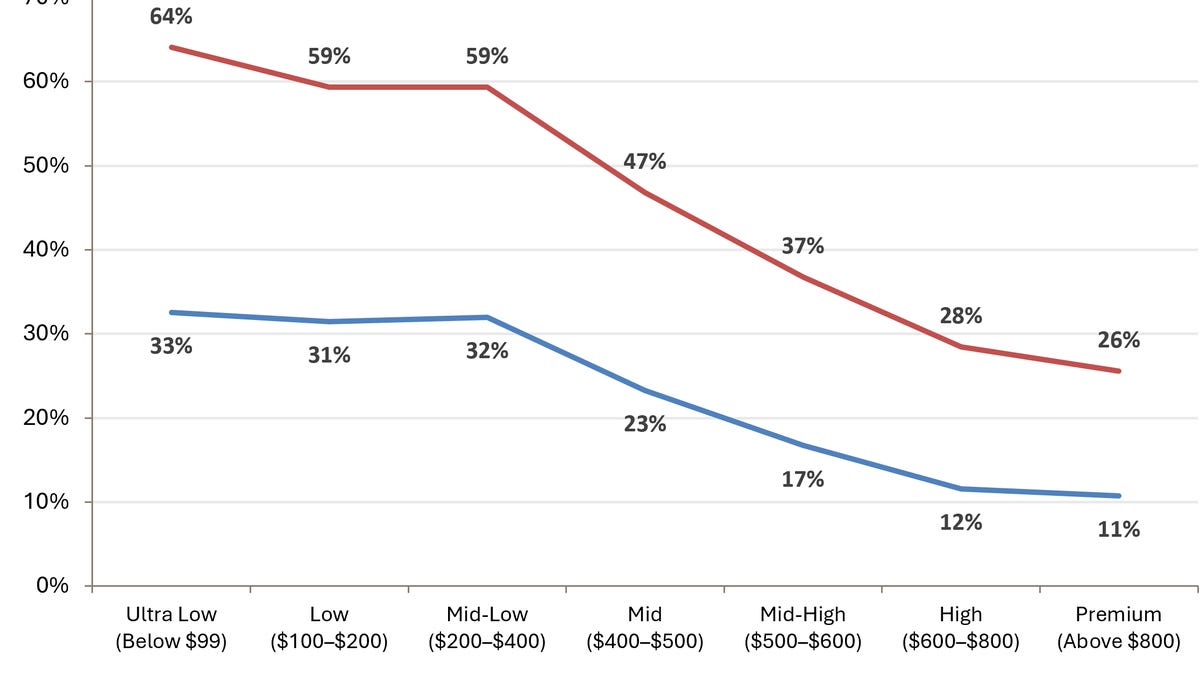
Analyst Zaker Li said that for phones in that price range, memory manufacturing costs have nearly doubled between the third quarter of 2025 and the first quarter of 2026. For phones above $400, memory costs have increased by more than 100%, according to Omdia’s Quarterly Smartphone Technology Trends report.
Li said that some companies are trying to offset the increased memory expense by cutting costs on other components, such as screens, sensors and radio frequency modules, which aren’t in short supply.
But Li said there is not a lot of wiggle room to keep phones as cheap as they have been with the rapidly increasing cost of memory.
As Chinese phone-makers such as Oppo, Vivo, Honor, Xiaomi and Transsion are forced to raise phone prices, cost-conscious consumers will stop buying them, Li said. As demand continues to decline due to higher prices, companies could stop producing low-end phones, Li predicts.
The gloomy analysis jibes with what CNET mobile managing editor David Lumb learned at Mobile World Congress in Barcelona in March: The rapid building out of AI infrastructure is using up memory, with a lot of RAM needed to power AI systems. It’s caused a global RAM shortage that is leading to higher prices for phones, and also the possibility that companies won’t make cheaper phones, since it won’t be worth it.
“Some vendors are telling us that they are considering leaving that [budget] segment entirely, because if you sell a phone for $150, and half the cost is memory, where will you make money? There’s no point in selling products, right?” Francisco Jeronimo, vice president for Worldwide Client Devices at IDC, told Lumb at MWC.
Whereas AI needs a lot of RAM for its countless processes, phones use it for storage and to keep multiple apps open at the same time.
The outlook for low-budget phones
In the short term, Omdia says the global phone market will drop 12% this year compared to 2025, because of the predicted 22% decrease in shipments of phones costing less than $400.
Long term, the prospects are brighter. IDC’s Francisco Jeronimo told CNET in March that the RAM crisis should be resolved by the fall of 2027 or early 2028. The AI infrastructure build-out will slow down, and more RAM will be produced.
In the meantime, consumers will stick with their current phones and avoid paying higher prices for upgrades, Forrester VP and principal analyst Dipanjan Chatterjee told Lumb. To counter that, companies will have to attract people to other non-phone products or add more features to phones to convince folks to buy them.
For those willing to pony up a bit more for a new device, Omdia says shipments of phones costing more than $400 will grow by 5.7% this year, which would match previous patterns: Even in times of economic distress, premium phones such as the iPhone 17 Pro Max and Galaxy S26 Ultra continue to sell, as their customers are more insulated from financial shocks. As a result of this RAM crisis, phone-makers are focusing more on higher-end devices, and a large percentage of consumers don’t mind spending that much, Omdia said. The memory-per-device cost percentage also drops significantly with higher-priced phones, analyst Li said.
Read the full article here