



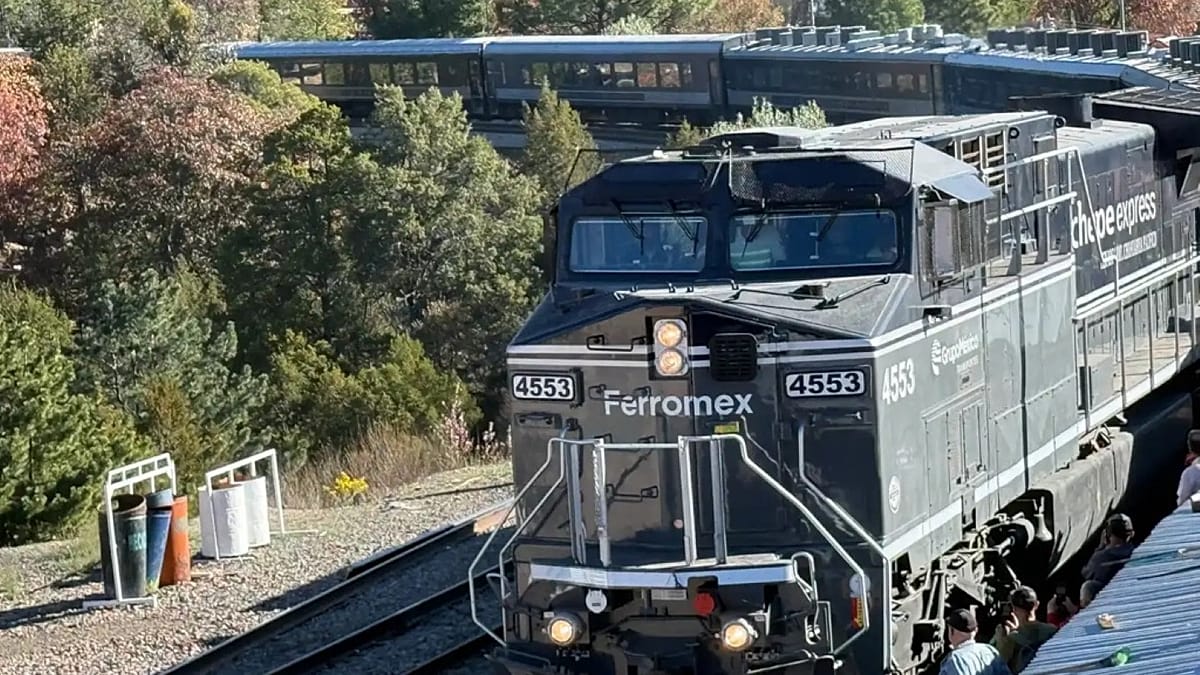
Travelling on the Chepe Express is one of the best ways to discover Chihuahua, Mexico’s largest stateon the border with the United States.
Along its 350-kilometre, 10-hour journey, the train offers a unique natural spectacle: In just a few hours you pass from mountainous landscapes and a cool climate, at an altitude of almost 2,400 metres, to warm, almost desert-like areas at just 25 metres above sea level.
The route connects Creel, in the heart of the Sierra Madre Occidental, with Los Mochis, in Sinaloa, near the Pacific Ocean. For many travellers, the latter is the starting point. In our case, the journey begins in Divisadero, a stop in the heart of the Copper Canyon.
Natural balcony over the canyons
Divisadero is one of the best places to contemplate the magnitude of the canyon system, made up ofup to six canyons stretching for 1,800 kilometres. Its size is impressive: it’s up to four times the size of the Grand Canyon in Colorado.
In addition to itsspectacular views, this enclave has become a reference point for adventure tourism. Here you will find the Barrancas del Cobre Park, which offers activities such as the ZipRider, the second longest zip line in the world, a circuit of seven other zip lines, cable cars 400 metres above sea level and via ferrata routes.
For adrenaline junkies, Creel offers quad biking in the impressive Valle de los Monjes, a unique landscape where huge vertical rock formations, up to 60 metres high, have been sculpted over millions of years by erosion. Many of them resemble human figures in robes as if they were monks in procession.
Rarámuri culture: The soul of the sierra
These mountains are home to the Rarámuri or Tarahumara people, one of the most representative indigenous communities in the state of Chihuahua. They are known for their physical endurance and for maintaining a lifestyle linked to nature and traditions. They are rural and self-sufficient communities that live dispersed under adobe, wood or stone roofs.
This is the case of Azucena who lives with her family in a cave dug into a rock, preserving the tradition of her mother Petra who died three years ago at the age of 97. She takes turns every year and a half with her three other sisters and their respective families to live in this place.
The Rarámuri presence, with their typical clothing of long and colourful skirts on women and girls, will be a constant throughout the trip. They will even help guide us on hiking trails in Divisadero, as in the case of Felicitas, a spritely nine-year-old girl who will take us through the countryside to view the canyons from different points, with a master class in pure nature that will remind us of the real connection to Mexico and its local culture.
During the trip on the Chepe Express we will also see them at the stops offering their handicrafts (especially baskets) to passengers, one of the best souvenirs you can take away from this experience.
On the train, 70% of the tourism is domestic; 20% is from North America and the remaining 10% comes from Asia and Europe.
A journey of contrasts
Katya Dittmar, a German from Bavaria who has lived in Mexico for 15 years, says she is impressed by the trip. “It’s a spectacular experience, with landscapes that look like a film.”
For Spaniard Laura García, the trip is particularly striking. “There is nothing like it in Europe with so many changes of scenery in such a short time,” she says. Her husband, Uri Gil, agrees: “The contrast of landscapesalong the route is what impressed me the most because I’ve never seen anything like it before.”
Mauricio Navarro, assistant manager of the train, highlights the unique character of the journey: “The difference with other trains is that we offer a singular route with dramatic changes in altitude that make this trip unique and very connected to the real Mexico and its local culture.”
Engineering and luxury on rails
The Chepe Express passes through 86 tunnels and crosses 37 bridges, the highest at 105 metres. It has three classes – first, business and tourist – with all the comforts of a luxury train. In first class, passengers can enjoy an open panoramic carriage with a bar to watch the scenery to the sound of music. There is also a famous 360-degree dining dome with spectacular views.
For Spanish photographer Ignacio Izquierdo this is his second time on the Chepe Express and he is enjoying it even more than the first. “The train is essential to get to know the authentic Mexico that Chihuahua is part of,” he says. “It goes through various ecosystems, starting from the top of the mountains, passing through subtropical climates to desert landscapes, which enriches the trip a lot.”
Many travellers decide to get off in El Fuerte, a Pueblo Mágico with a remarkable colonial heritage, a good hotel offer and a strategic location, thanks to its connection with Los Mochis.
The trip ends precisely in this coastal city, gateway to the Pacific. From there, some travellers continue on to the beach, like Katy from Germany, thus prolonging an experience that goes far beyond a simple train journey.
The Chepe Express is not just a train journey. It is a journey through the natural, cultural and human diversity of northern Mexico. A journey that crosses mountains and ravines, but also stories, traditions and ways of life that remain intact over time.
Read the full article here