


At a Senate hearing, Defense Secretary Pete Hegseth offered the line that may define the next era of presidential war-making: “We are in a ceasefire right now, which our understanding means, the 60-day clock pauses or stops.”
The Trump administration’s view is clear: The hostilities with Iran have terminated for now. That means the May 1 deadline for 60 days doesn’t apply. But Hegseth’s theory isn’t an established constitutional fact. It’s a challenge to Congress, one that dares lawmakers to disagree and limit the president’s power.
The Senate’s 47-50 vote rejecting another Iran War Powers measure on April 30, however, shows Congress is still treating its own constitutional authority as optional. It’s a naked desertion of its responsibilities. And it’s part of a pattern.
Congressional Surrender
The War Powers Resolution says a president must terminate the use of U.S. forces after 60 days unless Congress has declared war, enacted specific authorization, extended the period by law, or is physically unable to meet after an attack.
The Constitution Annotated notes that Article I gives Congress the power “To declare War,” even as the president’s Article II powers remain contested. The current Iran fight is not a mystery of legal interpretation. It’s a test of institutional appetite. Or, perhaps more accurately, the search for spines in a nest of invertebrates.
The administration’s ceasefire-as-clock-pause argument is novel enough that Brennan Center lawyer Katherine Yon Ebright told AP: “Nothing in the text or design of the War Powers Resolution suggests that the 60-day clock can be paused or terminated.”
But a statute that depends on Congress means little when Congress declines to act. The Senate record shows repeated failed motions to remove unauthorized U.S. forces from hostilities against Iran in March and April. And the House record shows H. Con. Res. 40 failed 213-214 on April 16.
This is not just executive overreach. It is legislative desertion with a roll call.
Congress’s War Powers Failure Is a Habit
Congress’s Iran posture has plenty of precedent.
In Lebanon in 1983, Congress used the statute to authorize Marines in the Multinational Force for 18 months, proving the law can become a bargaining framework rather than a withdrawal trigger. In Kosovo in 1999, the House rejected war, rejected withdrawal and deadlocked on support for Clinton’s air campaign.
Then, in Libya in 2011, the Obama administration argued the 60-day limit did not apply because U.S. forces played a limited, supporting role and were not in sustained fighting or active exchanges of fire. In Yemen in 2019, Congress passed a War Powers resolution, Trump vetoed it, and the Senate failed 53-45 to override.
After the Soleimani strike, Congress passed a 2020 Iran restraint; Trump vetoed that too, and the Senate fell short again. Biden’s 2024 Houthi strikes used the same executive grammar, with War Powers notices invoking Article II and describing “discrete strikes.”
The record does not excuse Trump’s Iran position. It sharpens the charge against Congress. The familiar pattern is presidential action, congressional protest, failed or symbolic votes, and no veto-proof majority.
The outlier in today’s case is narrower: the claim that a ceasefire can pause or terminate the statutory clock while military pressure continues. Congress can deliver its verdict on that claim if it chooses.
Republicans Outsource War to Trump
Iran agreed to a temporary ceasefire after Operation Epic Fury, and the Trump administration argues the president must retain flexibility against continuing Iranian threats.
The congressional time pressure threatens to undermine the war strategy of applying maximum pressure on Tehran to make a deal. If Iran knows the president is on the clock with Congress, it has less incentive to negotiate.
Interpreting the ceasefire as a clock-stopper on the War Powers Act’s time scale solves that problem by maintaining the pressure through the threat of sudden renewed military action and freeing the president’s hand to act as such if diplomacy fails.
The OMB statement opposing the House measure said the resolution would undermine the president’s ability to protect U.S. forces and “speak with one voice” in sensitive negotiations.
Sen. Kevin Cramer, a North Dakota Republican, gave the blunt constitutional version: “Our founders created a really strong executive, like it or not like it.”
Yet that argument points toward authorization, not avoidance. If Republicans believe Trump’s Iran campaign is necessary, they can vote to authorize it. If they believe the mission has ended, they can define the limits of any post-ceasefire naval operation.
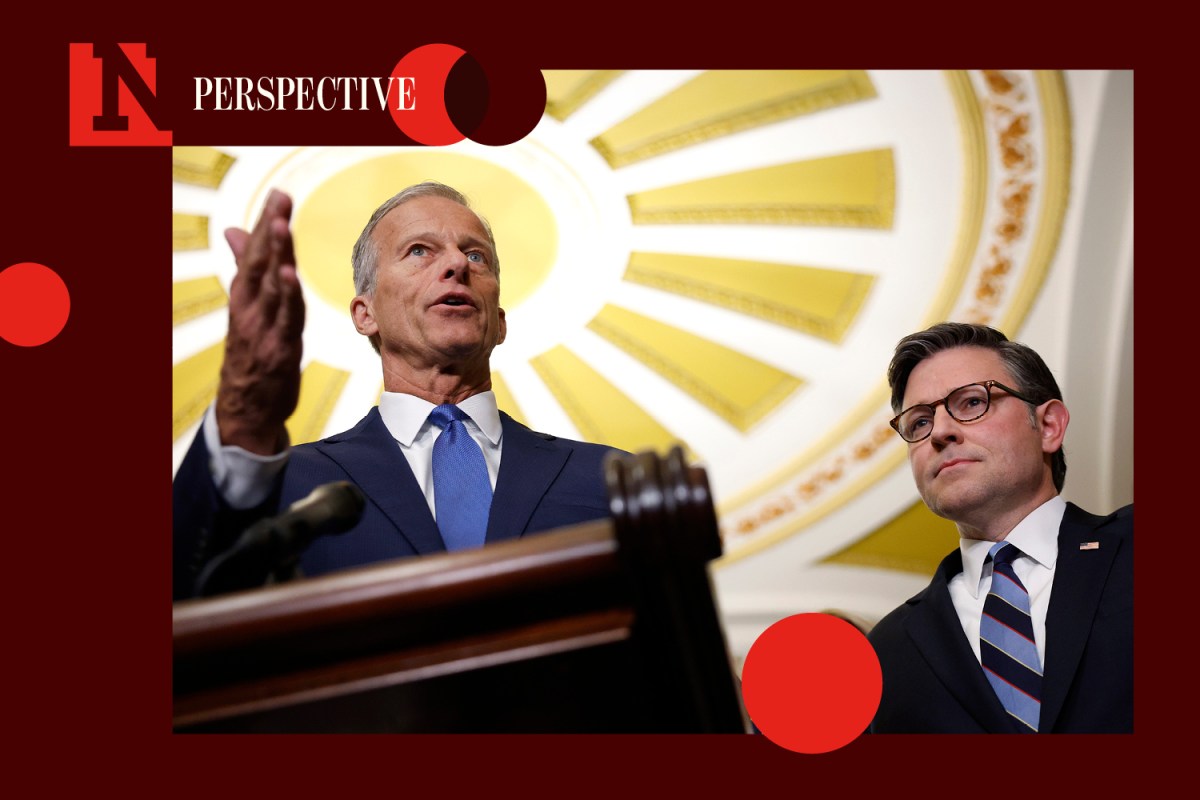
Instead, Senate Majority Leader John Thune said he did not plan a vote on force authorization: “I’m listening carefully to what the members of our conference are saying, and at this point I don’t see that.”
That is not constitutional conservatism. It is political escrow: let the president own the triumph if it works and let legal ambiguity absorb the risk if it does not.
Democrats Make Constitutional Case Easy to Dismiss
Democrats are demanding that Congress be asked to authorize the Iran war, a reasonable constitutional argument. But they are putting the case in rhetorical terms that make it more politically difficult for any sympathetic Republicans to join them.
Senator Adam Schiff, a California Democrat, said in a March statement: “There will be soon no constraint left on this president or any other to make war whenever they choose.”
But the Senate vote pattern shows the anti-war push has functioned mostly as a Democratic messaging vehicle rather than a durable institutional coalition. The April 30 roll call had only two Republicans, Susan Collins and Rand Paul, voting yea, while Democrat John Fetterman voted nay and three senators did not vote.
Schiff’s office framed one March measure as an effort to end Trump’s “illegal war,” according to its own release, which may be legally arguable but politically narrows the invitation to Republicans who distrust Democratic anti-Trump framing.
The irony is that Democrats’ strongest point is not that Trump is uniquely dangerous, as they are constantly and overwroughtly pointing out, or even the particulars of their opposition to the Iran war and how it is handled. Both of those are unlikely to win over many of their Republican colleagues.
The stronger and bipartisan argument is that Congress has built a habit of surrendering war powers across presidencies, and the War Powers Project found that executive power has steadily accumulated while courts have often avoided settling the disputes.
Holding a vote should not come down to support for Trump or the war. It is about the role of Congress as an institution. The question of war powers is more profound than petty squabbles and point-scoring. It is literally life-or-death.
A Congress serious about its role would make that argument less partisan, not more. There is simply too much at stake for partisan gameplaying.
Ceasefire Loophole Will Outlive Trump
The administration’s practical claim is that no exchange of fire has occurred since the April 7 ceasefire, though the U.S. Navy is still maintaining a blockade to prevent Iranian oil tankers from getting out to sea.
Future presidents will study not only the legal memo but the congressional silence that followed it.
Senator Lisa Murkowski, an Alaska Republican, said: “I do not believe we should engage in open-ended military action without clear accountability.” She added: “Congress has a role.”
Meanwhile, Senator Susan Collins, a Maine Republican, said the commander-in-chief’s authority “is not without limits” and that the 60-day deadline is “not a suggestion, it is a requirement.”
Those statements are correct, but they are also lonely. When Congress leaves enforcement to a few dissenters, the institution is not checking the president. It is preserving individual alibis.
The next phase may turn on whether the ceasefire holds, whether the administration seeks a limited authorization, or whether lawmakers keep accepting briefings as substitutes for votes.
But the precedent already taking shape is clear from the April 30 vote: a president can launch a war, declare it functionally paused, and watch Congress fail to muster the will either to bless it or stop it.
Voters looking for restraint should stop asking whether the War Powers Resolution contains the right verbs. The harder question is whether Congress contains enough members willing to use them.
Hey gang, Carlo Versano here. I hope you enjoyed this article. As Newsweek‘s Director of Politics and Culture and editor of the 1600 newsletter, I’m keen to hear what you think. Now, Newsweek is offering a new service to allow you to communicate directly with me in the form of a text message chat. You can sign up and get a direct line to me, as well as the reporters who work for me. You can shape our coverage.
As a Newsweek member, we’re offering this service to you for free. You can sign up below, or read more about how it works here. Let’s talk!
Read the full article here