



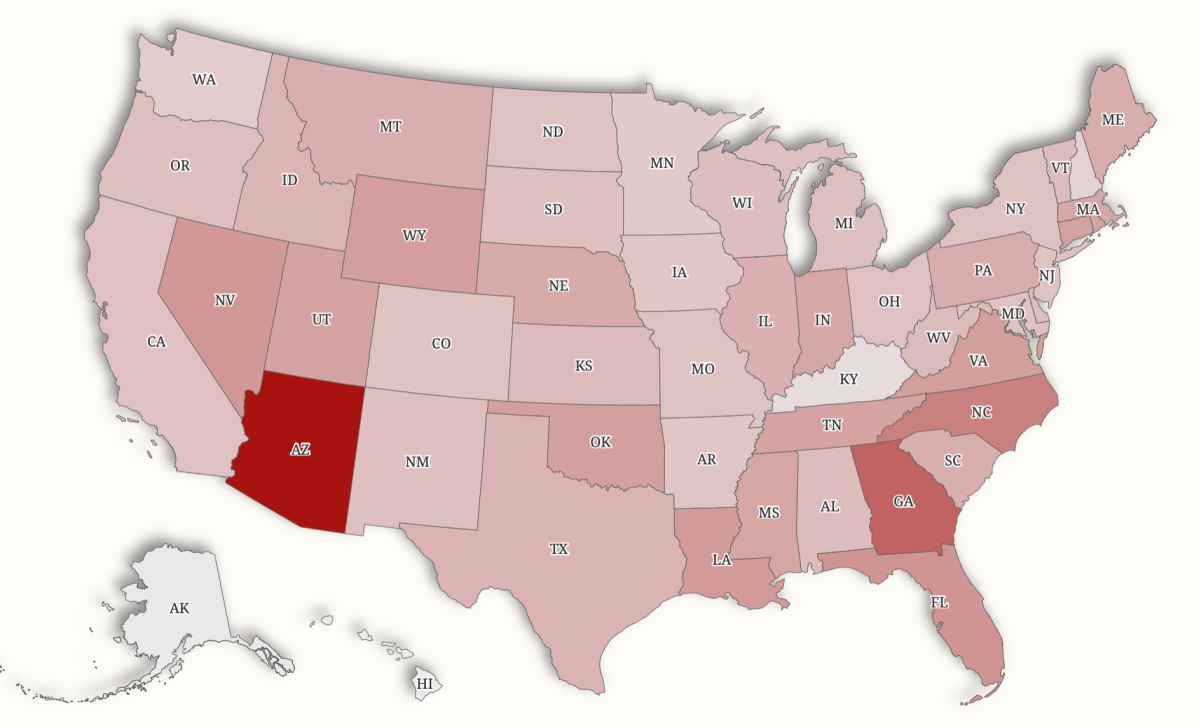
In nearly every U.S. state, the number of people receiving Supplemental Nutrition Assistance Program (SNAP) benefits has fallen since the start of President Donald Trump’s second administration.
Federal data from the U.S. Department of Agriculture (USDA) shows a nationwide drop of about 4.2 million recipients over the past year, with the decline accelerating after policy changes took effect in mid-2025.
SNAP, the country’s largest food assistance program, helps low- and no-income households cover grocery costs. The recent fall in participation coincides with the passage of the One Big Beautiful Bill Act (OBBBA) in July 2025, which tightened eligibility rules and expanded work requirements.
Preliminary USDA figures show participation fell from about 42.8 million people in January 2025 to just under 38.6 million by January 2026, with the sharpest declines occurring in the second half of the year as the new rules were rolled out.
Drop in SNAP Recipients
For much of early 2025, nationwide enrollment remained comparatively stable above 42 million, but still with a reduction of just over 800,000 recipients between January and July. However, once the new rules began to take effect, the number of recipients fell by around 3.4 million between August 2025 and January 2026.
The most pronounced monthly change occurred between October and November 2025, when enrollment dropped from 41,091,800 to 39,997,940, meaning more than 1.09 million people left the program in just one month. The USDA had set November 1 as the deadline for state-level compliance with the new requirements.
At the state level, the declines vary significantly. By far, the largest drop in SNAP participation has been recorded in Arizona. Newsweek analysis of USDA data found the Grand Canyon State experienced a 43.27 percent of its SNAP recipients lose their benefits between January 2025 and 2026: a loss of 388,781 recipients.
States with high levels of SNAP participation saw large drops. Georgia saw a decrease of 505,290 recipients, while Florida lost 464,978 participants. California, the state with the highest total enrollment, recorded a decline of 305,425.
Texas (-292,238), North Carolina (-293,303), and Pennsylvania (-191,793) also recorded substantial drops.
The smallest declines were recorded in states such as Kentucky, which saw a marginal reduction of just 1,220 recipients, and New Hampshire, down 1,559. Washington state experienced one of the smallest proportional decreases at 3.47 percent, while Minnesota (-3.52 percent) and Alaska (-2.83 percent) also ranked among the lowest percentage changes.
Alaska and Hawaii were the only two states to register increases in SNAP participation over the period, rising by 1,781 and 5,332 recipients, respectively.
The decline in SNAP participation was not unexpected. In its August 2025 analysis of the legislation, the Congressional Budget Office estimated that approximately 4 million people would be affected by reduced or lost benefits under the OBBBA changes. This figure included both individuals fully removed from the program and households experiencing reduced assistance due to another member losing eligibility.
The national data released so far closely aligns with that projection, with total enrollment falling by around 4.2 million between January 2025 and January 2026.
Why Have Some SNAP Recipients Lost Benefits?
The post-July 2025 decline in SNAP enrollment has been closely linked to the policy changes introduced under the OBBBA. One of the most significant adjustments was the expansion of work requirements for adults up to age 64, including stricter rules for Able-Bodied Adults Without Dependents tied to employment or training participation.
Previously exempt groups were also affected. The removal of exemptions for veterans, homeless individuals, and former foster youth brought additional recipients into the work requirement framework. Meanwhile, caregiver exemptions were narrowed, with some parents of children aged 14 and older now required to meet work or training conditions to remain eligible.
These changes have not only affected eligibility thresholds, but also administrative continuity. In many cases, recipients have not necessarily been removed due to higher income, but rather due to procedural or compliance issues. Missing paperwork deadlines or failing to complete recertification requirements has contributed to losses in coverage.
SNAP recipients typically must recertify their eligibility every three to six months, depending on the state. When individuals become subject to new rules during that process, they may lose benefits if they do not meet the updated conditions or fail to complete administrative steps in time.
Read the full article here