



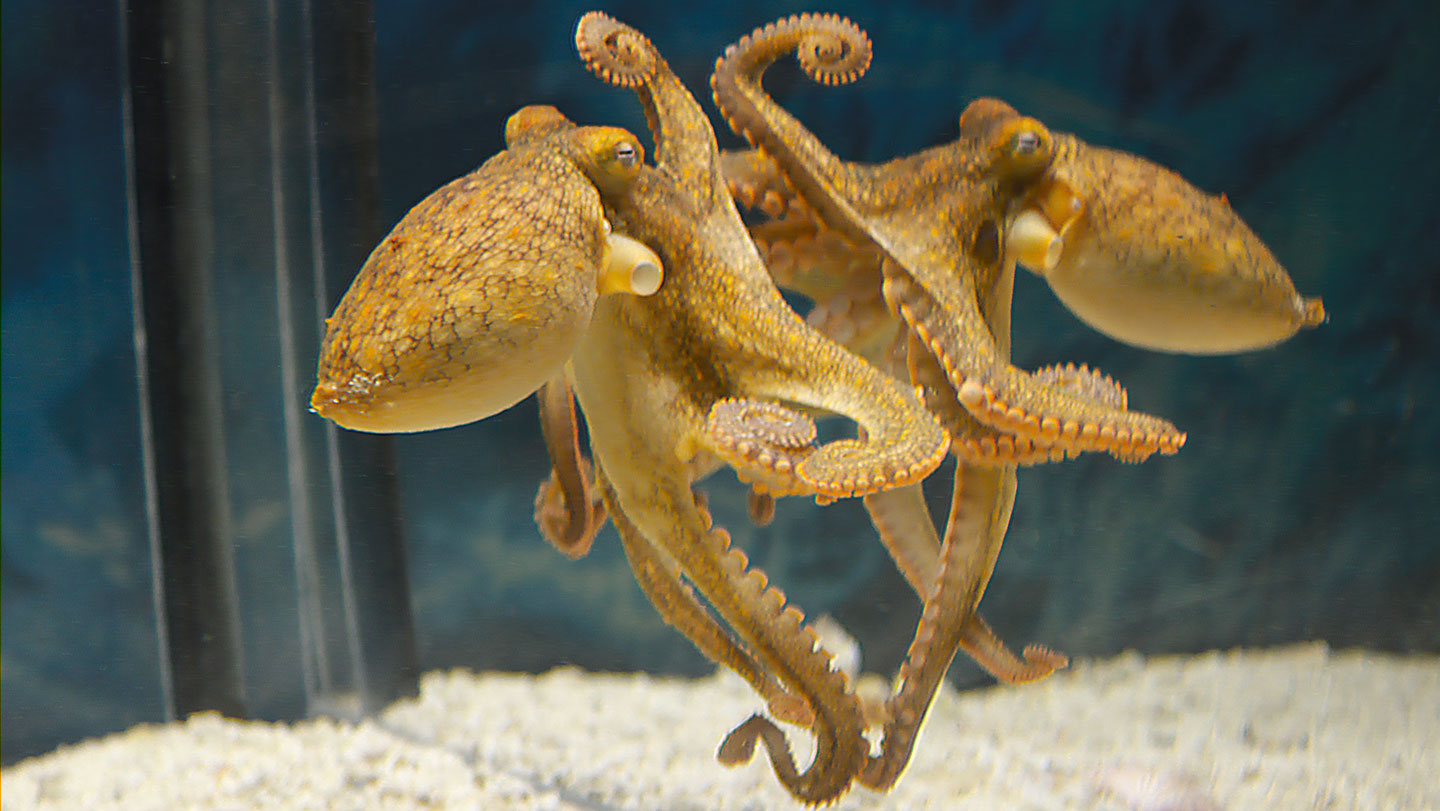
Mirrors are tricky. Even humans aren’t born with an intuitive understanding of them; we have to learn how they work. Now, scientists have discovered that the California two-spot octopus (Octopus bimaculoides) can also learn to use mirrors, researchers report June 3 in Current Biology.
When brainstorming octopus experiments, Mary Kieseler, a neuroscientist at the University of Fribourg in Switzerland, had wondered whether the famously smart creatures could pass the mirror test, which evaluates if an animal can identify itself in a mirror. Because of the challenging logistics the mirror self-recognition test would entail underwater, Kieseler and her team decided to first study whether octopuses could use mirrors as a tool to do something they’re already great at. And octopuses are great at hunting prey.
The team began by habituating three wild-caught octopuses to a mirror covering half their tank. They let the octopuses hide from the mirror and even explore the other half of the tank behind it. After the octopuses became comfortable with seeing their reflection and eating in front of the mirror, the team gave them a task: Find a hidden jar with a tasty crab inside, placed where the snack could be found using only its reflection in the mirror.
Initially, the octopuses approached the mirror, then turned around to find their prey. But after about 10 to 12 trials, each animal learned to crawl directly to the crab without the mirror pit stop.
When using real crabs, there was no way to know whether the octopuses might have been relying on smell or another nonvisual sense to hunt, so Kieseler and her team came up with one final test. Rather than using real crabs, the team used virtual ones.
They put each octopus in a small three-sided chamber that walled off their view of anything other than a mirror at the tank’s front. A screen behind the chamber displayed videos of a crab appearing to move along either side of the back wall, creating a reflection visible to the octopus. To receive a real crab as a reward, the animals had to navigate out of the chamber and move to the correct side.
Motivating the octopuses to participate in the experiment was a challenge, particularly if they weren’t hungry enough, Kieseler says. “They did plenty of trials where they just fell asleep or sat in front of the mirror.” Each octopus would complete only about one trial per day.
The octopuses successfully chose the correct side in about 73 percent of the trials with virtual crabs. In 59 percent of their correct trials, the octopuses even climbed over the side walls of the chamber to reach the crab stimulus rather than approaching the mirror.
This shows that octopuses can understand how a mirror represents the location of an object, “rather than just going impulsively to the mirror reflection hoping to get a reward,” says Trevor Wardill, a neurobiologist at the University of Minnesota in Minneapolis who was not involved in the research.
Octopuses adapt their navigation strategies in tricky environments with the tools at their disposal, the finding suggest. And now that octopuses are known to learn mirror use, Kieseler hopes that researchers will bring the mirror self-recognition test back into the tank.
Read the full article here